UT Arlington
Earth
  

Research in Earth and Environmental Sciences

spheres

The UTA Department of Earth and Environmental Sciences include geological, physical, chemical, and biological sciences. The research areas consist of interconnection between complex system displayed above.

Biostratigraphy Research

conodontsBiostratigraphic data sets are compiled with the use of foraminifers, conodonts, and radiolarians present in strata of the Bell Canyon Formation (late Middle Permian) and its stratigraphic equivalents in the Guadalupe and Apache mountains. Integration of a conodont biostratigraphy of the Lower Permian of Kansas are done in collaboration with other universities (Oklahoma State) and the USGS. For more information please see Dr. Nestell's web page.


Environmental Health Research

Research projects include the sampling and analysis of airborne particulate matter as well as electron microscopy studies of the fine particulate content environmental media samples. Additional research of outdoor airborne particles deposited indoors using computer-controlled scanning electron microscopy used to identify metallic particle concentration. For more information please see Dr. Hunt's web page.


Geochemistry Research

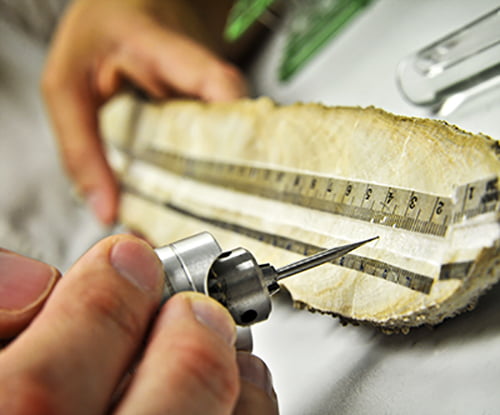
stalagmiteField- and laboratory-based research program that concentrates on reconstructing paleoenvironmental changes and identifying the underlying climate forcing mechanisms responsible for the changes. Currently funded projects include 1) development of Holocene/Pleistocene records of climate change preserved in stalagmites from the south-central Appalachians of West Virginia and Tennessee, and 2) development of Permo-Triassic paleoceanographic records that help resolve the underlying cause(s) of one of the largest mass extinctions in Earth history. For more information please see Dr. Rowe's web page.


Hydrogeology Research

hydroFocus on the studies of chemical processes in the intersection of the hydrosphere, geosphere, and biosphere, particularly on the nexus of environment, energy, and water resources. In particular, the coupling of physical, chemical, and biological processes, and the application of hydrology and aqueous geochemistry to critical issues of groundwater contamination and energy security such as nuclear waste disposal and carbon sequestration. For additional information please see Dr. Hu's web page.


Marine Geology and Geophysics Research

GIBResearch has been conducted on the morphology and depositional processes of deep-sea deposits and their bed forms; development of submarine fans and related features; climate control of deep-sea sediment deposition; seismic facies analysis; and geologic evolution of passive margins.Research in the past few years has been the Gulf Intraslope Basins Project (GIB), an industry sponsored project which studied depositional processes in the intraslope basins province of the northern Gulf of Mexico, to develop more reliable depositional analogs for hydrocarbon reservoirs. For more information please see Dr. Damuth's GIB pdf file.


Neotectonics-Geodesy Research

GIBNeotectonics ,a subdiscipline of tectonics, studies the motions and deformations of the Earth’s crust at recent geological time. Research initiatives at UTA focuses on the plate movement and boundaries of the North American and Caribbean plates using seismic and marine geophysical survey data, together with the global positioning system (GPS). For additional information see: Dr. Jansma's web page.


Paleoclimate Modeling Research

katrina Comprehensive climate models in collaboration with the National Center for Atmospheric Research are applied to predict climate and marine carbon cycle for the past, present and future. Current UTA research projects focuses on paleoclimatic changes during hothouse climates, e.g. the Paleocene Eocene Thermal Maximum (55 million years before present), the Permian-Triassic boundary (250 million years before present), and climate and carbon cycle changes during the last deglaciation. For more information please see Dr. Winguth's web page.


Paleogeography - PALEOMAP project Research

paleomapResearch highlights at UTA are on plate tectonic development of the ocean basins and continents, as well as the changing distribution of land and sea during the past 1 billion years. These research activities include paleontology, paleomagnetism, marine geophysics, satellite altimetry, reflection seismology, hydrocarbon charge systems, basin analysis, paleoclimatology, meteorology, Geographic Information Systems (GIS), computer graphics, computer programming, and database management. For more details see Dr. Scotese's web page.

Sedimentology Research

Holbrook_RussiaResearch interests centered about fluvial sedimentology. Recent work has addressed how neotectonic and climatic effects on fluvial geomorphology are preserved in the Holocene fluvial strata of active river systems. Current research areas focus on the factors controlling fluvial geomorphology and resultant fluvial depositional architecture for the Mississippi and Missouri River Basin. For more information please see Dr. Holbrook's web page.


Structural Geology and Tectonics Research

Blaylock FoldsResearch highlights the measurement of natural strain and its relationship to folds and faults. Geometric and numerical modeling of geologic deformation is utilized. Research has been conducted on fracturing and fracture density studies as well as regional structural geology particularly in the areas of the Ouachitas, Arbuckles, Appalachians, U.S. Rocky Mountains, California Coast Ranges and theTaiwan Foldbelt. For additional information please see: Dr. Wickham's web page.


The University of Texas at Arlington
Department of Earth & Environmental Sciences, Box 19049, Arlington, Texas 76019-0049
Phone 817.272.2987 | Fax 817.272.2628
Questions about this site? Email: GeoWebmaster