UT Arlington
Earth
  

Pictured from left to right: Dr. Harry Rowe, Dr. Arne Winguth, and Dr. "Max" Hu

Three Professors Receive Grant
Mon August 31, 2009

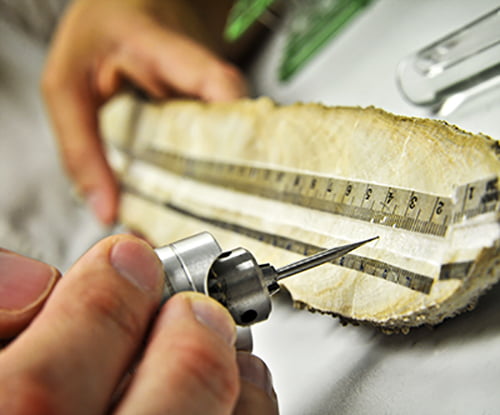
Three assistant professors in the UT Arlington Department of Earth and Environmental Sciences, along with colleagues at two other institutions, have just been awarded a $566,000 grant from the National Science Foundation’s Paleo Perspectives on Climate Change program. Almost $320,000 of the three-year grant has been awarded to UT Arlington. Drs. Harry Rowe, Arne Winguth, and Max Hu, all recent hires at UTA, are studying how the climate system in eastern North America evolved during the last eight glacial-interglacial cycles, which cover the last 600,000 years of Earth’s history. Rowe and Hu, both geochemists, are reconstructing climate change using chemical and isotopic records preserved in cave stalagmites recovered from the Appalachian Mountains of Tennessee and West Virginia. Each stalagmite is age-dated using a method called 230Th dating. Then, each 0.5-mm layer within a stalagmite is sampled with a drill and analyzed for its geochemical and stable isotopic composition. These data will help define the timing, duration, and magnitude of climatic disturbances like droughts and seasonal shifts in precipitation.

Winguth, a climate modeler, is using the climate reconstructions as a guide to develop and refine simulations of the climate system for key periods of rapid climate change. Specifically, Winguth is focusing on the Younger Dryas episode, an anomalously cold interval that ended ~11,600 years ago. The Younger Dryas has been portrayed as a ~1000-year-long period during which the climate abruptly cooled, and then warmed to near-modern temperatures in the span of a few years. These are the types of rapid climate changes that are believed to be most dangerous to the wellbeing of human populations.

Preliminary results from their study identify not only the climate response in eastern North America during the Younger Dryas and other cold/glacial episodes, but also several more abrupt shifts in precipitation that occurred during the last 7,000 years, a period when the Earth’s climate has traditionally been thought of as being relatively stable. Previously reconstructed paleoclimate records from the eastern United States go back only 12,000 to 20,000 years, thus, the record and the climate model simulations derived from the present study have the potential to dramatically enhance our understanding of the history and causes of climate change in a heavily populated portion of the planet.


NSF Grant Received
Mon August 31, 2009

Arne Winguth and Harry Rowe, assistant professors in the Department of Earth and Environmental Sciences in the College of Science, are co-principal investigators in a National Science Foundation grant of $114,000 awarded for a research project over four years entitled “Collaborative Research: Chemostratigraphic Analysis of Panthalassic and Tethyan Permian-Triassic Boundary Sections: Assessment of Global Paleoceanographic Dynamics”.

Dr. Winguth and Dr. Rowe will collaborate with Tom Algeo (University of Cincinnati), Katherine Freeman (Penn State University), Timothy Lyons (University of California-Riverside), and Brooks Ellwood (Lousiana State University) on investigating causes and dynamics of the largest mass extinction in Earth history, which occurred about 251 million years ago at the Permian-Triassic boundary. High-resolution chemostratigraphic studies of 19 marine boundary sections will be integrated with earth-system modeling in order to constrain the extent and intensity of Permo-Triassic deep-ocean anoxia, the patterns of upwelling of toxic deep-ocean waters onto shallow marine areas, and the relationship of these events to contemporaneous changes in seawater carbonate chemistry. This comprehensive study has the potential to lead to new insights on the causes of the largest environmental-ecological catastrophe in Earth history.


College of Science Teaching Award - John Holbrook

Citation by John Wickham

Dr. John Holbrook

I have known Dr. John Holbrook since 2004 when the Department of Earth and Environmental Sciences hired him for teaching and research in sedimentology. I first noticed his gift for teaching in the fall of 2005 when 90 students in two sections of a non-major introductory course gave him the highest ratings I had ever seen in that course.

Students respond to his enthusiasm, and his down-home Kentucky gift for story-telling and revealing humorous anecdotes, which are the sweetener coating a demanding, intensive course.

John has also offered a teleconferencing course in his specialty to UTD when they lost an instructor; so he has had experience in other delivery technologies.

John also has a commitment to incorporating undergraduates in his research. From the beginning, he has been able to attract money from the US Geological Survey to support undergraduate students during the summer working on the history of the Mississippi and Missouri River Channels in Missouri and South Dakota. This river history has important implications for understanding climate change over the past 15,000 years.

This interest in undergraduate research was recognized by the National Science Foundation with a major three-year award to continue funding undergraduate students in his river research. This award from the Research Experience for Undergraduates (REU) program not only supports UTA students but also brings other students from the Metroplex to UTA to participate in this research.


The University of Texas at Arlington
Department of Earth & Environmental Sciences, Box 19049, Arlington, Texas 76019-0049
Phone 817.272.2987 | Fax 817.272.2628
Questions about this site? Email: GeoWebmaster