UT Arlington

Dr. James L. Horwitz

Chair's Message

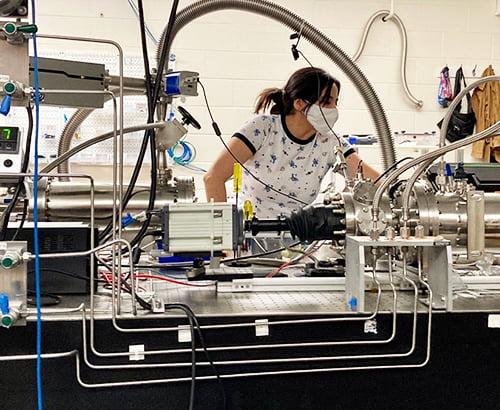
The Physics Department at The University of Texas at Arlington is committed to excellent teaching at the undergraduate and graduate levels, supervision of high-quality Master’s and Ph. D. degrees, and outstanding research, with competitive graduate research and teaching assistantship stipends. The department currently has twenty-one tenured or tenure-track faculty--twelve experimentalists and nine in theory/simulation and data analysis--with active research programs in astrophysics and space physics, condensed matter, experimental high-energy physics, magnetic materials, nanomaterials, optics, surface science, and now nano-bio physics. Dr. Wei Chen joined the department in August 2006 and has now initiated our nano-bio physics program, with involvement of several graduate and undergraduate students. The department has many excellent experimental laboratory facilities, including the High Energy Physics Detector Factory, Positron Spectrometers, a Scanning Tunneling Electron Microscope, UHV Photoemission Spectometers, Raman Spectrometer with High-Pressure Diamond Anvil Cell, Thin Film Growth and Characterization facility, Scanning Electron Microscopes, SQUID magnetometer, PPMS, X-Ray Diffraction System, diffractometers, and many other specialized facilities, as well as our existing planetarium. For computing, faculty, students and staff use computing facilities such as the joint high-performance GRID computing facility and UTA’s High-Performance-Computing facility, as well as the excellent personal computing and workstation facilities within all of our research groups. A 16-node Beowulf cluster for Computational Physics was installed during the Fall of 2005, and there was major progress in the development of the new NSF/DOE-sponsored Tier 2 regional computing Grid Farm for support of the High-Energy Physics ATLAS experiment at CERN, scheduled to commence operation in 2008. We also have a modern, staffed machine shop, and an electronics and computer support staff serving the faculty and students. Much of the department is now housed in the new Chemistry and Physics Building. This three-story, 123,000 sq ft building has excellent modern research and instructional facilities and hosts a state-of-the-art digital planetarium with a sixty-foot diameter dome and the Center for Nanostructured Materials. Professor Suresh Sharma became the new director of the Center for Nanostructured Materials (CNM) this past year, and has had several of the CNM common use facilities installed in the CNM laboratory in the Chemistry-Physics Building. Meanwhile, in Science Hall, we have newly renovated facilities for a Visualization Laboratory, a new Physics Clinic, two new lower division laboratories, and soon, new facilities for the SH wing of the Tier 2 ATLAS computing center.

This past year, Professor Ramon Lopez, a space physics and physics education expert, and Assistant Professor Amir Farbin, a high-energy experimentalist, have joined the Department, bringing our total of tenure/tenure-track faculty to 21 members. During the coming years, the department anticipates hiring several new faculty in the areas of nano-bio physics, high-energy physics, condensed matter and nanomaterials, and astrophysics and space physics. In addition, the department now has three Assistant Research Professors: Nurcan Ozturk, Armen Vartapetian, and Chuan-Bing Rong. Ozturk and Vartapetian are working in high-energy physics with Professor Kaushik De, while Rong is working in nano-composite magnetic materials with Associate Professor Ping Liu.

In terms of educational programs, we have joined with the Materials Science and Engineering(MSE) Department to implement a new “fast-track” program in which students may obtain both a B. S. in Physics and a Masters in MSE in as few as five years. We hope to have a similar arrangement with the Bioengineering Department shortly. We are also working with Changwon National University in South Korea to develop a program in which graduate students could receive Masters or Ph. D. degrees at both institutions by doing part of their course work and research at each institution.

In addition, the department continues to sponsor social functions to enhance the camaraderie among faculty, students and staff with such functions as: our second annual “welcome-back” picnic for faculty, staff and students in September, monthly “potluck lunches” and a joint Physics-Chemistry dinner held in late October 2007.

Whether you are a prospective undergraduate physics major, or are considering opportunities for graduate study in physics, or are a prospective Physics employee, you will find the environment at UT Arlington’s Physics Department stimulating and rewarding for learning, teaching, and research. Please feel free to contact me or members of the Physics department faculty and staff on how we can assist you in joining the Physics family at UT Arlington.


James L. Horwitz
Chair