|
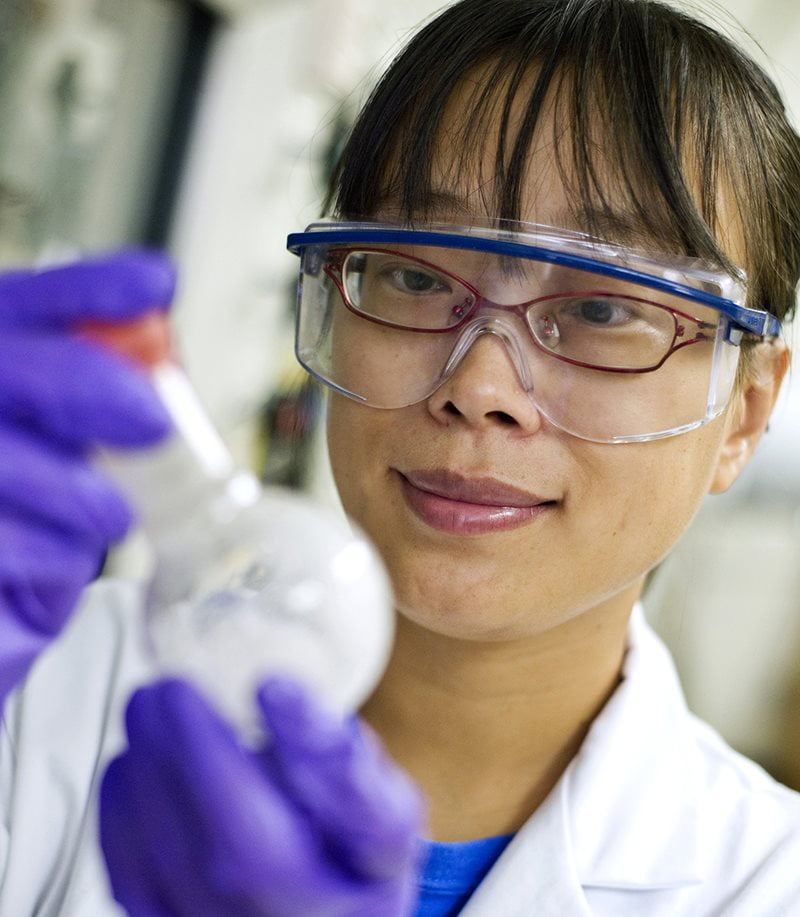
Frederick MacDonnell |
||
|
Inorganic
and Bioinorganic Chemistry
Professor, Associate Department Chair B.S. The University of Vermont (1986) M.S. Northwestern University (1988) Ph.D. Northwestern University (1993) Damon Runyon - Walter Winchell Postdoctoral Fellow, Harvard University (1992-1994) |
|
|
|
Phone: 817-272-2972 FAX: 817-272-3808 E-mail: macdonn@uta.edu Office: 302 CRB Personal Page |
||
|
RESEARCH INTERESTS The MacDonnell lab is interested in developing new molecular catalysts and materials with interesting optical, photochemical, electrochemical, stereochemical and bioactive properties. In particular, we have been heavily involved in the synthesis and characterization of new ruthenium-polypyridyl complexes containing unusual redox and photoactive ligands. The complexes exhibit a wide range of behaviors that makes them potential useful in areas as diverse as solar-energy harvesting, chiral separations and photocatalysis. In order to study these complexes we rely on a broad range of spectroscopic and spectrometric techniques including: electrochemistry, spectroelectrochemistry, photochemistry, crystallography, electron paramagnetic resonance, NMR and magnetic susceptibility.
Three currently emphasized areas of research in the lab are:
Solar-Energy
Conversion: New Photocatalysts for Driving Multi-Electron
Processes
Recent Publications: K. L. Wouters, N. R. de Tacconi, R.
Konduri, R. O. Lezna
and F. M. MacDonnell, "Driving Multi-Electron Reactions with Photons:
Dinuclear Ruthenium Complexes Capable of Stepwise and Concerted
Multi-Electron Reduction," Photosynth.
Res. J., 2006, 87(1),
41-55. Claudio
Chiorboli, Sandro Fracasso, Marcella Ravaglia, Franco Scandola, Sebastiano
Campagna, Kelly L. Wouters, Rama
Konduri and Frederick M. MacDonnell, "Primary Photoinduced
Processes in Bimetallic Dyads with Extended Aromatic Bridges.
Tetraazatetrapyridopentacene Complexes of Ruthenium(II) and Osmium(II),"
Inorg. Chem. 2005, 44(23), 8368-8378. Norma R. de Tacconi, Reynaldo O. Lenza, Rama
Konduri,
Krishnan Rajeshwar and Frederick M. MacDonnell, "Influence of pH on
the Electrochemical and Photochemical Reduction of a Dinuclear Ruthenium
Complex, [(phen)2Ru(tatpp)Ru(phen)2]Cl4,
in Aqueous Media," Chem. Eur.
J., 2005, 11, 4327-4339. R. Konduri, N. R. de Tacconi, K. Rajeshwar and F. M.
MacDonnell, "Multi-Electron Photoreduction of a Bridged Ruthenium
Dimer, [(phen)2Ru(tatpp)Ru(phen)2][PF6]4:
Aqueous Reactivity and Chemical and Spectroelectrochemical Identification
of the Photoproducts," J. Am.
Chem. Soc. 2004, 126, 11621-11629. F. M. MacDonnell, M.-J. Kim, K. L. Wouters and R. Konduri, "Hierarchical Structure in Assemblies of Ruthenium Trisdiimine Complexes: A Biomimetic Approach Utilizing Primary, Secondary, Tertiary, and Quaternary Structural Elements," Coord. Chem. Rev. 2003, 242, 47-58. C. Chiorboli, S. Fracasso, F. Scandola, S. Campagna, S. Serroni, R. Konduri and F. M. MacDonnell, "Primary Processes in Photoinduced Multielectron Storage Systems. A Dinuclear Ruthenium(II) Species Featuring a Charge-Separated State with a Lifetime of 1.3 ms," Chem. Comm. 2003, 1658-1659. W. P. Kirk, K. L. Wouters, N. A. Basit, F. M. MacDonnell, M. Tao and K. P. Clark, “Electrical and Optical Effects in Molecular Nanoscopically-Sized Building Blocks,” Physica E. 2003, 19, 126-132. D. T. Rosa, R. A. Reynolds III, S. M. Malinak, D. Coucouvanis, M. Ali, F. M. MacDonnell, “Useful Reagents and Ligands. 4,5-Diaminocatechol: A Useful Building Block in Synthesis of Multimetallic Complexes,” Inorganic Syntheses 2002, 33, 112-119. M.-J. Kim, R. Konduri, H. Ye, F. M. MacDonnell, F. Puntoriero, S. Serroni, S. Campagna, T. Holder, G. Kinsel and K. Rajeshwar, “Dinuclear Ru(II) Polypyridyl Complexes Containing Large, Redox-Active, Aromatic Bridging Ligands. Synthesis, Characterization and Intramolecular Quenching of MLCT Excited States,” Inorg. Chem. 2002, 41, 2471-2476. R. Konduri, H. Ye, F. M. MacDonnell. S. Serroni, S. Campagna, and K. Rajeshwar, “New Ruthenium Photocatalysts Capable of Reversibly Storing Up to Four Electrons in a Single Acceptor Ligand: A Step Closer to Artificial Photosynthesis,” Angew. Chem. Int. Ed. 2002, 41, 3185.
|
||
|
Department of Chemistry and Biochemistry |
||