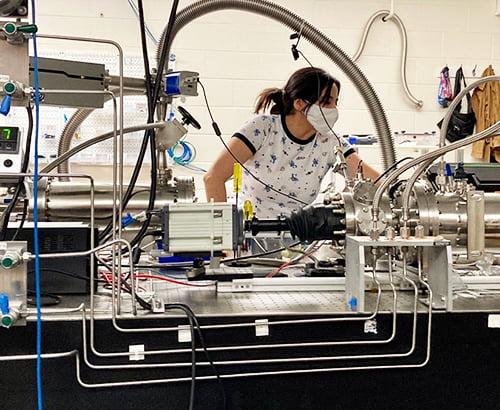
Dr. Wei Chen
Wei Chen, Ph. D.
Associate Professor
Department of Physics
American Editor for
Journal of Nanoscience and Nanotechnology
(www.aspbs.com/jnn)
Associate Editor for Journal of Biomedical Nanotechnology (www.aspbs.com/jbn)
Editor in Chief
Reviews in Nanoscience and Nanotechnology
(www.aspbs.com/rnn)
Office: CPB 214
Phone 817-272-1064
Fax 817-272-3637
Email:weichen@uta.edu
Mailing Address: |
|
Ph. D. in Chemistry, 1992, Peking University, Beijing, China
MS in Crystallography, 1988, Central South University, Changsha, China
BS in Mineral Chemistry, 1985, College of Earth Science, Jilin University, Changchun, China
| 9/'11 - present |
Associate Professor | Department of Physics, The University of Texas at Arlington |
| 8/'06 - 8/'11 | Assistant Professor | Department of Physics, The University of Texas at Arlington |
| 3/'00 – 8/'06 | Senior Scientist | Nomadics Inc, Oklahoma |
| 6/'99 – 3/'00 | Senior visiting scientist | Chemical Physical Center, University of Western Ontario, London, Canada |
| 8/'98 – 5/'99 | Visiting Scientist | Department of Materials Chemistry Lund University, Sweden |
| 10/'96 – 8/'98 | Deputy director | Laboratory of Semiconductor Materials science (LSMS), Institute of Semiconductors Chinese Academy of Sciences (CAS), Beijing |
| 7/'97 – 8/'98 | Senior Scientist | Institute of Semiconductors, CAS, Beijing |
| 6/'94 – 7/'97 | Research Scientist | Institute of Semiconductors, CAS, Beijing |
| 3/'92 – 6/'94 | Postdoctoral Fellow | Department of Materials Physics, University Of Sciences & Technology, Beijing, China |
- Nanoparticle based therapeutics for cancer treatment
We are interested in developing luminescence nanoparticle based therapeutics for cancer treatment, such as photodynamic therapy, radiotherapy and photo-therapy. We have proposed a new concept of modality for cancer treatment that combines radiotherapy and photodynamic therapy . Under this concept, luminescent nanoparticles with attached photosensitizers are used as a new type of agent for photodynamic therapy. Upon exposure to ionizing radiation such as X-ray, light will emit from the nanoparticles to activate the photosensitizers; as a consequence, singlet oxygen (1O2) is produced to augment the killing of cancer cells by ionizing radiation. With this novel therapeutic approach, no external light is necessary to activate the photosensitizing agent within tumors. Thus, we call this new modality nanoparticle self-lighting photodynamic therapy. This new concept of cancer modality will be more efficient for deep tumor but requires less radiation dose than conventional radiotherapy.
- Nanoparticle based Dosimetry
The development of scintillation nanoparticles and the demonstration of their applicability for dosimetry and radiation dose imaging. Once the concept is successfully demonstrated, it will be a great improvement for dose control in radiotherapy and will greatly benefit cancer patients by offering protection to adjacent healthy tissues.
- Water soluble nanoparticles for In vivo oxygen (hypoxia) measurement in tumor
Hypoxia is a common effect in tumor and is one of the major determinants of cancer resistance to radiation therapy, chemotherapy and photodynamic therapy. It is of great importance to interrogate tumor oxygen concentration and distribution. In this project, we will demonstrate the potential for using near infrared nanoparticles and oxygen intensity quenching and time-resolved decay lifetime techniques for hypoxia imaging in tumor.
- X-ray computed radiography improvement by quantum size confinement
Computed radiography (CR) is a promising digital imaging technique that offers many advantages over conventional X-ray film techniques and other digital methods. However, current X-ray storage systems suffer from significant shortcomings, such as relatively low spatial resolution and slower image processing. In this project, we will use size effect as well s quantum size confinement to improve the X-ray storage imaging quality.
- Multifunctional nanoparticles for medical imaging
In this project, we will design and fabricate multifunctional nanoparticles that can be used for targeting, fluorescence imaging as well as magnetic resonance imaging.
Distinguished young scientist award by the Chinese Academy of Sciences, 1997
Honor award for the distinguished achievement in Science & Technology by State Education Commission of China, 1995
Honor award for the achievement in Science & Technology by Peking University,1994
Research Excellent Award, University of Texas at Arlington, 2008, 2009, 2010