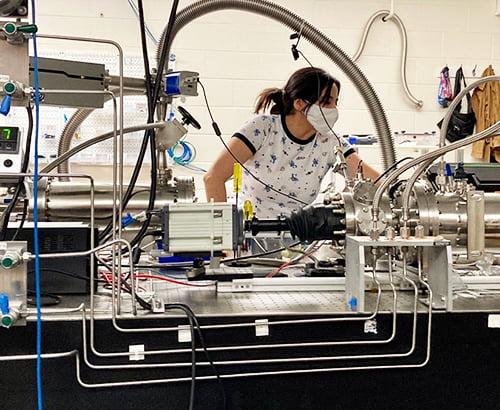
The Space Physics Research Group at UTA is led by Drs. James L. Horwitz and Yi-Jiun Su.

The focus of the Space Physics Research Group is mainly on the plasma phenomena in the terrestrial environments, including magnetosphere-ionosphere coupling, ionospheric plasma outflow, auroral energization, charged particle acceleration, and wave propagation. Our research involves numerical simulation, satellite in-situ observation, and radio remote sensing.

Member

Faculty  

Dr. James L. Horwitz

Dr. Yi-Jiun Su


Staff   

Dr. Sam Jones

Dr. Wen Zeng


Graduate Student   

Ms. Fajer Jaafari

Mr. Lun Ma

(Back to Top)

Science

The Earth is one of the solar system planets that has a strong internal magnetic field. In the absence of any external drivers, the geomagnetic field can be approximated by a dipole field with an axis tilted about 11 degrees from the spin axis. The dynamo interaction of the solar wind (magnetized plasma flow from the solar surface out into space toward the Earth) modifies this field, creating a what is to zeroth order a kind of cavity in the solar wind called the magnetosphere. This cavity shelters the surface of the planet from the particles comprising the solar wind. The outer boundary of the magnetosphere is called the magnetopause. In front of the dayside magnetopause another boundary called the bow shock is formed because the solar wind is supersonic. The region between the bow shock and the magnetopause is called the magnetosheath. Following magnetospheric field lines down toward the earth leads to the ionosphere. The magnetosphere is populated with plasma that originates both from the ionosphere and the solar wind.[Space Physics Text Book of Oulu, 1998]

(Schematic diagram of the terrestrial magnetosphere. Adapted from http://helios.gsfc.nasa.gov/magneto.jpg)

Because of the Sun's UV radiation, Earth's upper atmosphere is partially (0.1% or less) ionized at altitudes of 70-1500 km. This region is called ionosphere [Space Physics Text Book of Oulu, 2002]. The ionized content of the ionosphere varies with latitude, altitude, solar radiation level, local time, etc.

(Ionosphere plasma density profile. Adapted from http://www.oulu.fi/~spaceweb/textbook/ionosphere.html)

The ionosphere and magnetosphere are closely linked together via magnetic field lines. Magnetospheric electric fields map down to the ionosphere, producing plasma convection, frictional heating and plasma instabilities. Auroral particle precipitation ionizes the high latitude atmosphere also during nighttime, and heat can be conducted from the magnetosphere down to the ionosphere [Space Physics Text Book of Oulu, 1998].

On the other hand, some of the cold ionospheric electrons and ions flow up into the magnetospheric regions above labled as plasmasphere, plasma sheet and tail lobes. The magnetospheric ion composition (especially increased O+) influences local and global magnetospheric processes [Space Physics Text Book of Oulu, 1998].

The aurora is one of the most fundamental examples of the interaction between a planet's magnetosphere and ionosphere. They are seen on all of the magnetized planets in our solar system. The magnetosphere-ionosphere coupling phenomena involves many plasma process, such electron acceleration, wave generation, and ion heating.

The mass, energy, and momentum couplings between magnetosphere and ionosphere are explored by the Space Physics group at UTA, using simulation and analysis of data from spacecraft and ground-based instruments.

(Back to Top)

Research

In our research, we have developed a semikinetic, time-dependent simulation model, which tracks the motion of ion gyrocenters, to investigate the high-latitude ionospheric and magnetospheric plasma features. In order to simulate the complex process in an accurate, self-consistent and computationally feasible way, we use a low-moment-based fluid treatment from 120 km to 1100 km, a generalized semi-kinetic or hybrid treatment from 800 km to 3 RE, and couple the two portions by exchanging ion parameters at their boundary layer from 800 km to 1100 km [Estep et al., 1999].   

(Schematic diagram of the DyFK model)


We have applied the Dynamic Fluid-Kinetic(DyFK) model for simulation investigations of ionospheric plasma transport into the magnetosphere, including effects of soft-electron precipitation, transverse ion heating by waves, and parallel electric fields produced by hot plasma differential anisotropies. Particular focus on the dynamic behavior of the collisional-collisionless transition region of the high-latitude ionosphere-magnetosphere coupling zone. Here is an example of the simulation result - velocity distribution function in the dynamic transition region [Zeng et al, 2006]:

(Contour plots of H+ velocity distribution function at different altitudes after auroral energization [eng et al., 2006])


Our research also includes analysis of observations from satellite-borne plasma and field detectors of low-energy plasma transport in the magnetosphere and F-region/topside ionosphere, particularly the Thermal Ion Dynamics Experiment (TIDE) on NASA’s POLAR spacecraft. Current investigations focus on the morphology of O+ density troughs within the polar cap at 5000 km altitude [Zeng et al., 2004], and near-simultaneous near-conjunction ion transport measurements made by POLAR/TIDE (at 5000 km altitude) and DMSP (near 840 km altitude) ion detectors at high-latitudes [Zeng et al., 2001], and use of DyFK simulations to model direct spacecraft observations. Here we show evidence of an O+ density trough measured by POLAR/TIDE during 12/20/1998, indicated by the absence of counts during the period 9:18-9:27 UT in the spectrogram.

The top panel is a spectrogram of total ion flux vs. UT and spin angle. The bottom panel is a spectrogram of total ion flux vs. UT and energy. O+ density trough was observed from 0917 to 0926 UT [Zeng et al., 2004].

 ( Density comparison of DMSP12 (a), DMSP13 (b) with POLAR observations and results of a DyFK simulation on April 13, 1996. The simulation profiles shown were for 0, 12, 24, 36, and 48 minutes following the turnoff of the auroral processes [Zeng et al., 2001].)

A linear gyrofluid code, originally developed in nuclear fusion research, was adapted for use on the Earth's cusp magnetic field line to study Alfvén wave propagation. A test particle scheme is established to load electrons with wave fields generated by the gyrofluid model to study electron behaviors. With this approach, not only were we able to reproduce the energy-time dispersion signature studied extensively by modelers, but we also had the ability to generate the most frequently observed electron bursts. Our simulation results from this effort very closely resemble FAST observations.


(The left and right panels are results from simulations and observation, respectively [Su et al., 2004].)

We have suggested that each of the three types of auroral acceleration regions observed in the Earth's environment by FAST are active MI coupling processes on Jupiter as well. The bright emissions at the Io magnetic footprint are caused by Alfvén-dominated precipitation, while the extended tail emissions in Io's wake are due to electron acceleration from parallel electric field in an upward current region between Jupiter and Io. The downstream electron acceleration is investigated using a static Vlasov code. Results suggest that the proton and the hot electron population in Io's plasma torus control the electron current densities and thus may control the energy flux and the brightness of the aurora downstream from Io's magnetic footprint.


(This illustration is generated by Dr. Robert Ergun at University of Colorado at Boulder.)

An Alfvén eignemode, called the ionospheric Alfvén resonator, can develop between the conducting boundary of Jupiter and the exponential increase in Alfvén velocity on the topside of ionosphere. At Earth, reflections of Alfvén waves give rise to pulsations with a frequency near 0.1-1 Hz. Recently, we suggest that the Alfvén resonator in Jupiter's ionosphere may be associated with the periodicity of S-bursts.

Link to Dr. Yi-Jiun Su's research interests
 

(Back to Top)

Opening

Two Post-Doctoral Research Positions Available

These positions involve numerical simulation and plasma data analysis associated with Magnetosphere-Ionosphere coupling involving: (1) Wave-particle interactions in auroral physics, and/or (2) Ionospheric plasma outflow using a dynamic fluid-kinetic model and analysis of spacecraft and ground-based measurements of ionospheric plasma transport.

Candidates should have a demonstrated capability in programming and graphical display techniques. Applicants must have a Ph.D. degree in Space Physics or a relevant discipline at the time of appointment. Salary and benefits will be competitive. Initial appointment will be for one year, with funding available for extension for one or more further years pending satisfactory performance. For additional information please contact Dr. Yi-Jiun Su at yijiun@uta.edu, telephone 817-272-2460, or Dr. James L. Horwitz at horwitz@uta.edu, 817-272-0991 at the Department of Physics, University of Texas as Arlington, Arlington, Texas 76019.

(Back to Top)

Contact Information

Dr. Horwitz

  817-272-0991

Dr. Su   817-272-2460
Fax   817-272-3637
 horwitz@uta.edu

 yijiun@uta.edu

Mailing Address

502 Yates St
Department of Physics
University of Texas at Arlington
Arlington, TX 76019


(Back to Top)

References

1. Space Physics Text Book of Oulu, Magnetosphere (Earth's), http://www.oulu.fi/~spaceweb/textbook/magnetosphere.html, 1998.

2. Space Physics Text Book of Oulu, Ionosphere (Earth's), http://www.oulu.fi/~spaceweb/textbook/ionosphere.html, 2002.

3. Space Physics Text Book of Oulu, Solar wind - magnetosphere - ionosphere - thermosphere coupling, http://www.oulu.fi/~spaceweb/textbook/coupling.html, 1998.

4. Su, Y.-J., S. T. Jones, R. E. Ergun, and S. E. Parker (2004), Modeling of field-aligned electron bursts by dispersive Alfvén waves in the dayside auroral region, J. Geophys. Res., 109(A11), A11201, doi:10.1029/2003JA010344.

5. Estep, G. M., J. L. Horwitz, Y.-J. Su, P. G. Richards, G. R. Wilson, and D. G. Brown (1999), A dynamic fluid-kinetic model for ionosphere-magnetosphere plasma transport: Effects of ionization and thermal electron heating by soft electron precipitation, Terrestrial, Atmospheric and Oceanic Sciences, 10, 491-510.

6. Zeng, W., J. L. Horwitz, B. A. Stevenson, X. Y. Wu, Y.-J. Su, P. D. Craven, F. J. Rich, T. E. Moore, and J.-N. Tu (2001). Near-simultaneous Polar and DMSP measurements of topside ionospheric field-aligned flows at high latitudes. J. Geophys. Res. 106, 29601.

7. Zeng, W., J. L. Horwitz, P. D. Craven, F. J. Rich, and T. E. Moore (2004), The O+ density trough at 5000 km altitude in the polar cap, J. Geophys. Res. 109, doi:10.1029/2003JA010210.

8. Zeng, W., J. L. Horwitz, and J.-N. Tu (2006), Characteristic ion distributions in the dynamic auroral transition region, J. Geophys. Res., 111, A04201, doi:10.1029/2005JA011417.
 

Last update: March 2006

Acknowledgement: background pictures are adapted from http://odin.gi.alaska.edu/lumm/Pictures/Eidset/03112108_MAP.gif, http://www.astronautix.com/graphics/p/ppesa84.jpg, and http://www.aldebaran.cz/actions/2002_aurora/aurora/180.jpg.

Contact Curator