![]() |
||||||||||||||
|
Application Reference Form Word |
NSF-REU
|
|||||||||||||
|
The Research Problem:
The river they call the Big Muddy has changed much since the days of Lewis and Clark. The changes which preceded their historic mapping expedition in 1803, however, were even more profound. Early reports speak of massive outwash rivers pouring from the terminus of glaciers that were large enough to cover a continent. The lower reaches attest to a river that shifted in time from a placid and deep meandering path to a wide and shallow sand trap the crew of Lewis and Clark dubbed “The Gauntlet.” These past iterations of the Missouri are no less real than the river of today. The clues needed to chart their course, however, are literally buried somewhere within the sediments the river left within its valley.
Understanding the evolution of the Missouri River course carries implications for understanding both the modern river and the land it drains. The Missouri River is well married to the land that covers the 1/6 of the conterminous United States comprising its drainage. As such it responds to changes within the drainage and faithfully records the events which impact all aspects of climate (e.g., rainfall, vegetation, etc.) across this vast area. A record of changes in the map of the river within the valley would form one of the best recorders of climate change within the northern U.S. Western Interior, a region where the impact of climate change over the past 10,000 years is otherwise poorly known. Likewise, understanding the record of the river’s history is the key to understanding the river’s future. Knowing the many natural prior forms the river has taken is the key to knowing which goals modern river restoration efforts should strive to achieve. Likewise, geo-maps of the floodplain that we will produce will provide the distribution of foundational materials from which ecosystems, human cultural sites, and modern development arise. These maps are critical for managing modern floodplain resources.
At present, there is a serious dearth of geo-maps of the Missouri River floodplain, and, accordingly, the charts of prior river courses which they would provide.
Our Mission:
The Big Muddy Expedition marks an effort to revisit the Missouri Valley 200 years after Lewis and Clark, but this time to map the various courses of the river that once were. Through surficial geologic mapping of the Missouri River floodplain, we intend to gather the clues needed to forensically reconstruct the evolution of the river channel. This NSF-REU project in particular will build upon initial floodplain mapping efforts within the far lower reaches of the Missouri River east of Kansas City Missouri (funded by the USGS EDMAP Program). Mapping in these downstream locations uncovered major shifts in the Missouri River pattern at 3,500 years before present and approximately 2000 years before present that were driven by past climate shifts within the western U.S. This NSF-REU project will travel up river to make a first exploration of the floodplain reach between the large dams of South Dakota and the area around Omaha, Nebraska. What we may find there is currently unknown, and marks a great opportunity for true discovery. Should we find evidence of the changes recorded farther downstream, we may gain insights into the broader unknown issue of just how long it takes for a major change in a large river like the Missouri to ripple its way down stream. |
![]() |
What should student research participants expect from the NSF-REU Big Muddy Expedition?
- Weeks 1 -2: Three-hour college course “Physical River Systems”
The project is intended for undergraduates of Junior level and below, with most of the students entering from Freshman and Sophomore levels. Students are not required or expected to have more than the entry level courses in geology before entering the program. A three-hour college course through the University of Texas at Arlington comes with acceptance to this program, and will be paid for by the project at no student expense. This course will teach the fundamentals of river science as well as applications for geologic hazards, river restoration, and ecosystem management. The course comprises roughly equal shares of classroom and field experience. The course will provide preparation for field research to follow, and will provide a grounding for anyone wishing to do future work with river issues.
Weeks 3-6: Field Research
![]() |
The second part of the project centers on field research. The 10 students anticipated for the project will travel with Professor Holbrook to the research site (Vermillion, SD for 2008) where they will each be given responsibility for producing a first map for their share of the Missouri River floodplain. Students will do research in the field in pairs and return to the field headquarters each evening. Students will be aided in the field until independent, and will regularly exchange findings and ideas with fellow mappers at the mapping headquarters. Field mapping will last 4.5 weeks. |
Weeks 6 - 8: Lab Experience
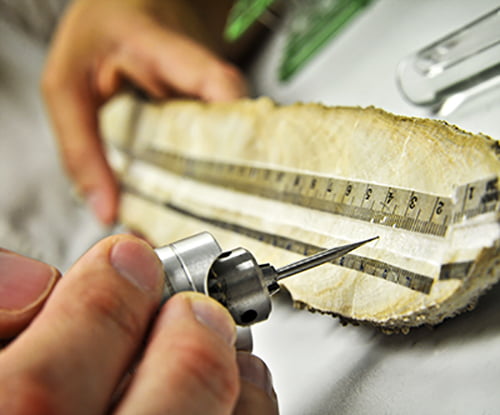
Over the course of field work, each student researcher will collect samples for Optically Stimulated Luminescence (OSL) dating. This is a new technique used for dating the age of deposition for sediments. Students will visit the OSL lab facility at University of Nebraska, Lincoln where they will prepare their samples for processing. While there, students will also examine samples for mineralogy and chemistry to assess likely origin of these sediments. Students are anticipated to be housed in the UNL dorms for this period.
Publications
The U.S. Geological Survey has agreed to publish maps produced during this study. Your efforts will result in a citable publication that will affirm your contribution to the larger study. In addition, students will have the opportunity to present their findings at a scientific meeting. A $600 allotment is provided for one member of each field team to present each year, and all participants will be provided a $600 allotment to defray expenses for a reunion and summation of results at a scientific meeting during the final year. In addition, journal and other publications are expected to result from this research, on which students are highly encouraged to contribute.
Real research experience
The project is part of an on-going research effort to better understand the Missouri River Valley. Student participants can expect to learn first hand how scientific research is conducted, and the thought processes, failings, and successes that come with the nuts and bolts of scientific discovery. As well, students should expect that they will leave with specialized qualifications in the study of river systems that they can take with them in any future endeavor they pursue.
Expenses paid, and a $340/week stipend for the 8 weeks
Housing and a food allotment will be provided to all participants for the 6.5 weeks in which participants are in the field, and for the initial 1.5 weeks of class time at the beginning if preferred (Students who live in the D/FW area may opt to commute rather than live on campus for the first 1.5 weeks). All necessary equipment and travel expense for the project are provided. In addition, students will be given a $340/week stipend above and beyond expenses. Some support for travel to and from the Dallas/Fort Worth area is also available.
Eligibility
Students should have at least one course in Geology (Physical Geology, Historical Geology, or an equivalent course are preferred). Applications should also be within the first years of their academic program, enjoy the thrill of discovery, have a strong interest in science, and like to work outdoors in a field environment. It is not required that students intended to major in Geology in order to participate, and applications from students with interests in other river-related areas are welcome. Applicants should not be advanced in their core coursework for any degree beyond the sophomore level. Exceptions will be made for non-traditional students returning to explore a second degree, and a couple junior or senior students will likely be included to add diversity to the group. Approximately half of the available slots are set aside for students from the Dallas and Tarrant County community college systems.
Program Dates
June 22 - August 7, 2010
Application Deadline
March 8, 2010. Applicants will be notified
no later than March 29, 2010
Useful links:
Download a flyer in PDF format
More information on the project in Word format
Contact Information
Please click on one of the links below to email:
John Holbrook (or contact by telephone at (817) 272-1201)
Ronald Goble (or contact by telephone at (402) 472-2649)