Social Work panel highlights community voices in suicide prevention
The University of Texas at Arlington School of Social Work hosted a community panel on September 25 to mark Suicide Prevention Awareness Month, bringing together survivors, advocates and experts to discuss ways to combat one of the nation’s leading causes of death.
The event, titled Community Voices for Suicide Prevention, featured Brad Hunstable, founder of Hayden’s Corner, CEO of Linear Labs, and Founding Board Member of Branch to Hope Community Center; Esmeralda Nava, UTA alumna and Mental Health Program Manager at the Grant Halliburton Foundation; and Kristi Wiley, vice president of programs at the Jordan Elizabeth Harris Foundation. The panel was moderated by UTA assistant professor Donna Schuman, whose research focuses on trauma and innovative mental health care.
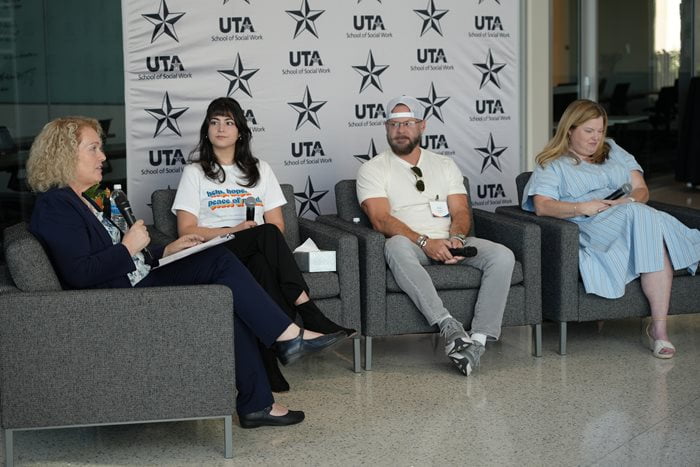
Dr. Donna Schuman (Left) Esmerelda Nava (Center-left), Brad Hunstable (Center-right) and Kristi Wiley (Right) discuss methods of suicide prevention during the Community Voices for Suicide Prevention Panel.
School of Social Work Dean Kirk Foster opened the evening by emphasizing the school’s commitment to hope, healing and community support.
“This panel brings together powerful voices who combine personal experience with professional expertise to shine a light on the urgent need for open dialogue about suicide prevention,” Foster said.
During the panel, panelists shared deeply personal stories of loss and resilience. Brad Hunstable recounted the death of his 12-year-old son, Hayden, during the pandemic and urged parents to have direct, age-appropriate conversations with children about suicide.
Kristi Wiley reflected on the devastating experience of losing both her father and her foundation’s namesake, Jordan Harris, to suicide. She spoke about the necessity of breaking down stigma and fostering cultures of connection as key elements of prevention. Similarly, Nava underscored her work with Hispanic communities through the Grant Halliburton Foundation, highlighting the critical role of culturally responsive outreach in ensuring that suicide prevention efforts meet the needs of diverse populations.
The discussion addressed challenges such as the impact of social media, barriers in schools and the need for policymakers to prioritize prevention. Panelists also pointed to strategies that have shown success in North Texas, including peer-to-peer support programs in schools, QPR (Question, Persuade, Refer) suicide prevention training, and efforts to integrate resilience education into curricula.
Wiley shared data that showed youth suicide deaths in Tarrant County dropped 80% from 2023 to 2025 following expanded prevention programs.
“When everybody has the same language and visionary leaders come together to say, ‘Not in our community,’ we know we’re saving lives,” Wiley said.
The event ended with a call to action. Panelists encouraged attendees to get comfortable using the word “suicide,” ask direct questions, and listen deeply to loved ones.
“You never know unless you ask,” Wiley said. Hunstable added, “Everybody is a counselor on some level. Just listening with love can be transformational”