UTA Launches New Certificate in Banking
As the Dallas-Fort Worth banking industry expands, UTA is helping students cash in on career opportunities.
The College of Business recently launched a Certificate in Banking, aimed at preparing students for various roles in the banking industry.
Beginning in Spring 2026, students can pursue the Certificate in Banking in addition to their major. Finance and real estate professor Dr. Teng Wang, who facilitated the launch of the program, said the certificate was created in response to the Dallas-Fort Worth region’s expanding banking industry and a growing need for trained talent.
“We heard from the DFW banking industry that UTA students have really stood out, but historically there was no banking course being offered,” Wang said. “So Dean Dombroski, Chair Sabherwal and others, asked ‘How do we bridge this gap so we can answer the demand from the local community and at the same time, leverage the strengths of our students?’”

Professor Teng Wang.
The DFW metroplex has historically served as a major financial hub for both Texas and the nation. Anchored by the Federal Reserve Bank of Dallas, the region includes a large, and growing, presence of both major global, national and regional banks as well as global financial institutions. In 2024, the DFW region passed Los Angeles to become the second largest employer in financial services sector in the United States, second only to New York City. The launch of the Texas Stock Exchange further solidifies the area's status as a growing center for banking and financial services.
Wang emphasized that for many of these small local and regional banks, success depends on relationship banking. Relationship banking focuses on long-term relationships between banks and their customers, relying on a deep understanding of a client’s business and financial needs rather than solely on automated data or standardized metrics.
“Small businesses really are the backbone of our country. Yet larger banks are often not especially enthusiastic about small business lending, given the higher costs and informational frictions involved, leaving regional banks to play a central role in this segment,” Wang said. “This is where our region stands out, and where enormous opportunities for UTA students arise, with more than 70 banks in Tarrant County alone and a highly active network of regional banks across the DFW area.”
Wang said that as many longtime loan officers retire, banks face a growing shortage of trained professionals. This, he said, is where UTA students come in.
Until now, UTA did not offer dedicated coursework in banking. The new certificate addresses that gap by blending existing finance, accounting and marketing courses with a new commercial lending course created with industry input. Students will learn credit analysis, lending processes, customer assessment, cash flow projections and the fundamentals of underwriting business loans.
Drawing on his decade of experience as a principal economist at the Federal Reserve Board, Wang helped steer the program to align academic training with industry needs, and said he is confident that the new program will help UTA students stand out in an increasingly competitive job market.
The program consists of 15 total credit hours built around four foundational courses and five electives. Students are required to take all foundations courses and then must select from one of the elective courses, which include topics like financial modeling and real estate finance, as well as the opportunity to pursue a finance internship for credit.
Available to all business majors and other students with necessary accounting and finance prerequisites, students will be prepared to analyze financial statements and cash flows, evaluate core banking services, assess financial risk and build long-term relationships with bank customers upon completion of the certificate.
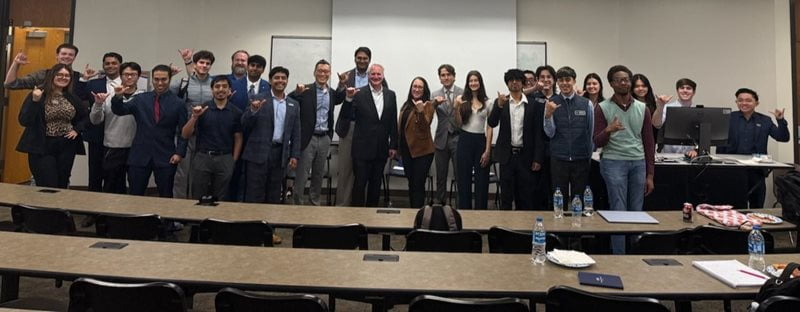
Students pose for a photo with Tarrant County Bankers Association Board Member Rick Jenkins and TCBA President Lacy Samples.
As part of the certificate, students have the opportunity to complete the Credit Essentials Exam, an industry-recognized credential developed by the Risk Management Association and embedded within the Lending and Credit Analysis course. The exam is designed to help students understand how commercial banks evaluate credit risk, analyze financial statements and structure loans.
Gabriela Rodriguez, who graduated in December 2025 with a bachelor’s in finance, completed the Credit Essentials exam during her final semester as she prepared to enter the banking industry.
“In my last semester at UTA, I took the Lending and Credit Analysis course with Professor Teng Wang to better understand how financial institutions evaluate credit risk and make lending decisions,” Rodriguez said. “I hadn’t known about the RMA Credit Essentials Exam before registering, but I was excited to earn an industry-recognized certification.”
Rodriguez said the certification helped connect classroom learning with real-world banking practices and increased her confidence as she transitioned into a professional role.
“As I transition from my life as a student to a young professional, earning the RMA Credit Risk Essentials increased my confidence in entering the industry,” she said. “Being able to connect the day-to-day skills to the theory gave me deeper level of knowledge on learning to know the customer, analyzing financial statements, cashflow and structuring a loan.”
Now that the RMA certification is built into the banking certificate, Rodriguez said future students will benefit from a clearer pathway into the industry.
“I truly wished the full banking certificate was launched before my final semester, because it creates a clear pathway for students interested in banking,” she said. “This helps students connect theory and practice before going into the industry, it helps reduce the learning gap between the classroom and the workplace and provides the tools and skills needed to succeed.”
Despite the rigor of the exam, Rodriguez said the effort is worthwhile.
“Being honest, it was not easy. It required working through a large amount of content, case studies and many hours studying,” she said. “However, I would do it all over again if I had the opportunity. The effort was worth it.”
Looking ahead, Wang encouraged students interested in a career in banking to consider applying for the certificate and advised students to meet with their advisors early to ensure they have completed the necessary prerequisites for the included courses.
“Even if they don’t meet the course requirements yet, students should still get to know the program and learn about the opportunities being offered,” Wang said. “This certificate can’t be a last-minute addition.”
Beyond coursework, Wang hopes to expand opportunities for student engagement by launching a new Banking Society, creating a community for students interested in the field. He also helps organize events that bring banking executives to the UTA campus.
“The broader vision is to create a comprehensive banking studies center at UTA that delivers a holistic learning experience for students while also benefiting the industry,” he said.
Rodriguez, who interned at Wells Fargo before accepting a full-time role, said the certificate can help UTA students stand out in a competitive banking industry where not every intern is offered a permanent position.
“There are many great schools in the area, and competition is strong,” Rodriguez said. “Programs like this help UTA students show credibility, gain the necessary skills and get serious about their career in banking.”
Learn more about the program using the University Catalog.