Friday, Oct 24, 2025
• Thomas Johns :
Thomas.Johns@uta.edu
The middle of the semester presents many opportunities for students to take part in events, observances and celebrations. With so many ways to volunteer and engage in extracurricular activities, student organizations help UTA School of Social Work students navigate campus life, connect with like-minded peers and participate in events that matter to them.
“Student organizations are important as they provide additional space for students to build community,” said Hollie Yang, Director of Student Engagement at the UTA School of Social Work. “Being involved in a student organization provides opportunities for social engagement, skill development, and professional growth.”
Beyond personal development, student organizations allow participants to explore their passions by collaborating with others toward shared goals. Organization leaders play a vital role in building strong bonds and fostering closer communities.
“Through leadership development and collaboration, the student leaders within each SSW student organization are taking the time to learn and understand the interests and needs of their organization members,” said Michelle Ann Villaceran, MSW Community and Administrative Practice (CAP) intern. “With that knowledge, they have created events and opportunities that help those involved develop skills that are transferrable to their respective professions, build community and increase confidence in themselves.”
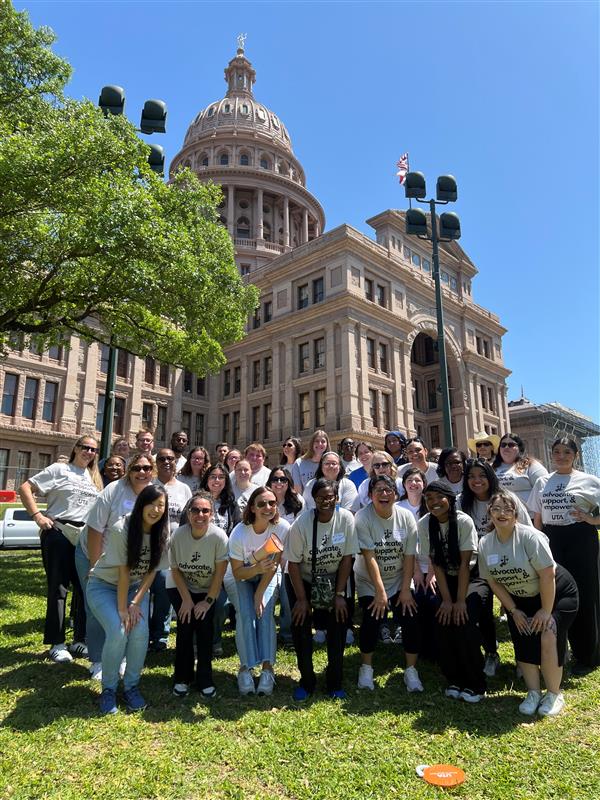
Members of the UTA SSW Office of Student Engagement, Student Association for Macro Social Work (SAMSW) and Phi Alpha Social Work Honor Society pose for a photo in front of the Texas State Capitol Building during NASW's Social Work Advocacy Day. (Photo by Hollie Yang)
Participation in student organizations also enhances key skills that serve students long after graduation.
“Students who participate in student organizations have the opportunity to enhance their communication skills, develop leadership skills, and receive mentorship from faculty and support from peers,” Yang said. “In addition, student organizations offer opportunities to network and gain a sense of community.”
Although student organizations operate autonomously, their faculty advisors act as mentors and provide advice to student leaders. Additionally, the SSW Office of Student Engagement further provides support in areas such as leadership development conflict resolution as needed to assist in the success and growth of the organization.
The need for more support for student organizations was discovered through Dean Kirk Foster's listening tours with students, faculty, and staff during his first year in 2024. One of the dean's solutions was to create two new positions in student affairs, which were filled by Dr. Danielle Klein as the Assistant Dean of Student Affairs, and Dr. Hollie Yang as the Director of Student Engagement earlier this year. Both positions were created to better support student organizations, improve academic advising, and address other student needs.
“The Office of Student Engagement serves as a liaison between the Student Organization Office and our student organizations to ensure that they are meeting the requirements to maintain good standing with the university,” Yang said. “This fall, we enhanced our support for student organizations based on feedback received in spring 2025. At the beginning of each semester, we are hosting a student organization retreat to assist our student leaders prepare for the semester. In addition, we are holding monthly meetings with the student leaders to promote leadership development and provide space for cross-collaboration and community building.”
Although the School of Social Work’s Office of Student Engagement has made significant progress in supporting student organizations, Yang and Villaceran agreed that the work is ongoing.
“We want to continue to support the orgs to establish a solid foundation for their organization to thrive upon and encourage them to continue to expand and build stronger relationships with their members, the School of Social Work and UTA community, and with the Arlington community,” said Yang.
Student organizations offer both undergraduate and graduate students the chance to connect their academic and social experiences, while building leadership, communication and organizational skills. They also provide opportunities to influence meaningful change within Arlington and surrounding communities.
“The student organizations within the School of Social Work are an excellent avenue to build your social work network, meet potential friends and mentors, and explore the social work profession,” Yang said. “If there is an organization that catches your interest, I strongly encourage you to attend a meeting to learn what the organization is about.”