Hummel earns fellowship to advance coastal resilience
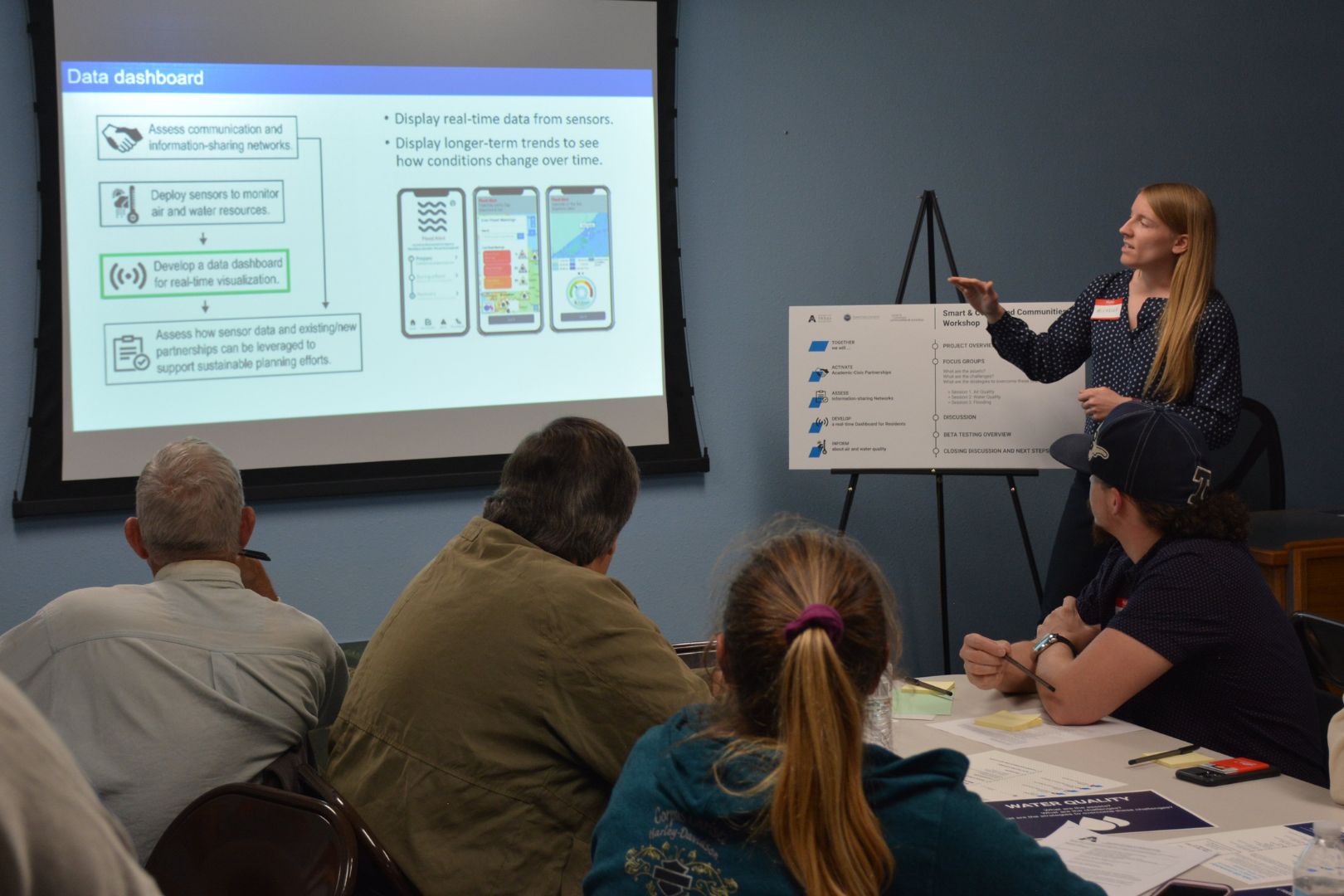
Michelle Hummel, an associate professor of civil engineering at The University of Texas at Arlington, has been named an Early-Career Research Fellow by the Gulf Research Program of the National Academies of Sciences, Engineering, and Medicine. She is one of eight fellows in the 2025-27 cohort of the program’s environmental protection and stewardship track.
The Early-Career Research Fellowship gives Dr. Hummel the independence and flexibility to pursue untested research ideas beyond the scope of traditional grants. The cohort structure also provides opportunities to develop relationships and interdisciplinary collaborations with like-minded researchers. Fellows receive a $76,000 financial award.
“I am excited to use this fellowship to explore how nature-based solutions can be better designed and managed to enhance the resilience of communities in the Gulf region,” Hummel said. “I look forward to building collaborations that bridge engineering and ecology to support more innovative solutions to coastal flooding and erosion.”
Hummel’s research examines how coastal regions—with their interdependent human populations, natural ecosystems and built infrastructure—adapt to changing environmental hazards. She develops advanced modeling tools to quantify the physical drivers of flood hazards, their impacts on coastal populations and infrastructure, and the effectiveness of engineered and nature-based adaptation strategies for enhancing resilience.
Related: A how-to for reducing flooding impacts in coastal towns
She has earned more than $5.5 million in research funding, including a National Science Foundation CAREER Award in 2025.
“Dr. Hummel’s research addresses a major challenge facing coastal communities, particularly as extreme weather events threaten lives and livelihoods,” said Melanie Sattler, chair of UTA’s Department of Civil Engineering and the Syed Qasim Endowed Professor. “This fellowship will allow her to deepen her commitment to finding creative and sustainable solutions that improve the quality of life for Gulf residents and enhance the health of coastal ecosystems.”
The National Academies’ Gulf Research Program is an independent science-based program founded in 2013 as part of legal settlements with the companies involved in the 2010 Deepwater Horizon disaster. Its mission is to develop, translate and apply science to enhance the safety of offshore energy, protect the environment and support the well-being of Gulf residents for generations to come. The program supports innovative research, guides data design and monitoring, and builds networks to generate long-term benefits for the Gulf region and the nation.
— Jeremy Agor, College of Engineering
About The University of Texas at Arlington (UTA)
The University of Texas at Arlington is a growing public research university in the heart of Dallas-Fort Worth. With a student body of over 42,700, UTA is the second-largest institution in the University of Texas System, offering more than 180 undergraduate and graduate degree programs. Recognized as a Carnegie R-1 university, UTA stands among the nation’s top 5% of institutions for research activity. UTA and its 280,000 alumni generate an annual economic impact of $28.8 billion for the state. The University has received the Innovation and Economic Prosperity designation from the Association of Public and Land Grant Universities and has earned recognition for its focus on student access and success, considered key drivers to economic growth and social progress for North Texas and beyond.