UTA researcher tackles erosion challenges on Texas coast
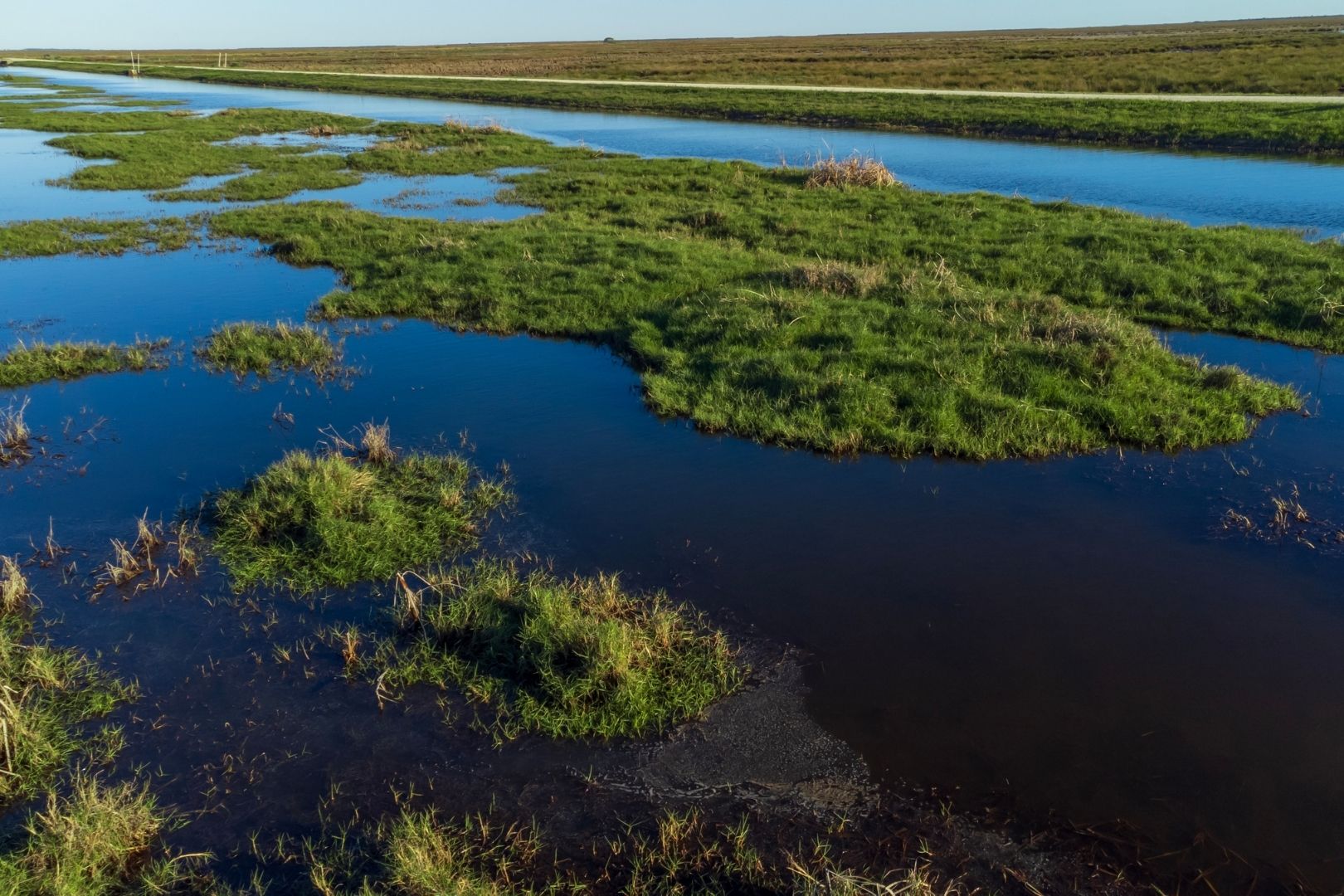
A stretch of the Texas mid-coast is facing sediment transport-related challenges, and a researcher from The University of Texas at Arlington is leading the effort to consider a range of potential solutions.
Yu Zhang, professor of civil engineering at UTA, has received funding from the Texas General Land Office to launch the second phase of a project studying how to remedy sediment imbalance along the coast of Brazoria and Matagorda counties just southwest of Houston. There, erosion is eating away beaches and threatening one of the nation's most important shipping channels, while excessive sediments are choking a coastal stream.
“The entire system is very dynamic—it’s evolving all the time,” Dr. Zhang said. “Unless we have a very good understanding of how the system could evolve after its equilibrium has been disrupted, we ought to be very cautious.”
The problems trace back nearly a century. In the 1930s, the mouth of the Brazos River—the longest river in Texas—was diverted east of Freeport. That rerouting improved navigation, but it also sent enormous amounts of sediment down the coast, where it began clogging the smaller San Bernard River to the west. Over the past two decades, sediment has accumulated at the San Bernard's mouth so rapidly that the river has repeatedly become disconnected from the Gulf. Local communities and nonprofit groups have pushed for dredging to reopen it, but each time the river is dredged, the mouth closes again.
Meanwhile, sediment is intruding into the coastal zone through the Gulf Intracoastal Waterway, the canal that intersects both rivers and serves as a key artery for transporting crude oil and other commodities. And at Sargent Beach—which has experienced some of the most rapid erosion anywhere along the Texas coast—the shoreline has retreated so severely that the communities fear that the Gulf could eventually breach the waterway itself, destroying its ability to function as a transportation route.
The project's first phase, launched in 2021 and completed last year, established a foundational understanding of the hydraulic and coastal processes driving these changes and developed modeling tools to evaluate potential solutions. In the second phase, Zhang's team will collect significantly more data across the coastal zone and use improved modeling systems to predict the consequences of different mitigation and restoration strategies.
Among the ideas under evaluation: depositing dredged material from the Brazos River, the Waterway and the San Bernard's mouth to fight beach erosion—an approach known as a sand engine—and harvesting sand along the lower Brazos to transport to Sargent Beach for nourishment. The team will use its models to identify which combination of strategies is most cost-effective and what the long-term ramifications of each would be.
The work will be conducted in coordination with regional entities, state agencies and federal partners, including the U.S. Fish and Wildlife Service, the U.S. Army Corps of Engineers, and Brazoria and Matagorda counties.
“Building partnerships with the regional entities, including the counties and political representatives, as well as the technical leadership across federal and state agencies, is a critical piece,” Zhang said. “It helps improve our odds of devising a solution that can be durably applied and achieve desirable impacts.”
Zhang's team is also incorporating newer technologies that haven't been applied to these problems in the past, including remote sensing products and advanced modeling systems that can resolve the interactions among sediment, hydrology and nearshore wave processes.
“The joint deployment of these technologies really gives us an edge,” Zhang said. “It helps us better pinpoint the costs and devise solutions that will be sufficiently robust.”
For Zhang, the project underscores how tightly human infrastructure and natural systems are intertwined—and how solutions to one generation’s problems can create the next generation’s challenges.
“We have pressing problems to tackle, and people come up with solutions,” Zhang said. “But once those solutions get implemented, they can also have negative impacts that don’t become evident until a decade later. The question is: What will be the most cost-effective way of restoring the system while preserving the functionality of the infrastructure that’s been built over many decades?”
While the challenges are playing out along Texas’ central coast, Zhang noted they are not unique to the state, and the answers his team develops could inform coastal management well beyond it. The key, he said, is not a single fix but a concerted deployment of multiple strategies.
About The University of Texas at Arlington (UTA)
The University of Texas at Arlington is a growing public research university in the heart of Dallas-Fort Worth. With a student body of over 42,700, UTA is the second-largest institution in the University of Texas System, offering more than 180 undergraduate and graduate degree programs. Recognized as a Carnegie R-1 university, UTA stands among the nation’s top 5% of institutions for research activity. UTA and its 300,000 alumni generate an annual economic impact of $28.8 billion for the state. The University has received the Innovation and Economic Prosperity designation from the Association of Public and Land Grant Universities and has earned recognition for its focus on student access and success, considered key drivers to economic growth and social progress for North Texas and beyond.