A new way to see inside a hurricane
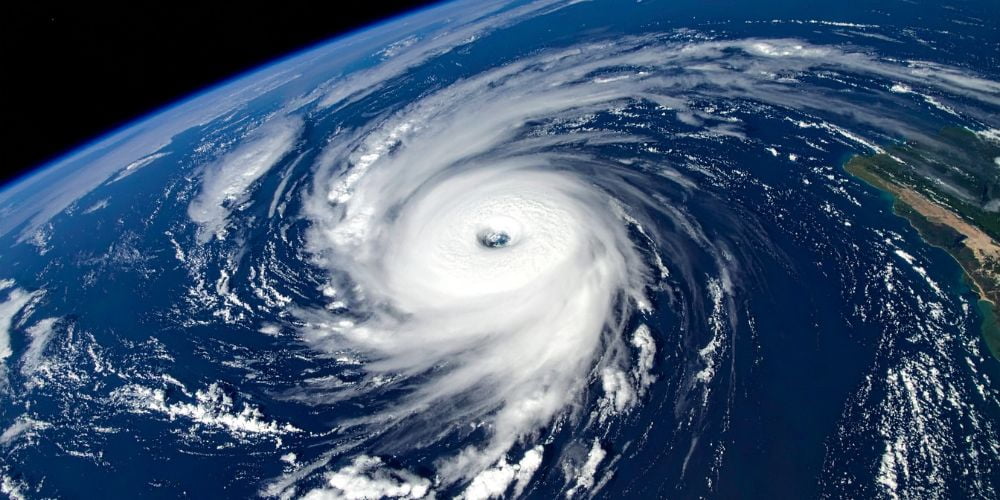
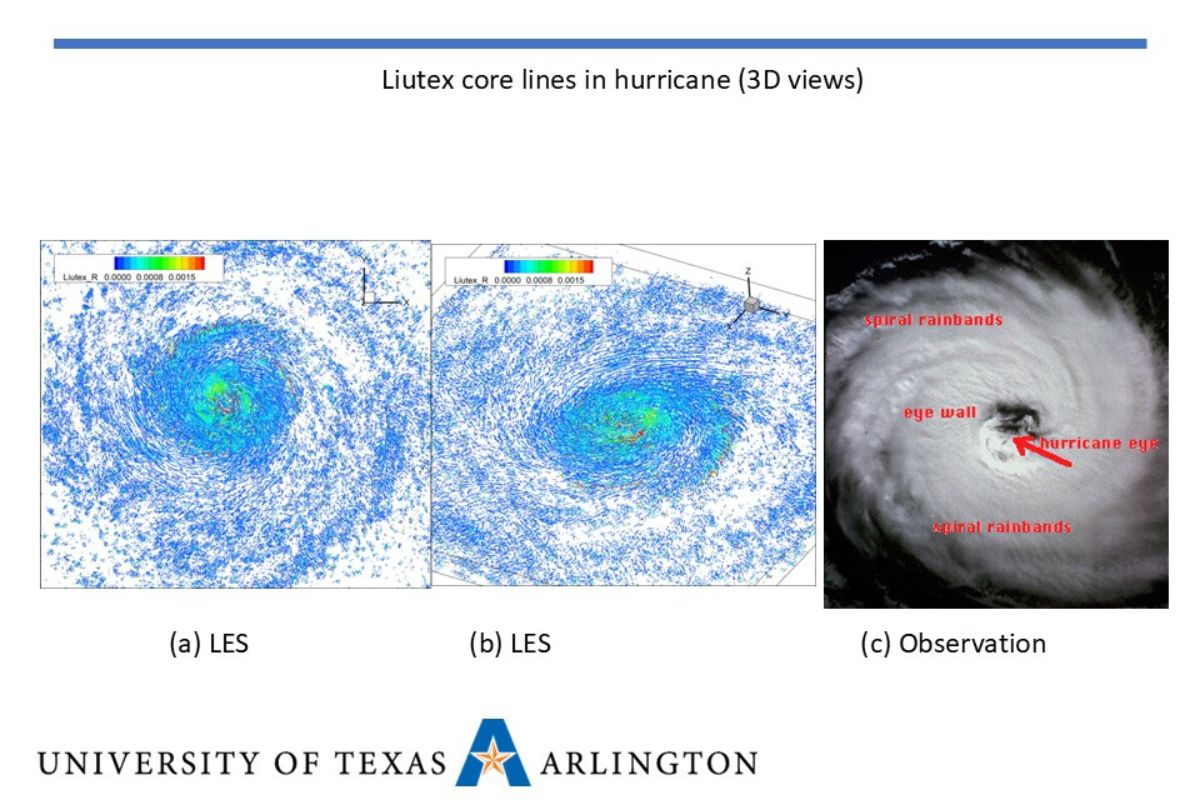
Researchers at The University of Texas at Arlington have created a mathematical model to identify and analyze vortices, the rotating structures at the heart of hurricanes. The National Oceanic and Atmospheric Administration is now using the model to monitor hurricane development worldwide.
Chaoqun Liu, professor of mathematics, has spent more than 36 years developing Liutex, a groundbreaking mathematical method for identifying vortices. A better understanding of hurricane structure and behavior could eventually improve hurricane forecasting, he said.
“There are no other vortex identification methods in the world comparable to Liutex,” Dr. Liu said.
The fundamental difference between it and traditional methods is that Liutex separates pure rotation from non-rotational shear in vortices.
“In many cases, most of the vorticity is actually shear rather than rotation,” Liu said. “If you use vorticity to identify a vortex, it is like trying to identify an apple by looking at an orange.”
He described the inclusion of Liutex on NOAA’s website as a milestone that demonstrates the method’s growing recognition within the atmospheric science community. Still, he said he welcomes challenges to Liutex.
“Everybody is welcome to challenge my idea and my concept. But unfortunately, I haven’t received any challenges so far,” Liu said, smiling.
He believes a better understanding of vortices could also help researchers understand how hurricanes form and strengthen.
“We want to understand the mechanisms of hurricane formation and development. Why are hurricanes so powerful? Where does that energy come from? We believe vortices are a key part of the answer,” Liu said. “Our simulations show that within a hurricane there are hundreds, thousands, or even millions of small vortices that combine and interact. Understanding that process could help explain how hurricanes develop and strengthen.”
The model also applies to fields beyond atmospheric science, including cardiovascular research, said Yifei Yu (’23 PhD, Mathematics), Liu’s mentee and an assistant professor of research in mathematics.
“Blood flow is also a fluid flow. Researchers studying cardiovascular systems have begun using Liutex,” said Dr. Yu. “Researchers believe it can lead to important new discoveries.”
The researchers are excited to see Liutex applied across disciplines.
“Since Liutex is a rigorous, quantifiable and mathematical definition of a vortex, it can be applied to all fluid-related research areas like vortex dynamics, turbulence research, aerospace engineering and bio-flows, which could be useful for early heart disease diagnosis,” Liu said. “A hurricane is just one example of Liutex applications, and this method could bring a lot of new research opportunities to UTA."
About The University of Texas at Arlington (UTA)
The University of Texas at Arlington is a growing public research university in the heart of Dallas-Fort Worth. With a student body of over 42,700, UTA is the second-largest institution in the University of Texas System, offering more than 190 undergraduate and graduate degree programs. Recognized as a Carnegie R-1 university, UTA stands among the nation’s top 5% of institutions for research activity. UTA and its 300,000 alumni generate an annual economic impact of $28.8 billion for the state. The University has received the Innovation and Economic Prosperity designation from the Association of Public and Land Grant Universities and has earned recognition for its focus on student access and success, considered key drivers to economic growth and social progress for North Texas and beyond.