UTA flood warning project charts statewide path

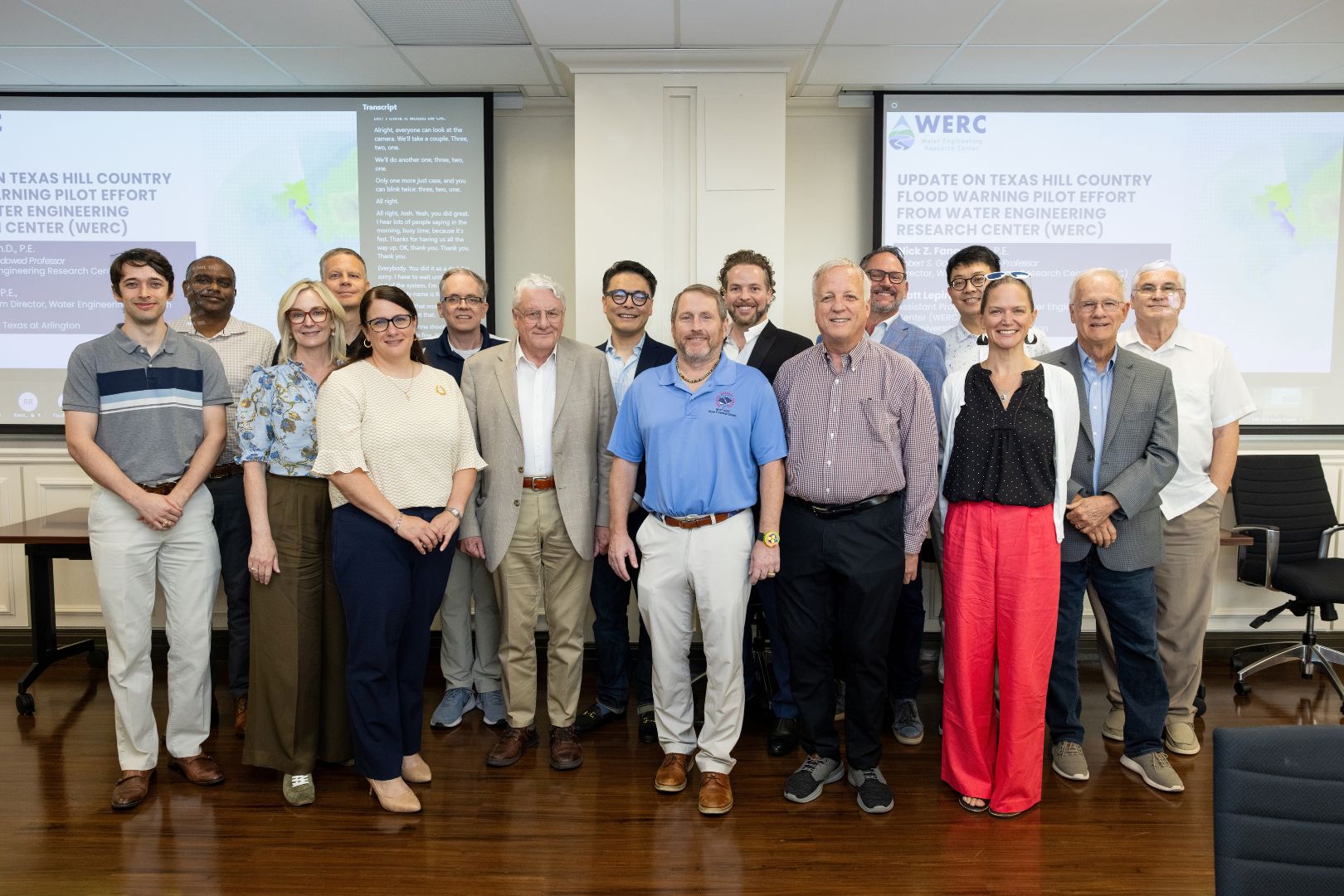
State and federal agency representatives, university researchers and flood experts gathered at the Water Engineering Research Center at The University of Texas at Arlington this week to discuss updates on UTA’s $4 million grant from the Office of Governor Greg Abbott supporting a Texas Hill Country flood early-warning system pilot and opportunities to strengthen flood prediction and warning capabilities across the state.
UTA received the grant in May, following the devastating July 2025 Central Texas floods, which claimed more than 130 lives. Through its Water Engineering Research Center (WERC), the University is building a rainfall monitoring, flood modeling and early-warning system for the Hill Country, partnering with Rice University's Severe Storm Prediction, Education and Evacuation from Disasters (SSPEED) Center.
The system feeds radar-derived rainfall data into hydrologic and hydraulic models to forecast potential flood conditions at specific locations, giving emergency officials more timely, actionable warnings before water reaches dangerous levels. This approach builds on decades of experience aimed at protecting Houston's Texas Medical Center.
The gathering, hosted by WERC, drew representatives from universities (Rice, Schreiner University, Texas Tech and UT Austin) and agencies from the local (Upper Guadalupe River Authority), state (Texas Water Development Board and Texas Department of Transportation) and federal (Federal Emergency Management Agency, U.S. Geological Survey, National Weather Service and U.S. Army Corps of Engineers) levels to review the project's progress, share information about existing flood forecasting resources and discuss how to expand the effort statewide.
Nick Fang, the Robert S. Gooch Endowed Professor at UTA and director of WERC, presented new findings from the team's rainfall modeling work. By cross-referencing radar data with a network of more than 300 rain gauges, researchers found that standard radar readings can underestimate storm totals by roughly 20% under some conditions—a gap that matters when every minute of warning time counts. The refined approach has allowed the team to reconstruct past storms, including the July 2025 Hill Country flooding, and improve the accuracy of rainfall estimates used in flood modeling.
Dr. Fang said the findings reinforce a key lesson from that storm: In the Hill Country's steep terrain, how hard rain falls matters as much as how much falls.
"Rainfall intensity is really the driver behind all the decision-making," Fang said. "It's a hill country—the slope is very steep, so the response time is very short. That's the challenge: how we use timely, accurate rainfall data for flood warning."
Fang also outlined why the Upper Guadalupe watershed, the project's pilot area, has proven especially difficult to model. The region sits atop a complex system of aquifers and geological faults that can move groundwater between neighboring watersheds—meaning rainfall alone may not fully explain the amount of water ultimately moving through a stream or river. Researchers are now working to fold that groundwater activity into their flood models rather than relying only on rainfall data.
The discussions also turned to how that research reaches the people who need it most. Matt Lepinski, WERC's assistant program director, formerly spent years responding to disasters for the Federal Emergency Management Agency and the U.S. Army Corps of Engineers before joining UTA. He told the group that translating complex engineering data into clear, actionable guidance for emergency managers is just as critical as the science itself.
"We don't want to understate that we've gotten this momentum to where we are now," Lepinski said. "Where we go from here is pivotal."
That momentum carried into a broader discussion about expanding UTA’s Flood Warning System pilot and strengthening coordination among universities and local, state and federal partners. Building on issues raised by lawmakers during the July 2025 joint House and Senate hearing in Kerrville, participants discussed how the pilot could help support a more coordinated statewide approach to flood prediction and early warning ahead of the 2027 legislative session.
About The University of Texas at Arlington (UTA)
The University of Texas at Arlington is a growing public research university in the heart of Dallas-Fort Worth. With a student body of over 42,700, UTA is the second-largest institution in the University of Texas System, offering more than 190 undergraduate and graduate degree programs. Recognized as a Carnegie R-1 university, UTA stands among the nation’s top 5% of institutions for research activity. UTA and its 300,000 alumni generate an annual economic impact of $28.8 billion for the state. The University has received the Innovation and Economic Prosperity designation from the Association of Public and Land Grant Universities and has earned recognition for its focus on student access and success, considered key drivers to economic growth and social progress for North Texas and beyond.