UTA lands second Genesis Mission research project
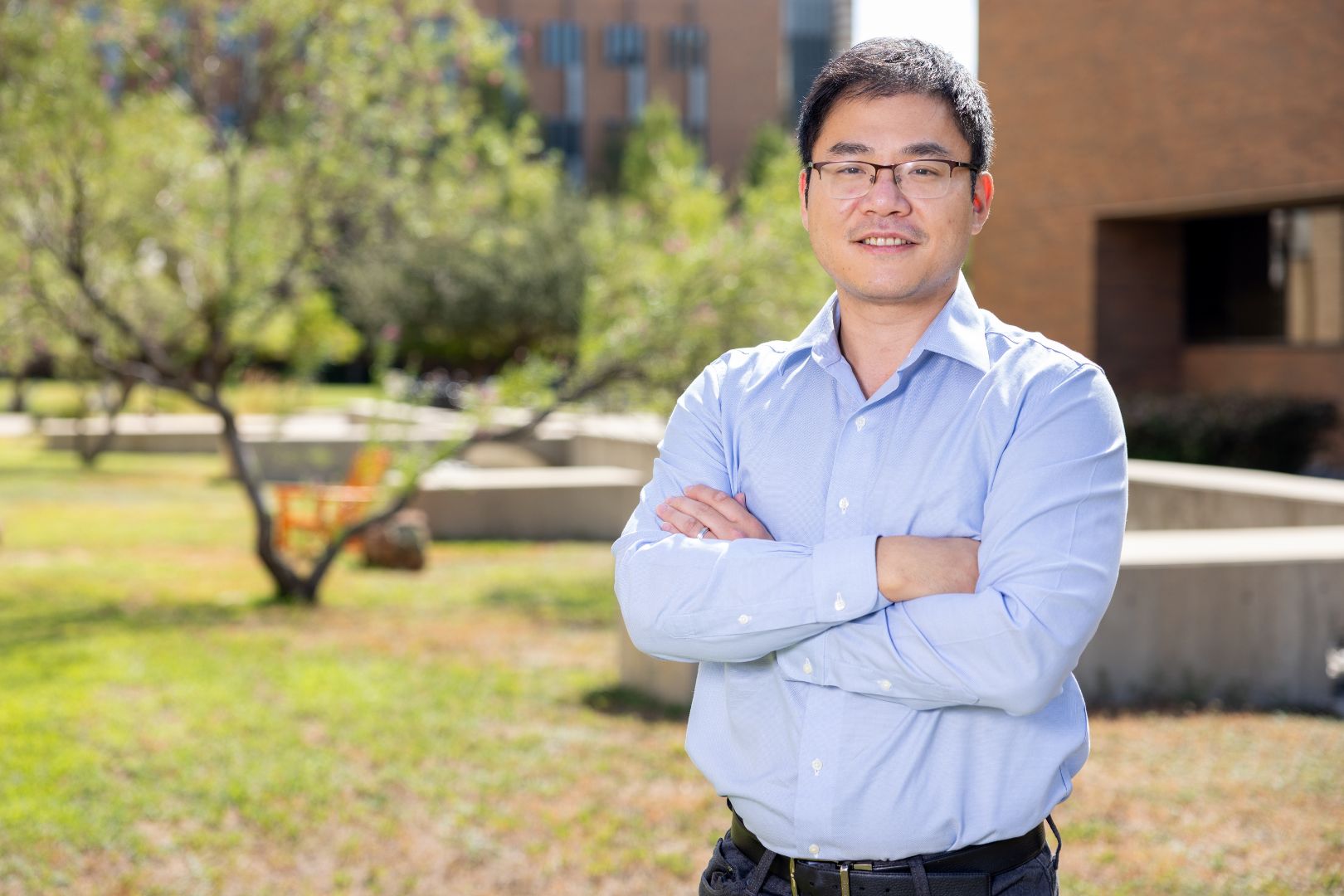
Tianqiao Zhao, assistant professor in the Department of Electrical Engineering at The University of Texas at Arlington, is among a group of collaborators receiving funding through a Brookhaven National Laboratory $14.2 million project that is part of Genesis Mission Phase II.
The researchers are working to develop a next-generation grid foundation model (GridFM) that uses artificial intelligence to simulate the addition of new loads to the electric grid. Their goal is to run 1 billion scenarios in just 24 hours, drastically speeding up grid expansion planning.
“If we know growth needs, how we plan the grid is how we provide power to customers based on all kinds of scenarios,” Dr. Zhao said. “If we can understand the concept of the grid and its inherent physics, we can use AI to develop a foundational model to provide a benchmark for future grid design. This isn’t just one project; we want to show the world that artificial intelligence is a tool that can really help the power grid.”
The project consists of three stages: 1) refine the artificial intelligence to improve the model, 2) develop an application layer and 3) work with four utility partners to deploy the model in their systems.
UTA’s role is to develop agentic AI for intelligent workflows, focusing on connecting its capabilities to applications for specific use cases. Zhao and his team will work to ensure the model can be used with grid validation-in-loop techniques to allow seamless integration regardless of a utility’s unique needs.
With GridFM, different AI agents will process different types of information and help utility partners make decisions. The goal is to provide a unified grid model that utilities can use and fine-tune to meet their needs. The general model can also be retrained for specific use cases, particularly as large loads on the electric grid rapidly increase.
The Genesis Mission is a historic national initiative led by the U.S. Department of Energy, which is building the world’s most powerful integrated science discovery platform. By uniting government, industry, academia and philanthropy, it is accelerating breakthroughs in energy, scientific discovery and national security through a new platform that combines AI, supercomputing, quantum systems and advanced scientific instruments.
About The University of Texas at Arlington (UTA)
The University of Texas at Arlington is a growing public research university in the heart of Dallas-Fort Worth. With a student body of over 42,700, UTA is the second-largest institution in the University of Texas System, offering more than 190 undergraduate and graduate degree programs. Recognized as a Carnegie R-1 university, UTA stands among the nation’s top 5% of institutions for research activity. UTA and its 300,000 alumni generate an annual economic impact of $28.8 billion for the state. The University has received the Innovation and Economic Prosperity designation from the Association of Public and Land Grant Universities and has earned recognition for its focus on student access and success, considered key drivers to economic growth and social progress for North Texas and beyond.