DFW backs UTA research to bolster flood resilience
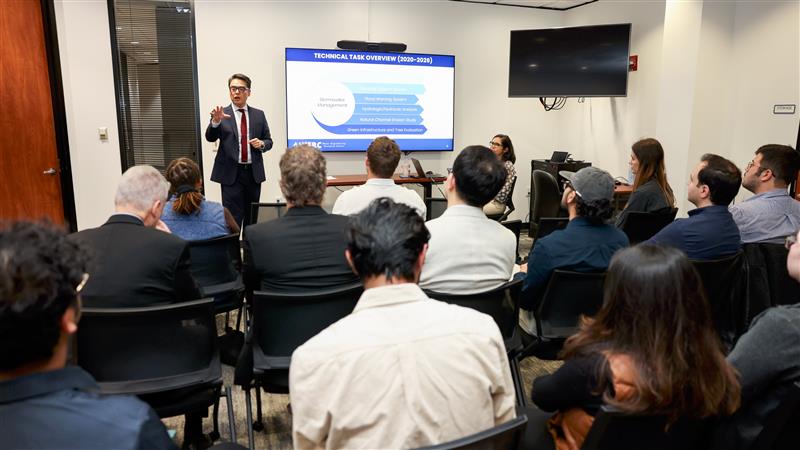
The University of Texas at Arlington and Dallas Fort Worth International Airport are expanding a multi-year partnership to improve stormwater management, environmental protection and long-term operational resilience at one of the world’s busiest airports.
After completing the first phase of the project, DFW has extended its partnership with UTA’s Water Engineering Research Center (WERC) with a $2.38 million investment to build on its previous work by shifting from assessment to solutions. In total, DFW has committed more than $4 million to UTA under the interlocal agreement to strengthen long-term operational resilience.
“This is such a natural partnership,” said Nick Fang, WERC director and the Robert S. Gooch Endowed Professor in Civil Engineering. “We know how vital DFW is to the health of the Metroplex, so our goal as water resources engineers is to address water-related challenges.”
Eduardo Tovar, systems performance manager at DFW Airport, said he believes the partnership will provide strong engineering recommendations to improve system operations, particularly first-flush stormwater, detention ponds and the airport’s flood-warning system.
“We are thrilled to continue this relationship with UTA, a local university with a great civil engineering program,” Tovar said. “We're very interested in being able to forewarn flooding that may be coming down from Big Bear Creek through this partnership.”
Related: UTA’s WERC sets the standard for water research
Dr. Fang and his research team will develop strategies to stabilize eroding channels, enhance the airport’s flood-warning capabilities using artificial intelligence, create digital twining of the stormwater system and refine hydrologic designs that translate research findings into actionable engineering guidance. The team will also study how stormwater infrastructure across surrounding cities affects the airport, an increasingly important issue as commercial growth continues around the Metroplex.
College of Engineering Dean Peter Crouch said the partnership reflects UTA’s role in shaping North Texas’ infrastructure future.
“DFW Airport is only going to become more important as the region grows,” Dr. Crouch said. “Civil engineering, construction and water management are central to North Texas’ economic health, and as the closest university to the airport, UTA is proud to play an important role in safeguarding its environmental and operational resilience.”
Related: UTA expert urges overhaul of flood warning system
Researchers note that the work supports not just the airport, but also the millions of residents and businesses connected through the same waterways. With forecasts suggesting the Metroplex population could double by 2050, UTA engineers say the need for data-driven stormwater planning has never been greater.
“This partnership prepares us for the next generation of challenges,” Fang said. “Whether it’s flood mitigation, water supply or erosion control, we’re building tools, knowledge and a workforce that will benefit the entire region.”
In recent months, WERC has been setting the standard for water research.
The center recently received grants from the Texas Water Development Board to study rainfall patterns, flooding and oil spills to help the state better understand, plan for and respond to water-related challenges.
The state also tapped Fang over the summer to provide expert guidance on designing, implementing and operating a statewide flood-warning system in the aftermath of catastrophic flooding that claimed more than 100 lives in Central Texas.
“We want WERC to become a think tank that guides planning and investment decisions: helping communities build safely, supporting responsible industry expansion and determining how we can make Texas more resilient,” Fang said.
About The University of Texas at Arlington (UTA)
Celebrating its 130th anniversary in 2025, The University of Texas at Arlington is a growing public research university in the heart of the thriving Dallas-Fort Worth metroplex. With a student body of over 42,700, UTA is the second-largest institution in the University of Texas System, offering more than 180 undergraduate and graduate degree programs. Recognized as a Carnegie R-1 university, UTA stands among the nation’s top 5% of institutions for research activity. UTA and its 280,000 alumni generate an annual economic impact of $28.8 billion for the state. The University has received the Innovation and Economic Prosperity designation from the Association of Public and Land Grant Universities and has earned recognition for its focus on student access and success, considered key drivers to economic growth and social progress for North Texas and beyond.