UTA physics grad sets sights on the stars

Like many kids, Shaan Patel spent nights staring at the sky in awe, wondering what existed beyond the stars. That curiosity has never faded.
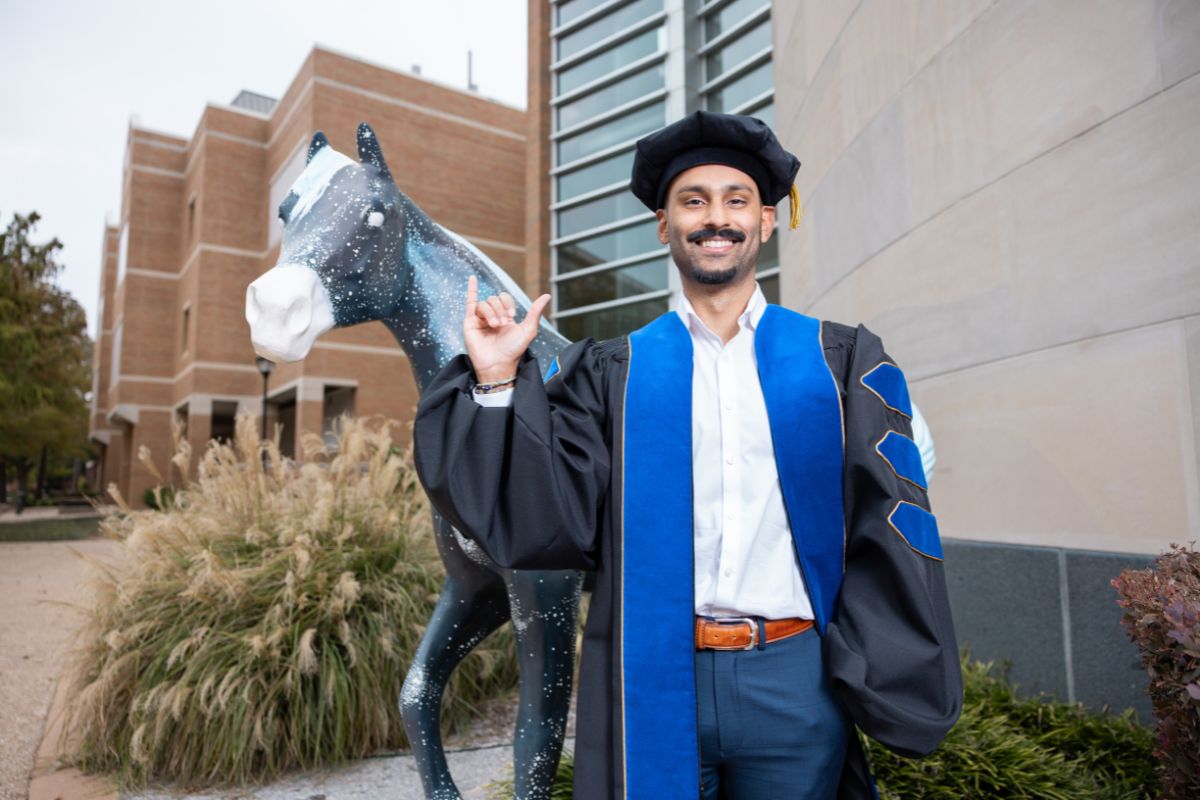
Now, he’s turning it into a career, earning his Ph.D. in physics from The University of Texas at Arlington. Patel will walk across the graduation stage Friday morning at Globe Life Field, a defining moment for an out-of-state student who has become a standout example of what’s possible at UT Arlington.
Related: UTA physicists' research casts more doubt on possible exomoons in some systems
During his four and a half years at UTA, Patel published four first-author peer-reviewed articles and coauthored two others, all focusing on the existence of exomoons. Through this research and his coursework, he developed in-demand skills—ranging from applying problem-solving methods in complex environments to computer coding—positioning him to pursue careers in data science, AI, consulting, and quantitative finance (among others).
Patel worked closely with esteemed faculty members, including Manfred Cuntz, who was named to the UTA Academy of Distinguished Teachers in 2020.
“Pursuing a graduate degree is tough because you’re juggling classes, research and teaching assistant work,” said Patel, who grew up in the Atlanta area. “But I loved my group and the environment here. The grad students get together for dinners and game nights, and the professors have been incredibly supportive. I’ve really enjoyed the experience at UTA.”
Related: Baseball stats sparked his path to data science
Patel discussed his work, his time at UTA and what’s next as he joins UTA’s top-tier alumni community.
What would you tell people about UTA, especially as an R1 research institution?
Patel: The main thing I knew about UTA when I came here was Dr. Cuntz. I didn’t know much about the rest of the Physics Department, but once I arrived, it became clear how high the quality of the professors and research was. The Physics Department is amazing. The space physics group has done a ton—NASA awards, impactful research. The high-energy group works directly with CERN (the European Organization for Nuclear Research). These professors are top tier, and you feel that environment in lectures and colloquiums. Everyone is at the top of their field, and it’s awesome to be a part of.
You recently published two studies on the search for exomoons in star-planet systems. How would you describe that to a lay reader?
Patel: Exoplanets have been a major research focus for decades, and now we are looking at exomoons, the moons of exoplanets. There are no confirmed exomoons yet, but several strong candidates. We run theoretical simulations to see if the observed signals could realistically be moons and whether those moons could be stable. In some cases, our results suggest the candidates could be real. In others, especially around M-dwarf stars, the moons may not survive. That has big implications for how common moons—and potentially life—may be in the universe.
What would you say about UTA to people with similar interests in astrophysics?
Patel: UTA has so much to offer, especially in physics. For younger students, I’d say to just follow your passion. Physics teaches problem-solving and analytical thinking, and those skills are in demand everywhere.
What are your next steps after graduation?
Patel: While finishing my dissertation and defense, I started looking at future roles. Physics opens a lot of doors. Academia is an option, but I’ve been looking at industry in data science, AI, consulting, quantitative finance—roles across many industries. Right now, I’m prepping for technical interviews, brushing up on coding and math, and seeing what’s out there. I’m leaning toward data science and industry, but I like doing different things. Who knows? In 20 years, I might come back as a part-time lecturer or researcher. I’m open to a lot.
About The University of Texas at Arlington (UTA)
Celebrating its 130th anniversary in 2025, The University of Texas at Arlington is a growing public research university in the heart of the thriving Dallas-Fort Worth metroplex. With a student body of over 42,700, UTA is the second-largest institution in the University of Texas System, offering more than 180 undergraduate and graduate degree programs. Recognized as a Carnegie R-1 university, UTA stands among the nation’s top 5% of institutions for research activity. UTA and its 280,000 alumni generate an annual economic impact of $28.8 billion for the state. The University has received the Innovation and Economic Prosperity designation from the Association of Public and Land Grant Universities and has earned recognition for its focus on student access and success, considered key drivers to economic growth and social progress for North Texas and beyond.