Box 19162
Arlington, TX 76019-0162
Strengthening Research Centers on Campus
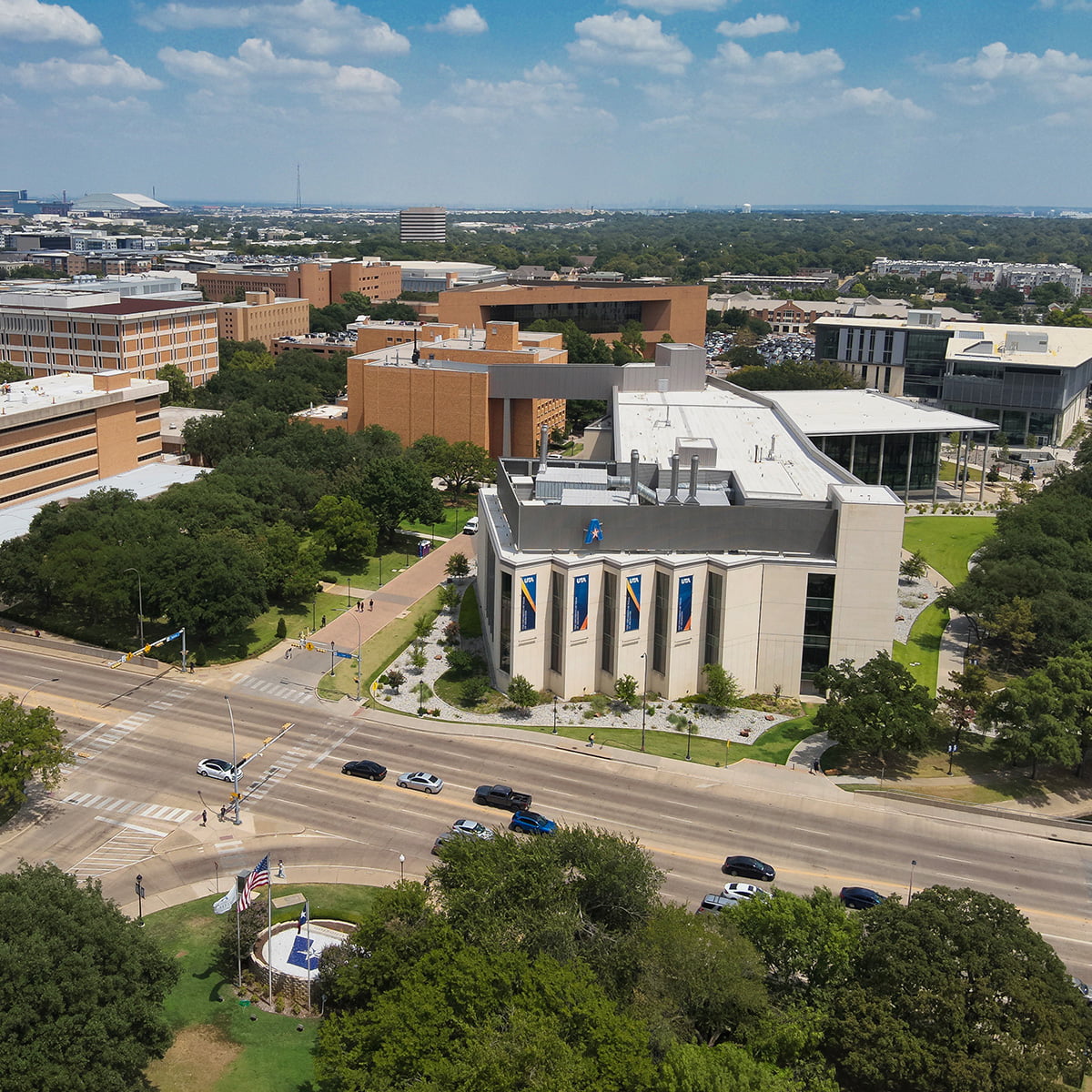
Over the past year, the University has upgraded key research facilities and launched several new centers to help drive future innovation on campus.
The North Texas Genome Center now offers faculty access to a next-generation gene sequencer through which they can study the genetic links between health and disease on a large scale, facilitating a deeper analysis of rare genetic variants and paving the way for breakthrough treatments. The $1 million sequencer is the only one of its kind in North Texas.
Officially opened in September 2025, the Maverick Autonomous Vehicle Research Center is a state-of-the-art facility designed to bring together university, industry, government, and community partners to develop autonomous and intelligent mobility systems—including applications like self-driving cars, military technology, and emergency response tools—and ensure their reliability and safety.
The newly launched Smart Agriculture Research Center—led by Jianzhong Su, mathematics chair, and Gautam Das, engineering associate dean for research—is transforming how we think about farming by leveraging data, artificial intelligence, and sustainable practices to address some of the most pressing challenges in agriculture. The center aims to open new interdisciplinary research avenues for faculty and deepen engagement with both federal partners and rural communities west of the DFW Metroplex.
Led by civil engineering Professor Nick Fang, the Water Engineering Research Center focuses on innovative solutions to water- and flood-related challenges through advanced modeling and interdisciplinary collaboration. It is also directly addressing the vulnerabilities exposed by critical disasters like the July 2025 Central Texas floods, especially with regard to flood forecasting, emergency response, and infrastructure planning. Read more about this work.
The mission of the Center for Space Physics and Data Science is to enhance space workforce training by creating new degrees in space physics, to leverage research efforts supported by the National Science Foundation and NASA, and to further establish UTA as a leader in the field. The center is led by Professor Yue Deng and includes faculty with expertise in space simulation, space instrumentation, data science, aerospace engineering, and physics education.
You Might Also Like

The Bookstop
When I began to explore the Cherokee past, I realized that there were major gaps in the story long predating the Trail of Tears—the agony of forced Indian removal and expulsion of the 1830s.

From the Vice President
As we celebrate 130 years of excellence, The University of Texas at Arlington stands at a defining moment in our history. Research and innovation remain at the core of this institution.

Before the Storm
Early warnings of natural disasters can save thousands of lives and millions of dollars. UTA researchers are using predictive tools to help design, build, and integrate such systems for everything from floods to wildfires to crop failures.