Tuesday, Oct 28, 2025
• Thomas Johns :
Thomas.Johns@uta.edu
Each October, the nation observes National Disability Employment Awareness Month (NDEAM), honoring the contributions of people with disabilities and emphasizing the need for inclusive, equitable employment opportunities.
For the University of Texas at Arlington School of Social Work, this month is not only a time for reflection but also a call to continue advancing equity in the workplace and beyond.
Dr. Darlene Hunter, director of undergraduate programs, associate professor of practice and Paralympic gold medalist, understands the importance of opportunity firsthand.
“Our perception of people with disabilities is guided by a lot of stigma and preconceived notions,” Hunter said. “The K-12 system has never educated about disability. For example, think of how people with disabilities are portrayed in media and entertainment. Much of the time, they’re portrayed as bad or comedically. This notion expands into people’s perceptions in hiring as well.”
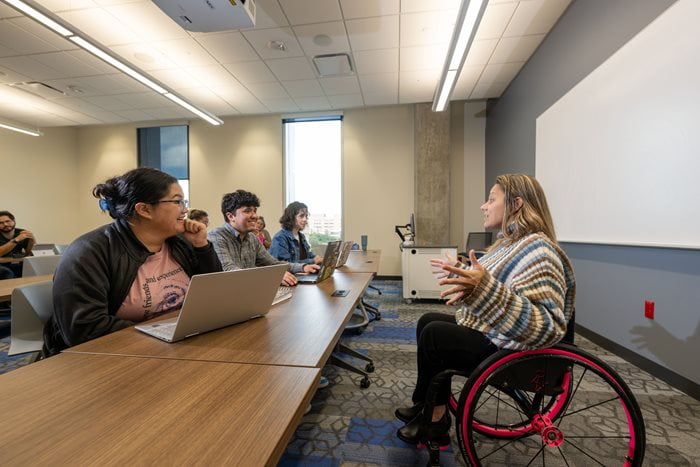
Dr. Darlene Hunter, director of undergraduate programs, associate professor of practice and Paralympic gold medalist, teaches at class at UT Arlington on January 13, 2025.
Hunter’s path began in Michigan and led her to the University of Arizona, where she studied psychology and competed in adaptive sports. She later earned her master’s degree in social work at UTA, where she helped start the women’s wheelchair basketball program.
Her experiences, education and advocacy align closely with the goals of NDEAM—promoting full participation and inclusion for people with disabilities in all areas of life, especially employment.
National Disability Employment Awareness Month dates back to 1945, when Congress designated the first week of October as “National Employ the Physically Handicapped Week.” Over the years, the observance evolved. In 1988, Congress expanded it to a full month and renamed it to reflect a broader, more inclusive understanding of disability.
“Many people don’t know anything about disability because we never talk about it,” Hunter said. “So we have this whole history that no one knows about.”
Today, NDEAM focuses on recognizing the talents of people with disabilities and promoting equitable workplace practices. According to the U.S. Department of Labor’s Office of Disability Employment Policy, the 2025 theme, “Access, Ability, and Advancement,” encourages organizations to evaluate not only hiring but also retention, promotion and workplace accessibility.
Employment remains a major issue for many people with disabilities. While the Americans with Disabilities Act opened doors, barriers persist—including bias, lack of accommodations and misconceptions about capability. The U.S. Bureau of Labor Statistics reports that the unemployment rate for people with disabilities remains higher than for those without.
“You’re starting to see older couples getting divorces, not because they want to, but because their jobs prevent them from getting the type of insurance they need,” Hunter said. “Many jobs and careers lead to people with disabilities making life-altering decisions based on navigating these regulations.”
In addition to institutional barriers, everyday perceptions continue to affect how people with disabilities are viewed in the workplace.
“It costs nothing more to accommodate me; the infrastructure is already in place,” Hunter said. “There’s a misconception in a lot of society that there are costs associated with hiring someone who is considered disabled, but due to the ADA, accessibility infrastructure is already in place, in most cases.”
Hunter believes that bridging the gap requires more than policy—it takes intentional inclusion.
“For many, living with a disability is a hard place to live because of the obstacles beyond your diagnosis,” she said. “Human beings want to have a purpose, and with restrictions to income, insurance or other factors, many people with disabilities are depressed—not due to their diagnosis but because they can’t get a job, or feel like they’re looked at as being limited in the spaces they work.”
NDEAM challenges employers and colleagues alike to consider what inclusion truly looks like in practice. Simple steps—such as evaluating workplace accessibility, providing bias training, or directly consulting employees with disabilities about their needs—can make a meaningful difference.
Employers who intentionally recruit and support people with disabilities often find their teams enriched by broader perspectives, creativity and resilience. Inclusive hiring not only meets ethical and legal standards but also strengthens workplace culture and innovation.
Social work professionals play a unique role in this mission. Whether working directly with clients or shaping policy, social workers advocate for equity and dismantle barriers. The UTA School of Social Work instills these principles in its students, preparing graduates to lead with empathy and evidence-based solutions.
As an educator and mentor, Hunter helps her students reframe how they think about disability—not as a limitation, but as part of human diversity.
“We don’t say people are suffering with disabilities,” she said. “Many people don’t feel like they’re suffering. I’ve acquired a spinal cord injury, but I’m not suffering. I use a wheelchair, but I’m not confined to a wheelchair. When leading with empathy, language is important, words are important. And these are just the little things people can recognize when reorienting perspectives around those living with disabilities.”
National Disability Employment Awareness Month serves as a reminder that inclusion is ongoing work. It calls on institutions, employers and individuals to continue building environments where people with disabilities can thrive on their own terms.
At UTA and beyond, that means listening, learning and leading. As Hunter’s story shows, when people are given access and opportunity, their potential is limitless.
“We work in a profession where we’re advocating all the time, and you could be the person who makes a difference,” she said. “You could be the person in the room to change someone’s life by taking a step back, recognizing what someone needs and ultimately getting them those resources.”