Friday, Feb 06, 2026
• Jaelon Jackson :
Jaelon.Jackson@uta.edu
The University of Texas at Arlington School of Social Work hosted a Black History Month panel Feb. 5 titled “The Power of Presence: Black Identity in Professional Social Work,” bringing students, faculty, staff and community members together for a conversation about professional identity, leadership and lived experience in the profession.
Hosted by the UTA Social Work Black Social Work Student Alliance, the event was held in recognition of the 100th year of Black History Month. BSSWA President Natasha Sutherland opened the evening by welcoming attendees and outlining the focus of the discussion.
“Tonight’s conversation centers Black voices, lived experiences and leadership within social work,” Sutherland said. “This matters because they create a space for reflection, affirm identity, and remind us of the power of showing up authentically in our communities and our professions.”
Dr. Jandel Crutchfield, associate professor at the UTA School of Social Work, moderated the discussion, guiding panelists through questions about identity, professional navigation, systems, resilience and long-term career sustainability.
The panel consisted of Dereka Hall, director of the Dallas College Social Work Academy, Adam Powell, president and CEO of United Way of Tarrant County and Debra Mitchell-Ibe, executive program manager of Denton County Friends of the Family. All panelists are graduates of the UTA School of Social Work.
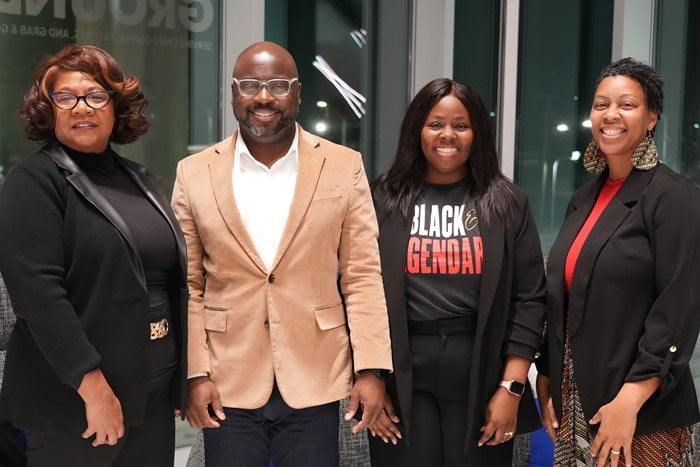
Debra Mitchell-Ibe, executive program manager of Denton County Friends of the Family (Left), Adam Powell, president and CEO of United Way of Tarrant County (Center Left), Dereka Hall, director of the Dallas College Social Work Academy (Center Right) and Dr. Jandel Crutchfield, associate professor at the UTA School of Social Work (Right) pose for a photo at the “Power of Presence: Black Identity in Professional Social Work” Black History Month Panel on Feb. 5, 2026. (Photo by Jaelon Jackson)
When asked what “power of presence” means as a Black social worker, the panelists emphasized authenticity and clarity about personal values.
Hall described presence as more than being physically in a space.
“The power of presence to me means more than just showing up,” Hall said. “It means being my most authentic self, connecting with and empowering all clients that I come in contact with.”
Hall reflected on entering the profession at a young age and stepping into leadership roles early in her career. She spoke about learning to navigate expectations placed on her as a Black woman in professional settings and developing confidence in her qualifications and abilities.
“I deserve to be here,” she said. “I bring a lot to the table.”
Powell discussed authenticity in the context of professional growth. He shared an early-career experience that prompted him to think intentionally about how identity intersects with workplace culture.
“Some of it is going to be palatable to a lot of people, and some of it is not,” Powell said. “And I have to be ok with that space.”
Powell also spoke about balancing multiple aspects of identity, noting that professional competence and personal background are not mutually exclusive.
“I am authentically a dude that loves trap music,” he said. “I am also authentically a dude who is a pretty good CEO. And two things can be true.”
Mitchell-Ibe framed presence as something shaped by family history and life experience. Growing up in East Texas, she said she learned early to be aware of dynamics within different environments.
“You carry your generations with you,” Mitchell-Ibe said. “You have to know what you stand for.”
As the discussion turned to professional systems and workplace experiences, panelists spoke about hiring, leadership and representation within organizations. Powell noted that hiring decisions can be influenced by comfort and perception, even when qualifications are comparable. Mitchell-Ibe encouraged attendees to observe leadership structures within organizations and consider how decision-making roles are filled.
The panel also addressed the demands of the profession. Social work, the speakers agreed, can be emotionally taxing. Hall emphasized the importance of mentorship and seeking guidance from experienced professionals. Powell encouraged students to cultivate interests and relationships outside of work to maintain balance. Mitchell-Ibe pointed to family support and meaningful client interactions as sources of motivation.
During a question-and-answer session, students and community members asked about navigating the hiring process and sustaining themselves without strong mentorship or family support systems. Panelists advised preparation, persistence and networking, including advice to build connections beyond one’s immediate field when possible.
To close the event, Crutchfield asked each panelist to complete the sentence, “The power of my presence as a Black social worker is …”
Their responses were brief:
“The future,” Mitchell-Ibe said.
In case you missed it, you can view the full livestream recap on YouTube.