Tuesday, Mar 10, 2026
• Jaelon Jackson :
Jaelon.Jackson@uta.edu
University of Texas at Arlington Master of Social Work student Ebin Thomas is leading an international initiative aimed at addressing mental health needs within a coastal community in Southern India affected by climate-related disasters.
Originally from Kerala, India, Thomas launched “Lamp for the Lost”, a youth-led volunteer initiative focused on building a culturally responsive, community-based mental health support model in Anjengo, a coastal community that experiences frequent sea erosion, cyclones and seasonal flooding.
The project aims to support residents navigating emotional distress caused by displacement, unemployment and ongoing environmental threats that often remain overlooked in disaster recovery efforts.
“Witnessing these events growing up motivated me to help people reduce their suffering in whatever way I can,” Thomas said. “Many families in coastal communities are living with constant uncertainty, yet mental health concerns remain highly stigmatized and largely undocumented.”
Residents in Anjengo rely heavily on fishing as their primary source of income, making them particularly vulnerable to extreme weather and changing sea conditions. Sea erosion has already displaced many families, while others continue to live with the fear of losing their homes.
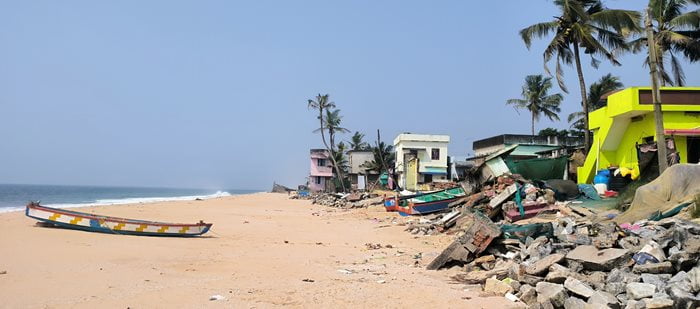
The coastline of Anjengo, Republic of India. (Photo by Ebin Thomas)
Although government programs and local organizations address housing displacement and employment challenges, Thomas said mental health needs are often underrecognized and services are rarely used due to stigma and limited outreach.
“Lamp for the Lost” seeks to address that gap through several strategies, including assessing community mental health needs, providing psychoeducation on emotional well-being and creating safe spaces for community dialogue.
The project’s first phase, a needs assessment, revealed widespread emotional and psychological stress among residents, including anxiety, sleep problems, dampened moods and concerns about displacement and economic instability.
Thomas and his team are now moving into the second phase of the initiative, which focuses on raising awareness about mental health and establishing community circles where residents can openly discuss emotional challenges and access support resources.
“I believe mental health support must exist alongside efforts to address housing and employment,” Thomas said. “These services help individuals and families build coping mechanisms while long-term solutions are still being developed.”
Thomas credits UTA’s School of Social Work with helping prepare him to approach the project through a research-informed lens.
“I learned that research informs practice,” Thomas said. “My professors encouraged critical thinking and self-reflection, and their mentorship gave me the confidence to start this project.”
Looking ahead, Thomas hopes the initiative will empower residents to support one another through community-led mental health spaces while also building local capacity for long-term sustainability.
Ultimately, he hopes the model can be adapted for other coastal communities across South Asia experiencing similar climate-related challenges.
“I hope the community becomes empowered to navigate emotional and psychological distress in healthier ways,” Thomas said. “If this model can be adapted elsewhere, it could help many other communities facing similar struggles.”