Thursday, Mar 19, 2026
• Jaelon Jackson :
Jaelon.jackson@uta.edu
The Student Association for Macro Social Work brought students, community leaders and advocates together for its Black History Month celebration, highlighting the role student organizations play in advancing community engagement and social change.
Held at the University of Texas at Arlington, the event centered on the theme of legacy, leadership and liberation, connecting the historical contributions of Black leaders to the work social work students are preparing to carry forward.
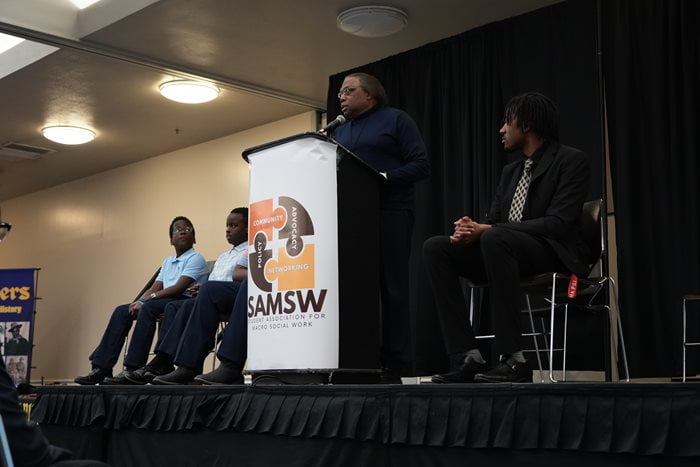
Mr. Curtis King, founder and president of The Black Academy of Arts and Letters (TBAAL) speaks during the Student Association for Macro Social Work (SAMSW) Black History Month celebration at the University of Texas at Arlington. (Photo by Jaelon Jackson)
In addition to honoring Black history, the program served as an example of how student-led organizations create spaces for dialogue, collaboration and real-world learning beyond the classroom.
Brian Popp, president of SAMSW, said the event was intentionally designed to bridge past and present efforts in social awareness.
“This year’s Black History Month celebration was inspired by the desire to honor the historical foundations that continue to shape social awareness work today,” Popp said. “That legacy reminds us that the work we do now didn’t start with us. It’s built on generations of advocacy, leadership and sacrifice.”
The program featured speakers representing history, public service and the arts, giving students exposure to different pathways for leadership and advocacy. These speakers included Al Henderson, president of Claude R. Platte Tuskegee Airmen Dallas Chapter, Paul Allen, president of the Dallas Chapter of the Buffalo Soldiers, Sam Allen, vice president of the Dallas Chapter of the Buffalo Soldiers and Curtis King, founder and president of the Black Academy of Arts and Letters.
Popp said bringing together these perspectives reflects the core of macro social work, understanding systems while staying grounded in community.
“Events like this move learning beyond the classroom and place students in direct conversation with community voices,” he said. “It shows that social awareness is not just theory, but something built through partnerships, engagement and leadership.”
SAMSW is one of several student organizations within the School of Social Work that work to connect students with community issues through programming, service and advocacy. Through events like the Black History Month celebration, student organizations create opportunities for students to engage with real-world challenges, build professional networks and develop leadership skills.
Popp said these experiences help students better understand their role in shaping systems and supporting communities.
“Organizations like SAMSW help students translate what they learn into action,” he said. “It gives them a space to develop their voice and see how they can contribute to policy, advocacy and large-scale change.”
While the event focused on Black history, Popp emphasized that the responsibility to honor that legacy extends beyond a single month.
“Honoring Black leadership should not be limited to February,” he said. “It’s about staying engaged, supporting communities and continuing the work year-round.”
Through continued programming and partnerships, SAMSW and other student organizations aim to provide students with meaningful opportunities to engage with the community and contribute to lasting social impact.