RISE 100 faculty takes on San Antonio heat
Two years ago, The University of Texas at Arlington launched RISE 100—Recruiting Innovative Scholars for Excellence—a $60 million initiative to recruit 100 new tenure-track faculty, with the goal of elevating UTA’s research profile and establishing leadership to pursue solutions to key academic and societal challenges.
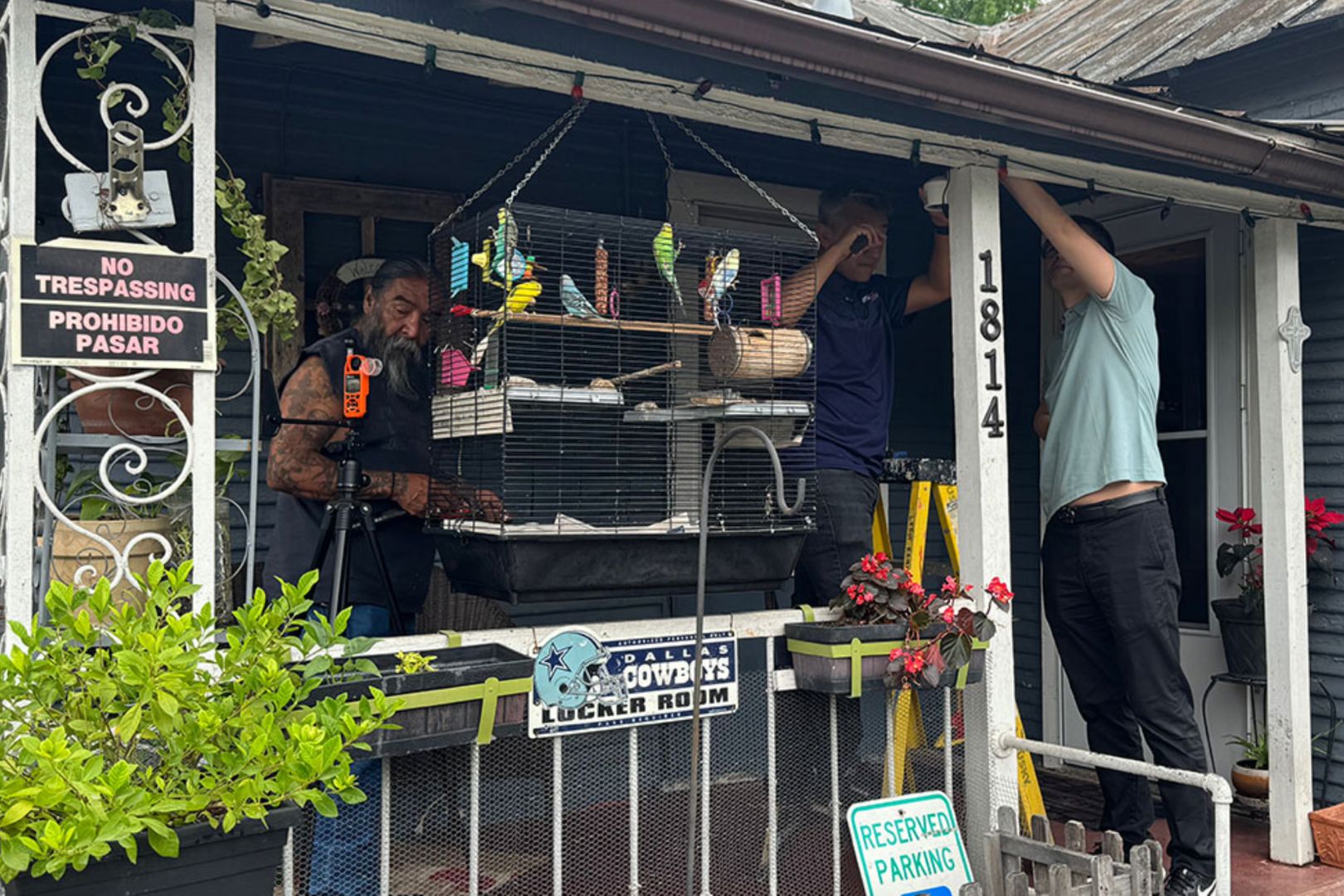
Among the newest RISE 100 faculty is Wei Zhai in the College of Architecture, Planning and Public Affairs. Dr. Zhai was recently awarded a $700,000 grant from the National Science Foundation (NSF) for a groundbreaking project addressing extreme heat in San Antonio's historic Westside. The initiative—CIVIC-FA Track A: Co-Created Digital Twins for Heat-Resilient Home Rehab Co-Design—blends advanced technology with grassroots collaboration to address one of the region's most pressing climate challenges.
The primary goal of the project is to enhance heat resilience for residents living in the Westside—an area marked by aging homes often poorly insulated and less energy-efficient—and in increasingly higher temperatures. During the sweltering Texas summers, these conditions pose serious risks to public health and quality of life.
Empowering Communities Through Technology
The project will pilot the creation of digital twins—3D digital replicas of 10 real homes—that integrate real-time temperature sensor data and simulate thermal behavior. By working directly with residents to co-create these models, the project empowers homeowners to visualize where heat accumulates in and around their homes and to explore practical, cost-effective retrofitting options before making any physical changes.
"Digital twins allow us to test 'what-if' scenarios, like adding insulation, planting trees or improving ventilation, and explore potential energy savings before making upgrades," Zhai said. "This approach helps residents make informed decisions about home rehab, prioritize limited resources and design effective, affordable strategies to keep their homes cooler."
Community-Driven Collaboration
Central to the project is the formation of the Cool Home Coalition, a broad partnership that includes residents, city departments, community organizations and researchers. This collaboration will coordinate efforts to streamline access to home improvement funding, share localized heat mitigation strategies and foster long-term community engagement.
Additionally, key collaborators include the Historic Westside Residents Association (HWRA) and the Esperanza Community Land Trust (ECLT), two organizations deeply tied to the neighborhood. HWRA will lead outreach, communication and recruitment efforts, ensuring that community voices remain front and center. At the same time, ECLT will manage the home retrofit process and contractor implementation, drawing on its extensive experience with housing rehabilitation.
"We chose HWRA and ECLT because of their long-standing trust and track record within the community," Zhai noted. "These organizations help us make sure the project is community-driven, culturally responsive, and grounded in the real needs of residents."
Beyond the initial pilot, the project aims to leave a lasting impact through the development of scalable resources: the Cool Home Platform and the Heat-Resilient Home Rehab Toolkit. These tools are designed for adaptation in other neighborhoods and cities, offering a blueprint for how communities across the country can respond to extreme heat through a mix of technology, community science and policy coordination.
"In the long term, we hope to reduce residents' exposure to extreme heat, lower energy costs and strengthen community capacity to address climate challenges," Zhai said. "We're also involving local youth in STEM programs to ensure the next generation of leaders is engaged in climate resilience."
Securing the NSF grant marks a significant milestone for Zhai and his team. It reflects growing recognition of the need to pair cutting-edge science with community-based initiatives.
"With this support, we can bring together residents, scientists and policymakers to co-create solutions that are both innovative and equitable," Zhai said. "The grant allows us to tackle extreme heat challenges head-on, ensuring that technological advances like digital twins directly benefit the communities."
As the pilot takes shape in San Antonio, Zhai is already exploring ways to scale the model to other cities facing similar climate pressures, including those in the Dallas-Fort Worth area.
— Eric Garner, CAPPA
About The University of Texas at Arlington (UTA)
Celebrating its 130th anniversary in 2025, The University of Texas at Arlington is a growing public research university in the heart of the thriving Dallas-Fort Worth metroplex. With a student body of over 42,700, UTA is the second-largest institution in the University of Texas System, offering more than 180 undergraduate and graduate degree programs. Recognized as a Carnegie R-1 university, UTA stands among the nation’s top 5% of institutions for research activity. UTA and its 280,000 alumni generate an annual economic impact of $28.8 billion for the state. The University has received the Innovation and Economic Prosperity designation from the Association of Public and Land Grant Universities and has earned recognition for its focus on student access and success, considered key drivers to economic growth and social progress for North Texas and beyond.