Wednesday, Nov 18, 2026
• Victoria Hernandez :
Victoria.Hernandez@uta.edu
School of Social Work
Dr. Alan Kunz-Lomelin ('19 MA, ‘19 MSW, '24 PhD) is an Assistant Professor at the Phyllis and Harvey Sandler School of Social Work in the College of Social Work and Criminal Justice at Florida Atlantic University. In addition to being a Licensed Clinical Social Worker, his work focuses on the future of behavioral health and human services, paying particular interest to how artificial intelligence can support clinical workflows, improve access, enhance training and supervision, and accelerate research in mental health and substance use systems. Dr. Kunz-Lomelin earned a bachelor’s degree in psychology from the University of Dallas, two master’s degrees in social work and criminology from The University of Texas at Arlington, along with his PhD in 2024 also from UTA's School of Social Work.
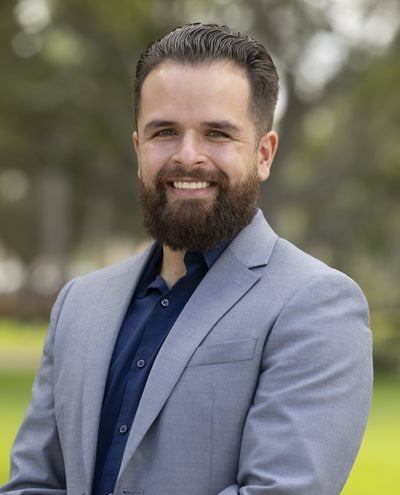
A photo of Dr. Alan Kunz-Lomelin. (Courtesy Photo)
Q: What inspired you to pursue a career in social work?
A: My interest in social work grew from a desire to better understand human behavior and, more importantly, how we can use that understanding to improve people's lives. I was particularly drawn to the intersection of mental health, substance use, and the social and structural factors that influence people's well-being.
What attracted me to social work was its unique combination of clinical practice, research, and social justice. It is a profession that challenges us to look beyond individual circumstances and consider the larger systems shaping people's opportunities and experiences.
Over time, that interest evolved into a passion for research and innovation. Today, I am especially interested in how emerging technologies, including artificial intelligence (AI), can help us address long-standing challenges in behavioral health and social services.
Q: How did your time at the UTA School of Social Work prepare you for your professional path?
A: UTA played a fundamental role in shaping who I am as a social worker, researcher, and educator. I completed my Master of Social Work, a master's degree in Criminology and Criminal Justice, and ultimately my PhD in Social Work at UTA.
That interdisciplinary training allowed me to examine social problems from multiple perspectives, integrating clinical practice, behavioral health, criminal justice, and research.
Perhaps most importantly, my mentors at UTA, Dr. Katherine Sanchez, Dr. Rebecca Mauldin, Dr. Anne Nordberg, and Dr. Rachel Voth Schrag, helped shape who I am today by challenging me, guiding me, and supporting me during my time at UTA and they continue to do so.
Today, as an Assistant Professor at Florida Atlantic University, I draw on that foundation in my teaching, research, and collaborations. UTA prepared me not only to contribute to the existing knowledge in social work but also to think critically about how the profession can evolve to meet emerging challenges.
Q: What is one project, initiative, or accomplishment you are most proud of?
A: One of the accomplishments I am most proud of is the opportunity to bridge social work, emerging technologies, and community impact through my research and leadership at Florida Atlantic University.
I currently serve as Principal Investigator on a multiyear, $450,000 initiative in partnership with Palm Beach County. This project focuses on exploring and evaluating how artificial intelligence and other emerging technologies can improve access to resources, strengthen recovery support, and enhance services for individuals and communities affected by substance use. What makes this work particularly meaningful is the opportunity to translate innovative ideas into practical solutions that address real community needs.
At the same time, I have been actively working to advance the responsible adoption of AI across the university. This includes helping the Sandler School of Social Work integrate AI into research, education, and professional practice. These efforts include developing AI-focused educational opportunities, mentoring students in AI-related research, and helping introduce a new course focused on artificial intelligence and social work.
What I find most rewarding is helping position social workers not simply as users of emerging technologies, but as leaders in shaping how these technologies are developed, evaluated, and implemented. I believe our profession has an important role to play in ensuring that technological innovation remains grounded in human dignity, ethical responsibility, and social justice.
Q: What are some of the challenges you've faced in your work, and how have you navigated them?
A: One of the biggest challenges in my work has been bridging the gap between research and practice. We can develop sophisticated research methods and innovative technologies, but their value ultimately depends on whether they can be implemented effectively and make a meaningful difference in people's lives.
This challenge has become particularly relevant in my work with artificial intelligence. While AI presents exciting opportunities, it also raises important questions about equity, privacy, bias, and the role of human judgment in social services.
I have approached these challenges by prioritizing interdisciplinary collaboration, remaining open to learning from practitioners and communities, and grounding my work in social work values.
I've also learned that meaningful progress often requires stepping outside our disciplinary comfort zones, embracing uncertainty, and being willing to learn new skills.
Q: Who or what has been a major influence or source of support in your career?
A: My professional development has been shaped by the people I've had the opportunity to learn from and collaborate with throughout my career.
Mentorship and interdisciplinary collaboration have been particularly important to my growth as a social worker and researcher. Working with individuals who bring different perspectives, whether from social work, healthcare, criminal justice, or technology, has challenged me to think more broadly about the problems we are trying to solve.
I am also continually influenced by the practitioners and communities whose experiences remind me why this work matters.
One of the most valuable lessons I've learned is that professional growth rarely happens in isolation. It happens through relationships, collaboration, and a willingness to learn from others.
Q: What advice would you share with current social work students or recent graduates?
A: My biggest advice would be to stay curious and never limit your understanding of what a social worker can do.
Social work is an incredibly versatile profession. Our training equips us to work directly with individuals and families, influence policy, conduct research, lead organizations, and increasingly contribute to fields such as technology and artificial intelligence.
I would encourage students to develop strong foundational social work skills while also exploring areas outside their comfort zones. Learn about research, data, technology, and other disciplines that can complement your social work education.
In particular, I believe the next generation of social workers has an important opportunity to shape how AI and emerging technologies are developed and used in human services. We should not simply be consumers of these technologies.
We should be actively involved in shaping them to reflect our profession's commitment to human dignity, equity, and social justice.
Q: How do you stay connected to the values and mission of social work in your everyday life?
A: I try to stay connected to social work's mission by asking myself a simple question: How can the work I am doing ultimately benefit individuals, families, and communities?
Whether I am teaching students, developing a research project, evaluating a community initiative, or exploring a new application of artificial intelligence, I try to keep that question at the center of my decisions.
My research increasingly involves sophisticated technologies and analytical methods, but I believe it is essential to remember that behind every dataset, algorithm, or research question are real people whose lives may be affected by the decisions we make.
For me, staying connected to social work values means approaching innovation with both curiosity and responsibility, recognizing that technological advancement should never come at the expense of human dignity, equity, or compassion.
I believe social workers have an important responsibility not only to respond to today's challenges but also to help shape a more equitable future.