Linguistics and TESOL -
Danielle Quaye
Danielle Quaye traveled to Ghana conduced dissertation research on Gã, a lesser-studied language spoken in Accra
Read Her Story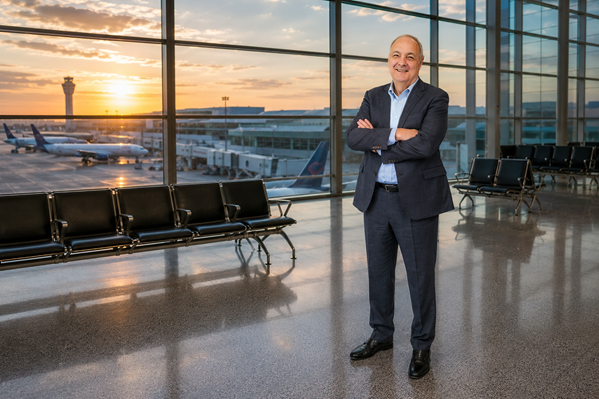
Every day, more than 200,000 passengers move through Dallas Fort Worth (DFW) International Airport.
Pilots guide aircraft into the sky. Air traffic controllers coordinate arrivals. Operations managers monitor logistics. Safety specialists oversee compliance. Analysts track data flowing through one of the busiest transportation hubs in the world. Most travelers never think about them. Marvin Diaz does.
What happens at DFW Airport is only part of the story. The Dallas-Fort Worth-Arlington Metroplex is home to the highest concentration of aviation-related businesses and manufacturers in the United States. Every day, thousands of professionals work behind the scenes to keep the industry moving—from airport operations and logistics to safety oversight, communications, data analytics, maintenance, public policy, and management.
"The future of aviation won't be built by pilots alone. It will be built by leaders."
That's the vision behind The University of Texas at Arlington's new Aviation Studies, housed within the College of Liberal Arts.
"The need is now," Diaz said. "We've heard directly from our aviation advisory group that airlines, airports, and support industries need a pipeline of talent. Our goal is to prepare students to have exciting and impactful careers throughout the aviation ecosystem."
As Associate Professor of Practice and the program's founding director, Diaz sees the pathway as an opportunity to connect students with one of the nation's most dynamic industries while equipping them with the skills employers increasingly demand. Those skills may be more important than ever.
For many universities, aviation education begins and ends with flight training. UTA's approach is different.
The Aviation Studies pathway is designed for students who want to work across the aviation industry—not only in the cockpit, but throughout the organizations and systems that make modern air travel possible. That broader perspective is one reason the pathway is housed within the College of Liberal Arts and supported through Liberal Arts Applied Programs (LAAP), including the Bachelor of Arts in Interdisciplinary Studies (INTS) and the Bachelor of Applied Arts and Sciences (BAAS).
These flexible degree pathways allow students to combine aviation-focused coursework with complementary areas of study, creating educational experiences tailored to their interests, professional backgrounds, and career goals. For Dr. Sarah Lock, assistant dean of LAAP, the connection is a natural one."Students entering the workforce today are finding that employers are looking for durable skills such as problem-solving, communication, and flexibility," Lock said. "Interdisciplinary pathways help students develop those skills while learning to approach challenges from multiple perspectives."
Whether students are entering college for the first time, returning to complete a degree, or building on existing industry experience, LAAP's structure allows them to connect aviation with disciplines such as communication, leadership, public policy, technology, and organizational management.
"Choosing an interdisciplinary path usually means that a student is curious and motivated, disciplined and flexible, and likely to have a wider range of experiences than peers in more narrowly defined programs," Lock said.
As the aviation industry is evolving at remarkable speed, global transportation demands continue to grow, data analytics shapes operational decisions, artificial intelligence accelerates research and problem-solving, and new technologies transforms everything from logistics and maintenance to customer experience and safety.
Yet for all the technological change, aviation remains fundamentally dependent on people.
"The aviation business is solely dependent on trust," Diaz said. "Everyone involved in owning, operating, maintaining, and manufacturing aircraft trusts that the person before them followed all the rules and procedures. Aviation depends on timely, reliable, and actionable communication."
That reality challenges one of the most common misconceptions about aviation careers.
"'Oh, you must be a pilot,'" Diaz said, laughing. "That's what most people think."
In reality, aviation offers opportunities in aircraft design, operations, maintenance, airport management, government agencies, safety oversight, communications, logistics, and countless other specialties that keep the global aviation system moving.
Success in those roles requires technical knowledge.
But it also requires something technology cannot easily replicate.
"We can't automate teamwork," Diaz said. "We can't automate the synergy created by pooling all our talents. We can't automate the passion that drives people to keep looking for better ways to do things."
For some, the idea of an aviation program within a College of Liberal Arts may seem unexpected.
For Diaz, it's exactly where it belongs.
"Aviation Studies is housed in the liberal arts college because of the values instilled here," he said. "Critical thinking. Problem solving. Time management. Communication. Teamwork. And perhaps most importantly, personal ethical responsibility."
Those competencies are increasingly valuable in an industry where professionals must navigate changing regulations, emerging technologies, economic uncertainty, global events, and complex operational challenges.
Lock describes LAAP's philosophy as "yes, and."
"Yes, we're preparing students to think critically," she said. "And we're showing them what that looks like in applied contexts."
The pathway reflects a growing understanding among employers that technical expertise alone is no longer enough. Organizations need professionals who can communicate across teams, solve problems collaboratively, adapt to change, and lead in high-pressure environments.
Those are qualities liberal arts graduates have long been developing.
As conversations about artificial intelligence continue to reshape industries around the world, both Diaz and Lock believe the future belongs to people who can combine technological fluency with distinctly human strengths.
Students today have access to more information than any generation before them. The challenge is learning how to use it wisely.
"Students today need strong digital and media literacy skills," Diaz said. "They can go further and deeper in their studies than any generation before. But they have to remember they're the ultimate decision-makers."
Lock agrees.
"People who are skilled at metacognition, analysis, empathy, creativity, and nuanced communication are indispensable," she said. "The people best able to identify misinformation or challenge flawed assumptions are those who have learned to think deeply and ask better questions."
In many ways, those qualities mirror the demands of aviation itself. The industry values efficiency, but it depends on relationships. It embraces technology, but it succeeds because of people. It relies on data, but it requires judgment.
The launch of the Aviation Studies pathway reflects more than the creation of a new academic offering.
It represents a broader vision for how higher education can prepare students for industries that are increasingly interconnected, fast-moving, and complex.
As career paths become less linear and workforce needs continue to evolve, employers are looking for graduates who can navigate uncertainty, communicate across disciplines, and lead through change.
Those are the very skills the College of Liberal Arts has been cultivating for generations.
For Diaz, the program's success ultimately won't be measured by enrollment numbers or course offerings. It will be measured by the graduates who leave prepared to make a difference.
He hopes they become "open-minded, fun-loving, positive-spirited individuals armed with the aviation knowledge to lead people in an aviation industry that is never the same from one day to the next."
In the nation's largest aviation market, UTA isn't simply creating another aviation program. It's building a talent pipeline. One grounded in communication, leadership, critical thinking, and ethical responsibility. One designed for an industry in motion.
And one ready for takeoff.
We can’t automate teamwork. We can’t automate the synergy created by pooling all our talents.
Discover other students' journeys.