Life Sciences Building, Room 206
501 S. Nedderman Drive
Box 19047
Arlington, TX 76019
From volcanoes to Venus: Glaze leading NASA's push to explore the solar system
UTA physics alumna has forged a stellar career in volcanology and planetary science
Science Week Home | Science Week Printable Schedule (.pdf)
While growing up, Lori Glaze was fortunate to have strong female role models who allowed her to see that a career in a STEM (science, technology, engineering, mathematics) field was possible and her future as limitless as the stars above.
Her mother was an aeronautical engineer, as was her father. An aunt worked in computer science. Glaze never felt that certain jobs were off-limits to women. She studied physics and volcanology, and earned three degrees in science — two from the University of Texas at Arlington.
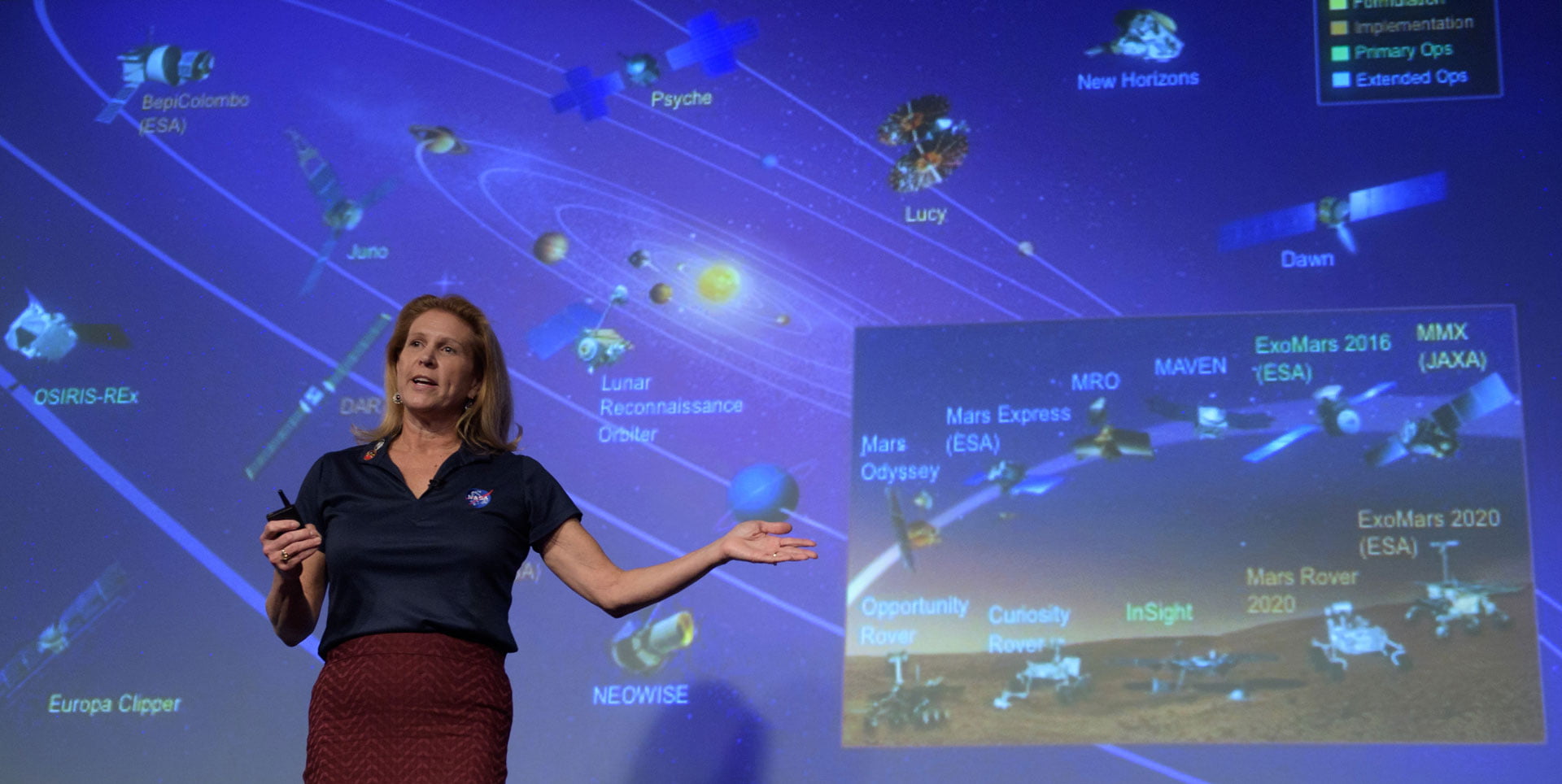
She has forged a highly successful career in planetary science which includes various leadership roles at NASA. Today she is director of NASA's Science Mission Directorate’s Planetary Science Division (PSD), one of six science divisions at the agency. She oversees all of NASA's flight missions and science research that is focused on ascertaining the content, origin, and evolution of the solar system and the potential for life elsewhere.
“The Planetary Science Division addresses fundamental questions of solar system formation and evolution, including understanding planetary environments that can support life, or could have in the past,” Glaze said.
Glaze says she is honored to serve as a role model for young girls and women who want to pursue careers in STEM fields. She wants to see even greater accessibility to STEM education so that all underrepresented groups can have the ability to follow their dreams.
“I know just how important it is to be able to see someone that looks like you in leadership roles,” she said. “I am so happy that I have the opportunity to be that for others and I hope that we can continue to increase diversity in science leadership to provide role models for all. I love talking with young girls and encouraging them to follow their passions, whatever they may be.”
Glaze is returning to UTA to present a talk on Thursday, April 21 as part of the College of Science’s Distinguished Women in Science Speaker Series. Her lecture, a featured event of the College’s annual Science Week, will take place at 4 p.m. in SEIR Building Room 198 and is open to all.
“We are honored to have Dr. Glaze return to campus to share her insights and expertise, and her visit will be a true highlight of Science Week,” said Morteza Khaledi, dean of the College of Science. “She has achieved and continues to achieve great things in planetary science, and we are extremely proud to have her as an alumna of the College and UTA.”
Leading the charge to explore new worlds
Prior to becoming PSD director, Glaze served as chief of the Planetary Geology, Geophysics and Geochemistry Laboratory at NASA’s Goddard Space Flight Center in Greenbelt, Maryland, and as deputy director of Goddard’s Solar System Exploration Division. Goddard Space Flight Center is a space research lab which develops and operates non-crewed scientific spacecraft and was NASA’s first space flight center.
“NASA’s primary objectives for planetary science are to understand the origin and evolution of our solar system and to learn where else life may have taken hold,” Glaze said. “We have space missions and programs to collect and analyze data from across the solar system to address these questions from a broad range of perspectives.”
In her role at NASA, Glaze is heavily involved in the agency’s current plans for exploration of the Moon, Mars, and Venus, among other missions. Prior to becoming PSD director, she played integral roles in many NASA-sponsored Venus mission concept studies, including as a member of the Venus Flagship Science and Technology Definition Team (2009), the Venus Mobile Explorer (2010), and the Venus Intrepid Tessera Lander (2010). Until her move to PSD director, she was also principal investigator of the Deep Atmosphere Investigation of Noble gases, Chemistry, and Imaging (DAVINCI) project.
Glaze is thrilled by NASA’s renewed focus on Venus. The DAVINCI project, which is scheduled to launch in 2029, will be the first U.S. probe mission to enter Venus’ atmosphere in more than 50 years. It will measure the composition of Venus’ atmosphere to understand how it formed and evolved, as well as determine whether the planet ever had an ocean. The mission’s goal is to determine if Venus was ever habitable, and to understand how it ended up as inhospitable as it did.
A second mission, Venus Emissivity, Radio Science, InSAR, Topography, and Spectroscopy, or VERITAS, will map Venus’ surface to determine the planet’s geologic history and understand why it developed so differently than Earth. VERITAS has a tentative launch date of 2027. NASA will also partner with the European Space Agency for EnVision, an orbital mission to Venus to perform high-resolution radar mapping and atmospheric studies.
‘A pivotal event in my life’
For Glaze, her interest in science started early. She was born in Dallas and lived in Irving before her engineer parents took positions at a NASA-owned assembly facility in Slidell, Louisiana. Two years later, the family moved to Arlington, where Glaze completed elementary and junior high school. As a teenager in early 1979, she went to see Pompeii A.D. 79, a wildly popular travelling exhibit at the Dallas Museum of Fine Arts. For Glaze, that sparked an interest in volcanoes that would soon greatly intensify.
In 1979, her family moved to Bellevue, Washington, a suburb of Seattle, where Glaze began her sophomore year of high school. On May 18, 1980, around 90 miles south of Seattle, there was a massive volcanic eruption of Mount St. Helens, following weeks of steam venting which resulted from an earthquake. The disaster killed 57 people, destroyed more than 200 homes and 185 miles of highway, and became the most economically destructive volcanic event in U.S. history.
“The eruption of Mount St. Helens was a pivotal event in my life,” Glaze said. “It impacted everyone living in the Pacific Northwest. I could actually hear the eruption itself on the morning of the 18th, although I heard it about 30 minutes afterward, as it took that long for the sound to travel. Subsequent eruptions in the summer of 1980 covered everything in ash. I was in awe of the incredible power of the eruption and the ability of volcanoes to both create and destroy a landscape.
“The eruption drew me to study volcanoes in college and eventually to pursue a career focused on volcanism throughout the solar system.”
After her junior year of high school, Glaze and her family moved back to Arlington, where she completed her senior year at Bowie High School. For college, Glaze chose UTA, which allowed her to live at home and work part-time while taking classes. Another incentive to attend UTA was the fact that her high school boyfriend and future husband, Terry Glaze, also decided to enroll there. Terry Glaze and some friends had started their own band, Pantera, with Glaze as lead singer, the year before. They were recording albums and touring and UTA offered the flexibility he needed as a musician who was away from home much of the time.
While at UTA, Glaze was part of the modern dance company, where she had the opportunity to perform and choreograph a couple pieces for the company, an experience she describes as “amazing.”
Combining volcanology with planetary science
Glaze studied physics as an undergraduate and her work led to an offer from the UTA Department of Geology (now Earth and Environmental Sciences) to work on a joint physics/geology master’s project. She received a B.A. in Physics in 1985 and immediately enrolled in graduate school. Her faculty advisors for her master’s studies were Asok Ray, a pioneering member of the UTA Department of Physics who died in 2013, and Steve Self, a professor of geology and a leading expert on volcanology.
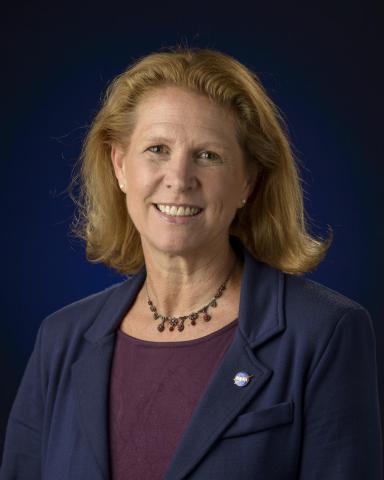
“Because my work — applying atmospheric diffusion models to the spread of explosive volcanic eruption clouds — crossed over between physics and geology, I had some wonderful professors in both departments,” Glaze said. “Steve was actually the one who got me interested in volcanology as an undergraduate. I really enjoyed working closely with the geologists and learning about physical geologic processes.”
“Lori and I have remained close colleagues and firm friends for 36 years,” said Self, who has done field work with Glaze in places like the Atacama Desert in Chile and the deserts of New Mexico. “I always want my students to be happy and productive, but Lori has exceeded the upward trajectory of most by attaining high-ranking leadership at NASA. It makes me proud that I introduced her to volcanology and that this led to her career in Earth and planetary volcanology and then other space missions. She is a remarkable woman and scientist. Very obviously, she is a great manager and a champion for women in science.”
During her master’s studies, she also had the opportunity to work with Peter Francis, a British volcanologist who studied active volcanoes on Earth as well as other planets in the solar system. Much of his research utilized remote sensing, or scanning of the Earth by satellite to obtain data.
“In the mid-1980s, the idea of using satellite data to study volcanic eruptions was still relatively novel,” Glaze said. “I learned a great deal about remote sensing from Peter. He was very interested in planetary science and was probably my first real introduction to that.”
Glaze’s research used images from weather satellites to study the transport of ash clouds from several eruptions, including Mount St. Helens. She received her M.S. in Physics from UTA in 1989 and got the opportunity to go to NASA’s Jet Propulsion Laboratory (JPL) in California to work on a mission concept for an Earth-based remote sensing volcano orbiter.
At JPL, she also worked on several planetary volcanic modeling studies, and she was introduced to Lionel Wilson, a world-renowned planetary scientist. After a year at JPL, she decided to do a Ph.D. at Lancaster University in the United Kingdom, with Wilson as her advisor. She earned a Ph.D. in Environmental Science, focusing on volcanic eruption plume dynamics, in 1994.
“By the time I completed my Ph.D., I was hooked on planetary volcanology,” Glaze said. “I still do some terrestrial work, but planetary science is incredibly exciting with new missions and data where we’re learning new things all the time.”
After earning her Ph.D., Glaze worked for 11 years at a private science research company where she served as senior research scientist and vice president before joining Goddard Space Flight Center in 2007. She served for four years as deputy director of the Solar System Exploration Division, and then one year as chief of the Planetary, Geology, Geophysics, and Geochemistry Laboratory.
“I was always interested in space but never really considered planetary science as a career until I was in my early 20s,” she said. “I have been very fortunate to spend my entire career working in space science.”
Balancing career and family
In addition to her career, Glaze and her husband raised two daughters, both of whom were involved in ballet and theater while growing up. Glaze says her mother, who died in 1999 of lymphoma, set a great example of how to balance family with a career.
“My mother was an incredible inspiration for me. She was an aeronautical engineer in the early 1960s when women were extremely rare in that field,” Glaze said. “She raced sailboats and motorcycles, and she loved to spend time with my brother and me. She was an amazing role model as a woman, a professional, and a mom. I have always aspired to carry on in her footsteps. I miss her greatly.
“With my daughters I was a Girl Scout leader, and I made ballet costumes for their performances and worked backstage for every show. I take my mom job as seriously as my professional career.”
Her husband Terry left Pantera in 1986; he went on to join the rock band Lord Tracy as lead singer and has been a professional musician for four decades. The Glazes still have family and friends in the Dallas-Fort Worth Metroplex, but her visit in April will be Glaze’s first to the area since the COVID-19 pandemic started.
“I have driven through the UTA campus and have marveled at how much it has changed since I was there; it’s been a long time since 1988!” she said. “I am really looking forward to seeing the campus and meeting with today’s students.”
Glaze remains excited about what the future holds for space exploration, including eventually sending crewed missions to Mars.
“Putting humans on Mars is very much a goal of NASA’s Moon to Mars initiative,” she said. “In planetary science, we are collecting data and conducting experiments today that are helping us prepare to send humans in the not-too-distant future!”
A line from an essay she wrote last year for the Lunar and Planetary Institute summarizes Glaze’s outlook and motivation for being involved in planetary science.
“As researchers, we are all driven by our individual curiosities and goals, but when I step back and remember why I originally became a planetary scientist, it wasn’t about a specific question or a specific place; it was about looking up at the sky, wondering what is out there, and how human ingenuity can take us there.”
--
The UTA College of Science, a Texas Tier One and Carnegie R1 research institution, is preparing the next generation of leaders in science through innovative education and hands-on research and offers programs in Biology, Chemistry & Biochemistry, Data Science, Earth & Environmental Sciences, Health Professions, Mathematics, Physics and Psychology. To support educational and research efforts visit the giving page, or if you're a prospective student interested in beginning your #MaverickScience journey visit our future students page.