Life Sciences Building, Room 206
501 S. Nedderman Drive
Box 19047
Arlington, TX 76019
Ravenscraft receives NSF CAREER grant to study how insects counter defense toxins in plants
The project will focus on how bacteria in insects' guts break down the natural toxins produced by plants, enabling insects to eat them.
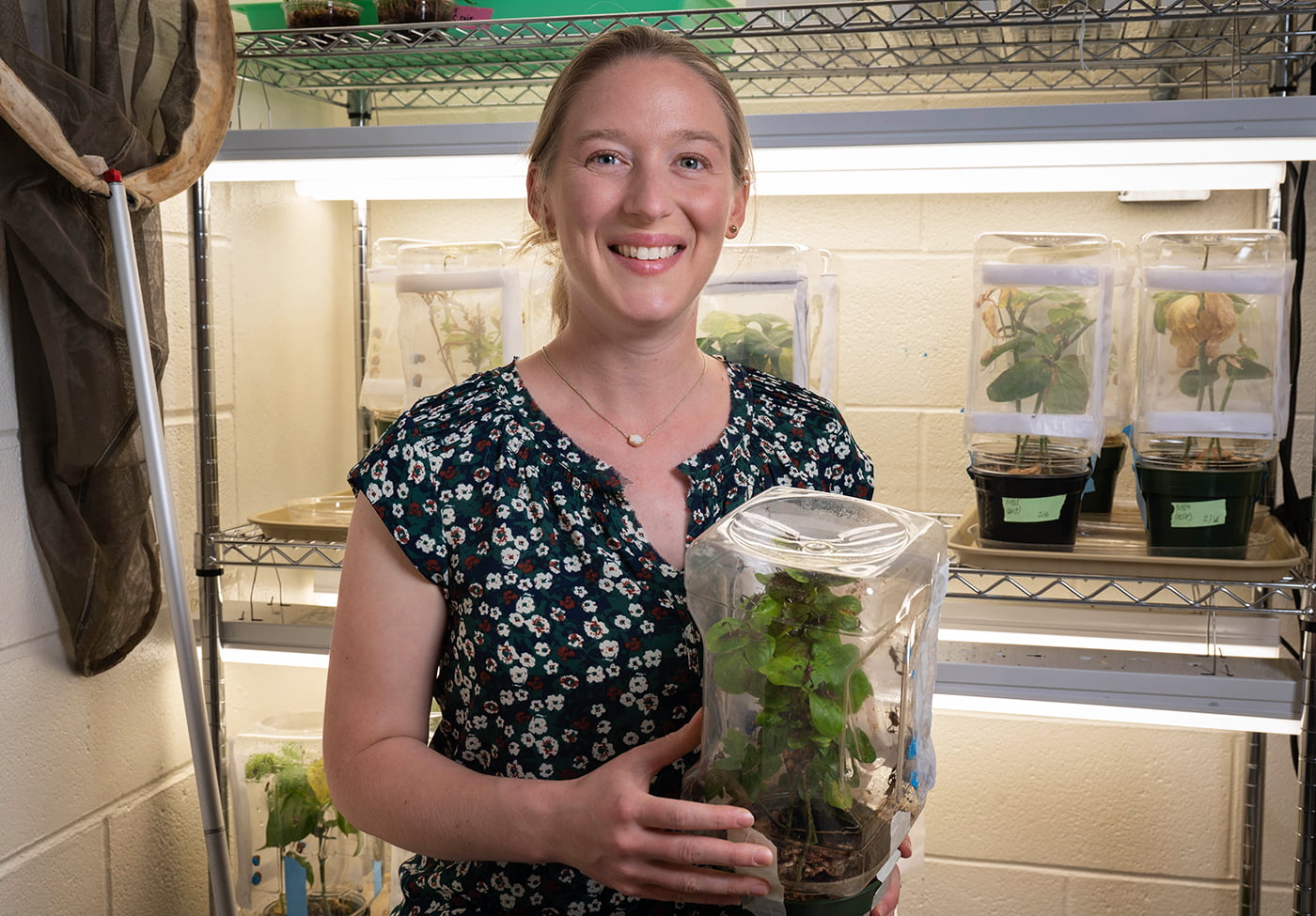
A biologist at The University of Texas at Arlington has received a prestigious national award for her research to learn more about how bacteria in the guts of insects break down natural defense toxins produced by plants, thus enabling insects to consume the plants.
Insect consumption of plants results in large loss of food crops and the need for application of costly pesticide treatments. Plants defend themselves by producing natural chemicals which are toxic to insects, but insects can overcome these natural defenses. One way they do this is through stomach bacteria, which can break down the plant toxins. When and how this happens is poorly understood, however.
Alison Ravenscraft, UTA assistant professor of biology, is the recipient of a five-year, $894,597 grant from the National Science Foundation (NSF) through its Faculty Early Career Development (CAREER) Program. Her project, titled “CAREER: Prevalence, magnitude, and importance of gut microbial detoxification services in insect herbivory,” will help provide answers to how much help insects receive in detoxification from their gut microbiota. Doctoral and undergraduate students in her lab will assist in conducting the research.
“I'm so excited to finally have the chance to do this research,” Ravenscraft said. “I first learned about symbiont-mediated detoxification over six years ago and I've been wanting to study its effects on insect herbivory since then. I'm also really excited to bring more hands-on research opportunities to undergraduates at UTA.”
Rachel Vargas, a first-year doctoral candidate in Ravenscraft’s lab and member of UTA’s Maverick Bridge Doctoral Fellowship program, is among the students who will work on the project.
The Food and Agriculture Organization of the United Nations estimates that pests destroy up to 40 percent of global crop production annually, and invasive insects cost the global economy at least $70 billion a year.
“The goal of this research is to identify which bacteria break down plant toxins and measure how much these bacteria help insects eat plants,” Ravenscraft said. “Understanding the different ways insects disable plant toxins will help us design more effective, targeted insect control strategies. Ultimately this could reduce crop losses and lessen the need for broad-spectrum pesticides.”
The project’s main goals include: (1) isolating bacteria from herbivorous insects’ guts and identifying what plant toxins these bacteria can degrade using culture-based assays; (2) measuring the ability of these bacteria to detoxify plant chemicals when inside the insect; and (3) quantifying the impact of gut microbial detoxification on insect fitness and plant consumption. The study will utilize beetles, grasshoppers and caterpillars feeding on plants with different defense chemistries.
To meet the first goal, students in Ravenscraft’s lab will catch insects in the wild, dissect out their guts in the lab, plate them on petri dishes to isolate live bacteria, culture the bacteria in liquid mixtures containing one of several plant toxins, and measure how much, if any, of the toxin the bacteria degrades using various chemical techniques.
“We will also characterize the insects’ gut microbial communities using high-throughput DNA sequencing (Illumina amplicon sequencing), which will give a more unbiased and complete picture of which microbes were present in the guts since it does not depend on culturing live microbes,” Ravenscraft said.
For the second goal, the researchers will inoculate insects with toxin-degrading or non-degrading isolates, allow the insects to feed on plants, and measure concentrations of toxins excreted in insect frass, or droppings, to determine how much microbial degradation occurred.
“Our lab members will raise insects in the lab,” Ravenscraft said. “They’ll inoculate the insects with gut bacteria that can or can’t degrade a plant toxin, feed the insects a diet containing the toxin, and measure how much toxin remains in the insects’ poop after the leaf material has been digested.”
For the third project goal, generalist and specialist insects will be reared on their host plants, and inoculated with an isolate that does or does not degrade one of the plant’s major toxins.
“We will compare the insects’ growth rate, development time to adulthood, survival, and total leaf area consumed,” Ravenscraft said.
College of Science Dean Morteza Khaledi noted the highly competitive nature of the NSF CAREER awards and hailed Ravenscraft’s award as further evidence of the high caliber of research being done in the College.
“I want to congratulate Dr. Ravenscraft on this tremendous honor,” Khaledi said. “Her study could provide important new evidence of how insects are able to neutralize plant toxins, which could have major implications for agriculture regarding the number of crops lost to insects and the kinds of pesticides used to protect crops.”
The CAREER award is heavily focused on undergraduate STEM teaching and will enable Ravenscraft to develop related hands-on lab activities for her current class, Microbial and Evolution, which a total of up to 120 students will take over the five-year duration of the grant. She will also develop a course-based summer research experience in which up to six students per year (30 total) will assist with insect rearing and data collection.
In addition, the award will enable Ravenscraft to recruit about two students per summer starting in the second year of the project to design and conduct independent research projects related to the goals of the grant. These students will be encouraged to take an independent study with Ravenscraft in the ensuing fall semester and write up their results for publication.
CAREER awards are the NSF's most prestigious awards in support of early-career faculty who have the potential to serve as academic role models in research and education and to lead advances in the mission of their department or organization, according to the NSF website.
Ravenscraft earned her Ph.D. in Ecology and Evolution from Stanford University in 2016. She was a National Institutes of Health postdoctoral research and teaching fellow at the University of Arizona from 2016-19 and came to UTA in Fall 2019.
--
The UTA College of Science, a Texas Tier One and Carnegie R1 research institution, is preparing the next generation of leaders in science through innovative education and hands-on research and offers programs in Biology, Chemistry & Biochemistry, Data Science, Earth & Environmental Sciences, Health Professions, Mathematics, Physics and Psychology. To support educational and research efforts visit the giving page, or if you're a prospective student interested in beginning your #MaverickScience journey visit our future students page.