Life Sciences Building, Room 206
501 S. Nedderman Drive
Box 19047
Arlington, TX 76019
Trio of UTA chemists recognized for excellence and impact
Armstrong, Dasgupta, and Schug named to magazine's 2023 list of top 100 analytical scientists in the world
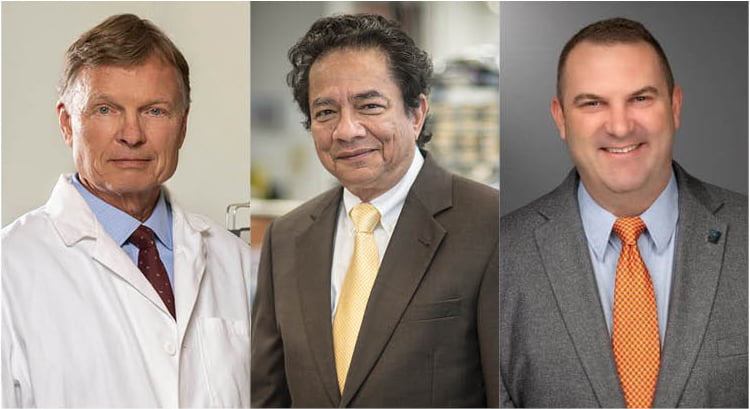
Three chemists from The University of Texas at Arlington are among the most influential analytical scientists in the world as selected by a top publication.
The Analytical Scientist magazine recently celebrated the 10th anniversary of its Power List, which this year includes the leading 100 analytical scientists from around the globe. UTA honorees are:
-
Daniel Armstrong, the R.A. Welch Distinguished Professor in Chemistry;
-
Purnendu “Sandy” Dasgupta, the Hamish Small Chair in Ion Analysis;
-
Kevin Schug, the Shimadzu Distinguished Professor of Analytical Chemistry
To celebrate the 10th anniversary of the Power List, this year’s edition recognizes those scientists whose excellence and impact have stood out over the past decade across four areas: Inventors and Trailblazers, Mentors and Educators, Leaders and Advocates, and Connectors and Interdisciplinarians.
Armstrong (No. 10) and Schug were named to the Connectors and Interdisciplinarians category, while Dasgupta was included in the Innovators and Trailblazers category.
“This is a tremendous honor for Drs. Dasgupta, Armstrong, and Schug. They are very worthy of being included in this prestigious company,” College of Science Dean Morteza Khaledi said. “Their commitment to making a difference through their groundbreaking research is inspirational.”
Armstrong has more than 35 years of experience in the field of chiral recognition, enantiomeric separations, and their biological relevance. He has authored or co-authored over 740 publications, including 38 book chapters, and has 35 patents. He is considered the “father” of micelle and cyclodextrin based separations, and his work and columns were in part responsible for the chromatography and electrophoresis-lead revolution in chiral separations over the last three decades. His chiral HPLC work provided much of the impetus for the FDA to pass new drug development guidelines, which changed the pharmaceutical industry worldwide.
“Having three scientists not only from the same university but also the same department is quite extraordinary and something that is rare,” Armstrong said. “It gives UTA a lot of visibility and enhances graduate student recruiting in this area.”
Dasgupta has made significant contributions to many areas, most importantly to ion chromatography, as well as to arsenic detection, perchlorate detection, and dried blood spot analysis. His recent research projects include developing instrumentation for extraterrestrial exploration. He created an instrument platform called open-tubular chromatography to detect and separate ions. As it travels through space, this device can collect drops of liquid and analyze their content for conditions that support life. He has authored or co-authored more than 450 publications and holds more than 40 patents, the majority of which have been licensed.
“While I personally do not believe in a caste system in any discipline, much less my own, my being included among an elite group of people never fails to please one very important group of people. Those are my students, both present and past, and they are really the people who deserve the credit for others to think that we are doing something worthwhile,” Dasgupta said. “So, kudos to them!”
Schug is director of the Collaborative Laboratories for Environmental Analysis and Remediation (CLEAR) at UTA. His research focuses on the theory and application of separation science and mass spectrometry for solving a variety of analytical and physical chemistry problems, in the fields of environmental, pharmaceutical, biological, and energy research. He has authored or co-authored more than 200 peer-reviewed publications. This year he was named a U.S. Fulbright Scholar and next spring he will be conducting research abroad at Palacky University in Olomouc, Czech Republic.
“It is an honor to be recognized together with my esteemed colleagues,” Schug said. “If you want exceptional training as an analytical chemist, there are few places better than UT Arlington.”
The trio has been named to multiple iterations of the Power List in its 10-year history. All three were selected to the 2021 Power List, as well as the 2019 Top 100 Power List, with Armstrong ranking No. 8. The 2017 list, which included the top 10 scientists in 10 different categories, featured Armstrong and Dasgupta.
Armstrong ranked No. 16 on the magazine’s inaugural Power List of the top 100 most influential people in analytical sciences in 2013, and he was No. 8 on the 2015 list. Dasgupta was named to the 2015 field, while Schug was selected for the Top 40 Under 40 list of young analytical scientists in 2014.
Muhammad Farooq Wahab, a UTA research engineering scientist in chemistry and biochemistry, was named to the 2018 Top 40 Under 40 Power List.
To identify the top scientists in the field for the 2023 list, The Analytical Scientist held open nominations and a panel of expert, independent judges narrowed down the candidates to the final 100.
--
The UTA College of Science, a Texas Tier One and Carnegie R1 research institution, is preparing the next generation of leaders in science through innovative education and hands-on research and offers programs in Biology, Chemistry & Biochemistry, Data Science, Earth & Environmental Sciences, Health Professions, Mathematics, Physics and Psychology. To support educational and research efforts visit the giving page, or if you're a prospective student interested in beginning your #MaverickScience journey visit our future students page.