Life Sciences Building, Room 206
501 S. Nedderman Drive
Box 19047
Arlington, TX 76019
Rare ‘ring of fire’ eclipse will be visible in Arlington on Oct. 14
UTA to host a ‘Sun Block Party’ in the Planetarium Mall area to view eclipse
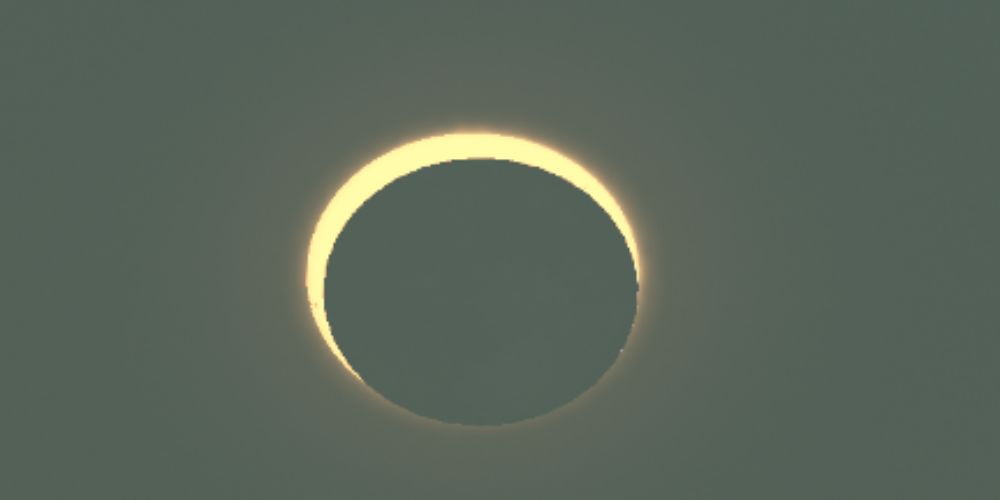
The University of Texas at Arlington Planetarium will play host to a Sun Block Party on Saturday, Oct. 14 to view a “ring of fire” solar eclipse that will be visible throughout Texas.
For those on the annularity path, the moon will appear to briefly cross in front of the sun to block out about 90% of the sunlight. The north part of Texas is not directly in the annularity path, so residents will see this as a partial solar eclipse.
Around UTA and the Arlington area, the eclipse will begin at 10:23 a.m. and last until just after 1:30 p.m., said Levent Gurdemir, UTA Planetarium director. The moon will appear to block out the largest area of the sun at 11:54 a.m., he added.
The annularity—when only the edges of the sun are visible around the moon, creating a “ring of fire” appearance—will start around 11:41 a.m. and will be visible in the Midland-Odessa and San Antonio areas for between four and five minutes. In Texas, the best viewing will be in Corpus Christi, which will see the annularity for an estimated five minutes and two seconds.
Gurdemir said viewers should take extreme precautions when viewing the eclipse to avoid eye damage.
“Everyone must look through safe, high-quality solar viewing glasses with high-quality solar filters,” he said. “Looking at the sun directly, even during the maximum eclipse, is extremely dangerous and may result in permanent eye damage. Sunglasses, fogged glass and tinted windows are not safe ways to watch eclipses. Never use a telescope, binocular, camera lens or similar optical device to look at the sun.
“Permanent eye damage will be immediate and irreversible. The eye retina doesn’t have pain receptors, and therefore one wouldn’t feel it when the extreme light from the sun is burning the retina.”
This will be the last "ring of fire" eclipse visible in Texas until 2046. The event is a warm-up act to the main event: a total eclipse that will occur on April 8, 2024, with prime viewing in Arlington and the DFW area.
“For that eclipse, Arlington and the rest of the Metroplex will be in the path of the totality for maximum viewing,” Gurdemir said.

The UTA Planetarium will also run shows all afternoon on Oct. 14, including The Sun, Our Living Star at 2 p.m. and Magnificent Sun at 6 p.m. All outdoor events are free and open to the public. Planetarium shows will be regularly priced.
More information can be obtained at the UTA Planetarium’s eclipse website, https://www.uta.edu/planetarium/eclipse.
--
The UTA College of Science, a Carnegie R1 research institution, is preparing the next generation of leaders in science through innovative education and hands-on research and offers programs in Biology, Chemistry & Biochemistry, Data Science, Earth & Environmental Sciences, Health Professions, Mathematics, Physics and Psychology. To support educational and research efforts visit the giving page, or if you're a prospective student interested in beginning your #MaverickScience journey visit our future students page.