Life Sciences Building, Room 206
501 S. Nedderman Drive
Box 19047
Arlington, TX 76019
Geology major excelling in the field and in the lab
Rios following her passions as a double major in EES and Spanish translation and interpretation
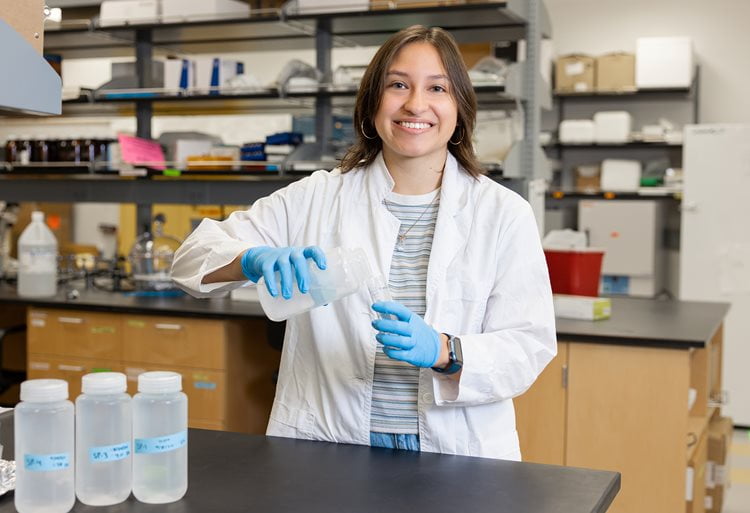
Isabella Rios will graduate in May and plans to continue her studies in Earth and environmental sciences in graduate school.
She came to The University of Texas at Arlington intending to major in the subject, but when she took an introductory course in geology her freshman year, she was intrigued by its hands-on nature.
“I really enjoyed the field aspect of geology and ultimately decided to study geology with a concentration in environmental science,” she said.
Following her freshman year, she participated in a summer study abroad program in Salamanca, Spain, which further solidified a love she already had for languages. She found that the extra credits she earned made it possible for her to add a second degree in the Department of Modern Languages.
“I selected Spanish translation and interpretation because it seemed like a great chance to give back to my community and honor my grandmother,” she said. “Both degrees have been uniquely fulfilling, while unexpectedly showing me there’s a lot more similarities between the disciplines than I imagined.”
The Honors College senior, who will graduate in May, has also been immersed in research since her sophomore year. As part of an honors assignment, she observed the environmental chemistry research being done in the lab of Un-Jung Kim, assistant professor of Earth and environmental sciences. Kim said that Rios immediately distinguished herself through her motivation and intellectual curiosity.
“From the outset, Isabella consistently went above and beyond academic requirements, embracing new laboratory techniques and instrumentation while engaging deeply with the scientific theories underpinning our ongoing research about microplastics and emerging contaminants,” said Kim, who encouraged Rios to join the lab as an undergraduate researcher.
Rios did so and her contributions have been invaluable to the collective progress and joyful work culture in the lab, Kim said.
“We work on quantifying contaminants such as polycyclic aromatic hydrocarbons (PAHs), polyfluoroalkyl substances (PFAs), polychlorinated biphenyls (PCBs), and microplastics in the air, water, soil, and biological specimens,” Rios said. “I’m currently working on my honors thesis, investigating the occurrence of disinfection byproducts in local children’s splash parks.”
Kim said Rios’ positive attitude and a willingness to lead or assist whenever additional effort is needed make her an exceptionally reliable and inspiring junior team member.
“Her remarkable efforts have led her to present co-authored research posters at academic conferences, secure several prestigious scholarships, and thrive in competitive off-campus summer research programs,” Kim said. “Looking ahead, I am truly excited to witness Isabella’s continued growth and success, confident that her passion and drive will lead to outstanding accomplishments in her future career.”
Following her sophomore year, Rios participated in UTA’s summer I-Engage Mentoring Program, where she worked under Majie Fan, professor of Earth and environmental sciences. Rios studied the depositional environment of the North American loess structure utilizing quartz morphology. Loess is a loose accumulation of windblown silt that forms vertical hills and cliffs.
Rios has also participated in UTA’s McNair Scholars program and National Science and Technology Medals Foundation inSTEM program, and this past summer she took part in the Summer Multicultural Access to Research and Training (SMART) program at the University of Colorado at Boulder. She worked with Thomas Marchitto, professor of geological sciences and associate director of CU’s Institute of Arctic and Alpine Research, to improve a paleoclimate proxy utilizing aragonite precipitation rates. She won the Best Visual Poster Presentation for her work at the SMART symposium.
“I have had the privilege of working with incredibly kind and talented graduate students and faculty, helping me make the most of my research experiences,” she said.
Rios grew up in Mansfield and graduated from Lake Ridge High School. She has a twin sister, Carina—a criminology and criminal justice major—and the sisters decided to come to UTA so they could live at home and cut down on living expenses. Isabella has worked as a mentor in the Peer Lead Team Learning (PLTL) program, in which small groups of students work together to practice problem sets developed by UTA faculty in difficult courses.
“Hands down, my favorite thing about UTA is the people,” she said. “I have learned so much from my peers and owe a lot of my growth and success to them. My coworkers in PLTL taught me leadership and patience. My lab mates have taught me countless technical skills, resilience, and dedication. The EES Department has shown me how to build a community amongst both peers and faculty. The Department of Modern Languages has given me global perspective and the value of community service.
“UTA has taught me the meaning of ‘it takes a village,’ and every friendship I’ve made has aided in my growth as person.”
Rios is applying to doctoral programs, including the Rhodes Scholarship and Marshall Scholarship, and wants to continue her research in Earth and environmental sciences with a focus on Hispanic communities.
“Ultimately, I want to manage my own research group as a professor or aid in policy development as a policy advisor or government scientist,” she said. “Personally, I hope to travel more, learn more languages, and keep meeting new people. That’s the dream for now but I’m excited to see where the wind takes me.”
--
The UTA College of Science, a Carnegie R1 research institution, is preparing the next generation of leaders in science through innovative education and hands-on research and offers programs in Biology, Chemistry & Biochemistry, Data Science, Earth & Environmental Sciences, Health Professions, Mathematics, Physics and Psychology. To support educational and research efforts visit the giving page, or if you're a prospective student interested in beginning your #MaverickScience journey visit our future students page.