Life Sciences Building, Room 206
501 S. Nedderman Drive
Box 19047
Arlington, TX 76019
Course offers biology students enhanced research experience
Scholar section provides hands-on research in cell and molecular biology
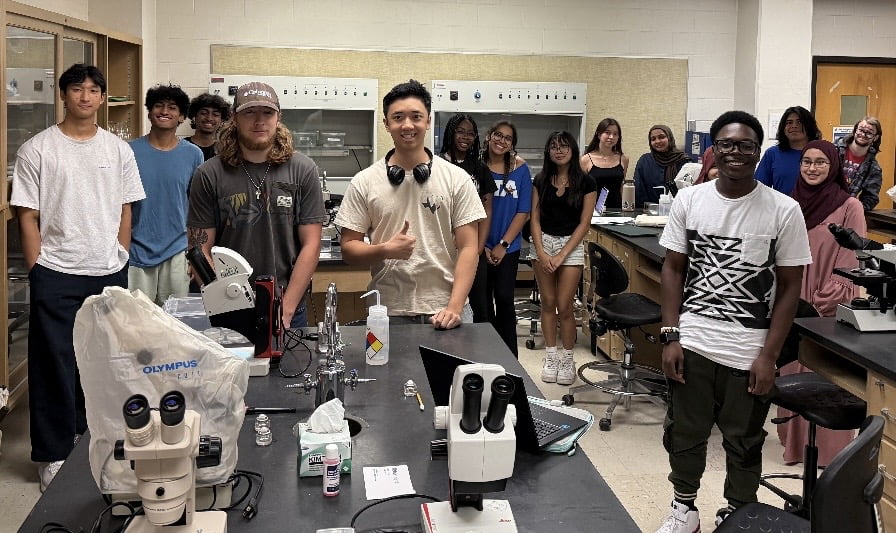 Students in the Biology Scholars Program section of BIOL 1441 are shown in the lab during the Fall 2025 semester.
A new initiative gave biology students at The University of Texas at Arlington the opportunity to take part in hands-on research in cell and molecular biology.
The Department of Biology offered the Biology Scholars Program for the first time in the Fall 2025 semester. It provided enhanced exposure to scientific research for 24 high-achieving students enrolled in a special section of BIOL 1441.
The BIOL 1441 course focuses on the chemical and molecular basis of life, including metabolism, cell structure and function, and genetics. The new scholar section was designed and taught by Ida Klang, assistant professor of instruction, and Mark Pellegrino, associate professor of biology. Klang taught the lab component and Pellegrino the lecture component of the course.
“The scholar section emphasizes applying fundamental concepts using Caenorhabditis elegans as a model organism, with a particular focus on cellular stress responses and underlying molecular pathways, such as the mitochondrial stress response,” Klang said.
Caenorhabditis elegans, or C. elegans, is a tiny roundworm which is commonly used in biological and genomic research due to its simplicity and the fact that it shares many of the essential biological characteristics that are central problems of human biology.
The scholar section students worked with C. elegans throughout the semester and conducted a series of experiments which examined how various stressors activate the mitochondrial stress response, Klang said. The course culminated in a student-led poster presentation in which students presented and interpreted their experimental findings.
“The skills learned in this special laboratory component will help prepare students for more advanced course practicals or to join a research group to conduct innovative science,” Pellegrino said.
“With this program, the goal was to create a more hands-on laboratory experience that builds practical skills and provides experiences that are directly transferable to careers in the biological sciences,” Klang said.
She noted that the experiments helped students gain experience with core molecular biology techniques, including restriction enzyme digestion, polymerase chain reaction (PCR), gel electrophoresis, and fluorescence microscopy.
“The course explores a mitochondrial stress response pathway that helps recover damaged mitochondria,” Pellegrino said. “This stress response pathway is relevant for many diseases, including neurodegenerative diseases and cancer. Students explored this pathway in the laboratory component of the course using various genetic approaches applied to the C. elegans model system. Their experiments assessed the relevance of this pathway in organismal fitness by measuring its impact on animal development during stress.”
Klang said that course evaluations provided by students at the end of the semester confirmed the value in the course’s emphasis on practical laboratory experiences.
“I appreciated the continuous stream of work done with C. elegans ... It gave me an opportunity to observe genetics across generations,” one student wrote. “I appreciated this lab for introducing genetics very early on.”
“Getting hands-on work with C. elegans to study different genes really helped me apply biological concepts outside of the textbook,” another student wrote. “Every lab I learned something new, but they were all connected to each other through C. elegans. Dr. Klang’s lesson plans and lab protocols were also very well-written and prepared, making it easier for us students to follow.”
Melissa Walsh, associate professor of instruction and Biology Department associate chair for academics, said the course’s added emphasis on intensive research will benefit students as they progress toward their biology degrees at UTA and in their future careers.
“We feel that the course was a resounding success, and we look forward to offering the scholars section again next fall,” she said
--
The UTA College of Science, a Carnegie R1 research institution, is preparing the next generation of leaders in science through innovative education and hands-on research and offers programs in Biology, Chemistry & Biochemistry, Data Science, Earth & Environmental Sciences, Health Professions, Mathematics, Physics and Psychology. To support educational and research efforts visit the giving page, or if you're a prospective student interested in beginning your #MaverickScience journey visit our future students page.