Life Sciences Building, Room 206
501 S. Nedderman Drive
Box 19047
Arlington, TX 76019
UTA launches Center for Space and Data Science
Center aims to enhance UTA's role as a leader in space research and education
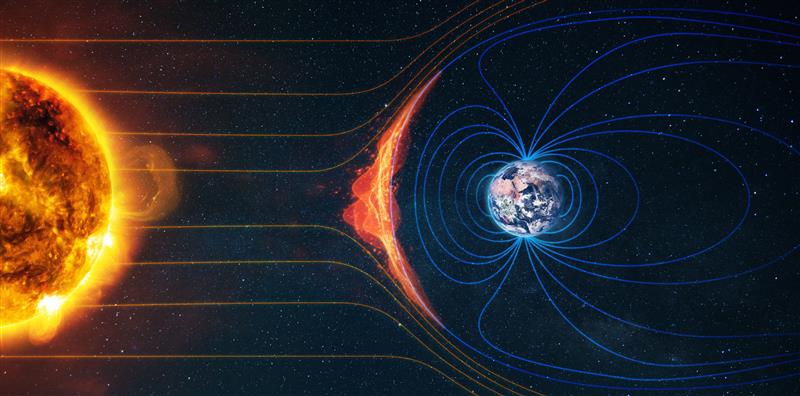
llustration showing the Sun, Earth and the heliosphere, the region of space surrounding the Sun which encompasses its solar wind and magnetic field. The heliosphere is an important area of space physics research.
For years, The University of Texas at Arlington has been a leader in space physics education and research, and now it is poised to make an even greater impact with the launch of the Center for Space and Data Science.
The Center, which was created with the help of $1.5 million in funding from the National Science Foundation (NSF) Faculty Development in GeoSpace Science (FDSS) project in 2024, aims to further establish UTA as a leader in the field. Other aspects of its core mission are to enhance training of the space workforce through the creation of new B.S. and M.S. degrees in space physics and data science, and to leverage research efforts supported by NSF, NASA and Air Force projects.
Yue Deng, UTA professor of physics, is director of the Center, while Ramon Lopez, UTA professor of physics, is associate director for education, and Anton Artemyev, UTA associate professor of physics, is associate director for research.
“We are very excited to launch the Center for Space and Data Science, which will strengthen UTA’s already thriving space physics program,” said Morteza Khaledi, dean of the College of Science. “We have an excellent team in place to lead the Center and a plan to provide a comprehensive, multidisciplinary education that students will need in order to succeed in the space workforce. I believe this will position UTA to make a major impact on the space industry here in Texas and beyond.”
Deng is principal investigator for the NSF grant which was used to create the Center, with Lopez and Alex Weiss, professor of physics, as co-PIs.
“We have a strong foundation for space physics research at UTA but with the creation of the Center for Space and Data Science, our goal is to elevate UTA into the top five universities in the United States in space physics and strengthen UTA’s role as a leader in the space community,” Deng said.
Core team members of the Center include UTA Department of Physics faculty Yujie Chi, Mingwu Jin, Amir Shahmoradi, Cheng Sheng, Nila Veerabathina, Zihan Wang, and Zhonghua Xu; Levent Gurdemir, UTA Planetarium director; and Hongru Chen and Liwei Zhang of the UTA Department of Aerospace Engineering.
Affiliate members include Weidong Zhou, UTA professor of electrical engineering; Qingyu Zhu, assistant professor of physics at UT Dallas; and Jorg-Micha Jahn, research scientist at Southwest Research Institute in San Antonio.
The Center will develop students’ expertise in six areas: space simulation, space instrumentation, astrophysics, data science, aerospace engineering, and physics education. The curriculum will prepare students for careers in the space industry, which is well-represented by companies in Texas and the Dallas-Fort Worth area.
New degree plans include a bachelor’s degree and a fast-track master’s degree.
“These new degree programs will include courses which are critical for the space industry workforce: engineering courses focusing on building spacecraft and launch systems; space physics courses which explain the space environment and its impact on missions; and cross-disciplinary courses which ensure adaptability in computing, data, and policy,” Lopez said.
The Center is well-positioned for sustained growth, Deng said. UTA members of the Center receive close to $3 million per year in funding from NASA, National Science Foundation (NSF) and other funding agencies. The Center received a grant from the NASA Heliophysics Science Center program, which will be supported going forward. In addition, the state launched a new agency, the Texas Space Commission, in 2024 to drive Texas’ leadership in the space and aerospace sectors, with $150 million in initial funding and an additional $300 million approved in June 2025.
Deng came to UTA in 2009 and has been a leader in space physics research for more than a decade. She has secured millions of dollars in external funding for her research, which include National Science Foundation (NSF) CAREER award and a project to study the impact of space weather on Earth, particularly the impact of solar-induced phenomena on electrical power grids, funded by NASA through its Heliophysics Living with a Star program. She is one of three Interdisciplinary Scientists (IDS) for the NASA Geospace Dynamics Constellation (GDC) satellite mission.
She also led the Multidisciplinary University Research Initiative (MURI) project to develop next generation simulation capability in ionosphere-thermosphere coupling at multiple scales for environmental specification and prediction. The project included seven universities with UTA as the lead institution and was funded by a $7.3 million grant from the U.S. Department of Defense and a $1.5 million supplemental grant. She was awarded the American Geophysics Union (AGU) Joanne Simpson Medal for Mid-Career Scientists and became an AGU fellow in 2022.
Lopez came to UTA in 2007 and has been a longtime leader in space physics research and science education. His projects have been funded by millions of dollars in federal grants from NSF, NASA, the Department of Education, and other sources. His research has included projects examining the magnetosphere, solar wind and other space weather phenomena.
He has also been heavily involved in work to improve science education standards and provide better training for STEM teachers, as well as preparing teachers and students for quantum information science. He is co-director of the highly successful UTeach Arlington program, in which students can earn bachelor’s degrees as well as secondary teacher certification in science and mathematics and which has produced more than 360 graduates in its 15-year history.
--
The UTA College of Science, a Carnegie R1 research institution, is preparing the next generation of leaders in science through innovative education and hands-on research and offers programs in Biology, Chemistry & Biochemistry, Data Science, Earth & Environmental Sciences, Health Professions, Mathematics, Physics and Psychology. To support educational and research efforts visit the giving page, or if you're a prospective student interested in beginning your #MaverickScience journey visit our future students page.