Life Sciences Building, Room 206
501 S. Nedderman Drive
Box 19047
Arlington, TX 76019
Mathematics Department Aims to Improve Student Success in Gateway Courses
Courseware program provides supplemental materials to students in Calculus I classes
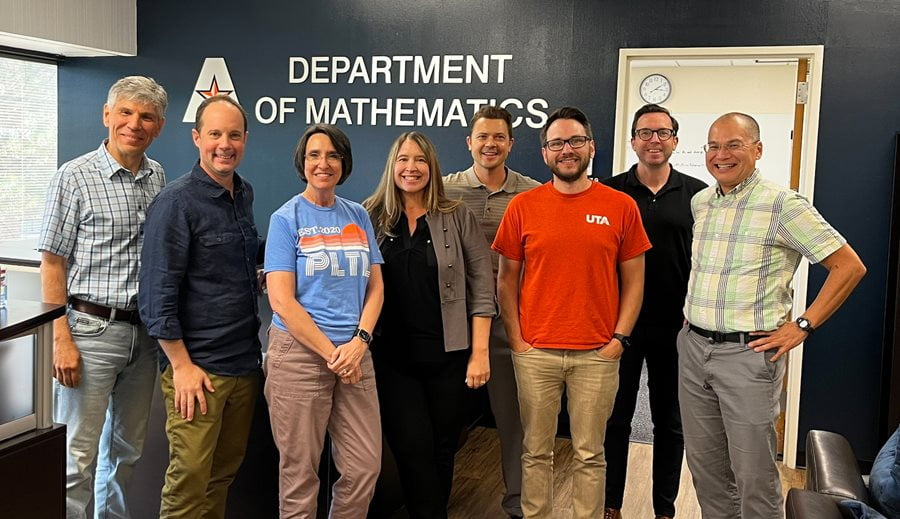
Members of the Courseware Lighthouse BEACON at UTA are, from left: Hristo Kojouharov, UTA professor and chair of mathematics; Jamison Miller, Digital Learning Implementation project manager, Every Learner Everywhere; Laura Holm, UTA coordinator of special programs; Katie Easley, assistant vice president, Gardner Institute; Mark Krasij, UTA distinguished senior lecturer and Calculus I coordinator; Jeremy Glass, UTA distinguished senior lecturer; Lewis Hosie, research manager, WestEd; Dave Kung, executive director, TPSE Math.
A new initiative at The University of Texas at Arlington has the potential to change the way gateway mathematics courses are designed and taught, with the goal of improving students’ success and strengthening their STEM foundations.
The Courseware Lighthouse BEACON Implementation Program, led by the Every Learner Everywhere network, is providing funding to UTA and 11 other participating institutions. UTA received a $110,000 grant which will support the implementation of Learnvia, a courseware platform that combines interactive lessons, homework, quizzes, discussion forums and a built-in AI tutor in one digital environment. The courseware lessons are intended to be completed prior to class to better prepare students for in-class discussions.
Gateway mathematics courses, such as calculus, are among the most important courses in higher education, serving as foundational experiences that shape students’ academic trajectories and open doors to careers in STEM, business, and other fields. College calculus courses traditionally have been a stumbling block for many students, including many who are interested in STEM.
The goal of the Courseware Lighthouse program is to change that reality by improving student success and helping university mathematics departments fundamentally rethink how gateway math courses, specifically Calculus I and II, are designed, delivered, and continuously improved.
“This initiative focuses on strengthening Calculus I and II, which serve as critical gateway courses for students pursuing STEM and related fields,” said Hristo Kojouharov, professor and chair of the Department of Mathematics and principal investigator for the grant. “UTA is beginning implementation with selected sections of Calculus I in Fall 2026, including both online and face-to-face offerings, with possible expansion in Calculus II classes in Spring 2027 based on the results.”
The program is designed as a sustained, department-level improvement effort rather than a one-time technology pilot, Kojouharov said. It uses the “BEACON” framework, a six-phase model that guides departments through the full arc of implementation: Build the team & governance; Establish outcomes & design considerations; Analyze baseline & course fit; Co-design the teaching & learning experience; Operate at scale; and Normalize continuous improvement.
In addition to Kojouharov, UTA faculty involved in the program include:
- Mark Krasij, distinguished senior lecturer — He is responsible for aligning existing course content with Learnvia, evaluating opportunities to incorporate active-learning strategies into the face-to-face course design, and teaching the participating in-person Calculus I sections.
- Jeremy Glass, distinguished senior lecturer — He is teaching the participating online Calculus I section. He also provides departmental leadership for the initiative and helps coordinate its implementation.
- Laura Holm, Learning Resource Center coordinator — She is supporting the initiative’s operational and instructional technology needs, including Canvas integration, accessibility compliance, and overall implementation support.
“The goal is to help more students pass Calculus I and continue along their intended degree paths without disruption,” Krasij said.
The program is supported by a grant from the Gates Foundation to the Western Interstate Commission for Higher Education (WICHE), a nonprofit organization that works to expand educational access across the western United States. In addition to Every Learner Everywhere, the program partners with the John N. Gardner Institute for Excellence in Higher Education, Transforming Post-Secondary Education in Mathematics (TPSE Math), and WestEd, which contribute expertise in faculty engagement, research, evaluation, and implementation.
---
The UTA College of Science, a Carnegie R1 research institution, is preparing the next generation of leaders in science through innovative education and hands-on research and offers programs in Biology, Chemistry & Biochemistry, Data Science, Earth & Environmental Sciences, Health Professions, Mathematics, Physics and Psychology. To support educational and research efforts visit the giving page, or if you're a prospective student interested in beginning your #MaverickScience journey visit our future students page.