Life Sciences Building, Room 206
501 S. Nedderman Drive
Box 19047
Arlington, TX 76019
McFarland named new chair of Department of Chemistry & Biochemistry
Dias steps down after four-year tenure, returns to faculty position full-time
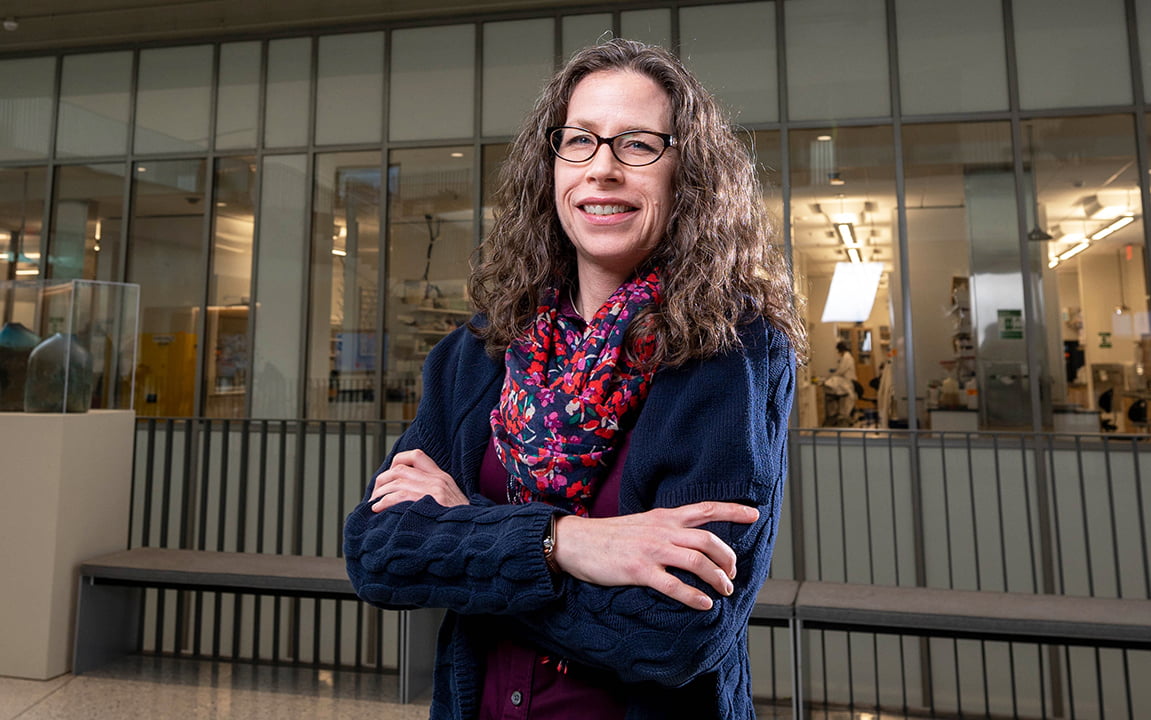
Sherri McFarland, professor and new chair of the UTA Department of Chemistry and Biochemistry.
Sherri McFarland, a UTA professor and acclaimed researcher in photodynamic therapy, has been named the new chair of the UTA Department of Chemistry and Biochemistry.
McFarland, who came to UTA in 2020, officially took on the new role September 1. She replaces Rasika Dias, professor of chemistry and biochemistry, who led the department for the past four years and previously served as chair from 2010-15. Dias is returning to the faculty where he will have more time to devote to his research.
“I’m genuinely honored to become chair and look forward to serving my department in the best way I can,” McFarland said. “I agreed to take on the role because I believe our department is at an important moment. We have real strengths to build on, and I want to help turn good ideas into meaningful progress.
“My first priority will be to listen carefully and to understand what is working, where people feel constrained, and what support would make the greatest difference.”
College of Science Dean Morteza Khaledi announced the appointment and expressed confidence that the department will continue on the upward trajectory that it has traveled under Dias and previous department chairs.
“I want to congratulate Professor McFarland and wish her all the best as she takes on this new leadership role,” Khaledi said. “I know she is looking forward to building on the department’s strengths in research and education while fostering collaboration, student success, faculty development, innovation, external partnerships, and continued growth.
“I also want to express my sincere thanks to Professor Rasika Dias for his leadership and dedicated service as chair over the past four years. His efforts have advanced the department in important ways across student success, faculty support, research, and graduate education, and the department is stronger because of his service.”
McFarland said she wants to build on the excellent foundation the past chairs and associate chairs of the department have built.
“In the near term, I hope to strengthen communication and set departmental priorities,” she said. “I want us to recruit and support excellent students and colleagues, expand opportunities for innovative teaching and research, and ensure that people in every role and at every stage can see a path to succeeding here.
“What excites me most is the opportunity to build on the department’s strengths and contribute to an environment in which people can do their best work. If, several years from now, our students continue to feel well supported, our faculty and staff feel valued for their contributions, and the department has grown even more connected and ambitious, I will consider that meaningful progress.”
McFarland’s research team specializes in photodynamic therapy, a cancer treatment that uses light to target and destroy tumor cells. Her lab develops and tests chemical compounds that, when exposed to light, become powerful anticancer and antimicrobial agents. The combination of transition metal compounds and light creates highly selective cancer- and infection-fighting agents that do not affect surrounding healthy tissue.
“Professor McFarland is an internationally recognized scholar in photochemistry, photobiology, and medicinal inorganic chemistry,” Khaledi said. “Her research on light-activated therapeutics for cancer and infection has advanced from fundamental discovery to translational research and clinical evaluation.”
She has secured sustained external funding, published extensively in leading journals, and has received numerous patents for her research in photomedicine. In 2012 she and UTA professor of research Colin Cameron co-founded a biotechnology start-up, PhotoDynamic, Inc. The company works to commercialize light-activated antimicrobial and therapeutic technologies and has developed consumer products designed for orthodontic and gingival care. They have also licensed their anticancer technology and are currently completing a human clinical trial for treating bladder cancer.
In 2022 McFarland received the College of Science Outstanding Achievement in Research Award. In 2024 she was elected to a two-year term as president of the American Society for Photobiology, a national organization dedicated to promoting research related to the effects of light on human health and the natural world. Also in 2024, she was named a senior member of the National Academy of Inventors for producing technologies that can have a real impact on the welfare of society.
McFarland earned a Ph.D. in Chemistry from the University of California, San Diego in 2003. She completed a postdoctoral fellowship at Dalhousie University in Nova Scotia, Canada from 2003-05, then joined Acadia University in Nova Scotia, where she established a multidisciplinary cancer research program in photomedicine.
Khaledi thanked members of the chair search committee — College of Science faculty members Kevin Schug, committee chair; Saiful Chowdhury; Clay Clark; Hristo Kojouharov; and Todd Castoe, COS liaison — for their thoughtful work throughout the process.
--
The UTA College of Science, a Carnegie R1 research institution, is preparing the next generation of leaders in science through innovative education and hands-on research and offers programs in Biology, Chemistry & Biochemistry, Data Science, Earth & Environmental Sciences, Health Professions, Mathematics, Physics and Psychology. To support educational and research efforts visit the giving page, or if you're a prospective student interested in beginning your #MaverickScience journey visit our future students page.