Life Sciences Building, Room 206
501 S. Nedderman Drive
Box 19047
Arlington, TX 76019
Kroll Receives Two Honors from the American Ceramics Society
Chemistry professor named to 2026 Class of Fellows, wins Global Star Award of the Engineering Ceramics Division.
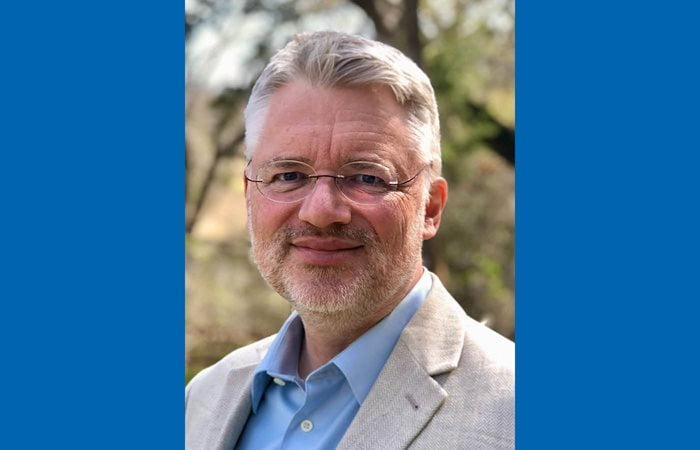
Peter Kroll, UTA professor of chemistry and biochemistry
Peter Kroll, professor of chemistry and biochemistry at The University of Texas at Arlington, recently received two distinctions from the American Ceramic Society (ACerS) for his contributions to the ceramic science community.
He received the 2026 Global Star Award of the Engineering Ceramics Division of ACerS at the International Conference and Expo on Advanced Ceramics and Composites (ICACC) in January in Daytona Beach, Fla. The Global Star Award recognizes active volunteers for their contributions to the Engineering Ceramics Division (ECD) and to the technical program of the ICACC meeting. The 2026 meeting marked the 50th anniversary of the ICACC.
On October 5 Kroll was named to the 2026 Class of Fellows, along with 12 other ACerS members worldwide, at the Society’s Annual Honor and Awards banquet, held in conjunction with the Materials Science and Technology Conference in Pittsburgh.
The Fellow designation recognizes members who represent the values of the Society and who have distinguished themselves through outstanding contributions to the ceramics community, through a combination of broad and productive scholarship in ceramic science and technology, conspicuous achievement in ceramic industry, and/or outstanding service to the Society.
“These are wonderful and well-deserved honors for Peter,” said Sherri McFarland, professor and chair of UTA’s Department of Chemistry and Biochemistry. “He is an accomplished scientist whose contributions extend well beyond his own research through his longstanding service to the ceramics community.
“Peter is someone who quietly goes about doing excellent work without seeking the spotlight, so it is particularly gratifying to see him receive this recognition from his peers. We are fortunate to have him as a colleague.”
Peter Kroll received his diploma in physics from the Ruprecht-Karls University in Heidelberg and earned his Ph.D. in materials science from the Technical University of Darmstadt. He conducted postdoctoral research at Cornell University, and completed his habilitation in inorganic chemistry at RWTH Aachen University. From 2005 to 2007 he was a Heisenberg Fellow of the German Science Foundation. He joined UTA in 2007 and received the College of Science Research Excellence Award in 2014.
His research interests include amorphous ceramics and glasses, and structure and function of polymer-derived ceramics. His work bridges chemistry, physics, and materials science, combining quantum-chemical calculations and molecular dynamics simulations to clarify polymer-to-ceramic conversion processes.
He pioneered high-pressure synthesis routes for nitride materials, contributing to the discovery of cubic silicon nitride and the development of carbon nitrides. He develops atomistic models of amorphous polymer-derived ceramics (PDCs), focusing on how free carbon forms and is incorporated at the atomic level.
Kroll has contributed to ACerS meetings since 1994 and been a continuous member of the Society since 2010. He has organized and co-organized more than 30 symposia focusing on PDCs, ultra-high-temperature ceramics, and computational modeling. He is a co-founder of the ACerS Technical Interest Group on polymer-derived ceramics.
The American Ceramic Society, founded in 1898, is the leading professional membership organization for ceramic and materials scientists, engineers, researchers, manufacturers, educators, and students.
---
The UTA College of Science, a Carnegie R1 research institution, is preparing the next generation of leaders in science through innovative education and hands-on research and offers programs in Biology, Chemistry & Biochemistry, Data Science, Earth & Environmental Sciences, Health Professions, Mathematics, Physics and Psychology. To support educational and research efforts visit the giving page, or if you're a prospective student interested in beginning your #MaverickScience journey visit our future students page.