Life Sciences Building, Room 206
501 S. Nedderman Drive
Box 19047
Arlington, TX 76019
Construction begins on Massive Underground Neutrino Detector in South Dakota
UTA physics faculty and students are playing key role in the DUNE project
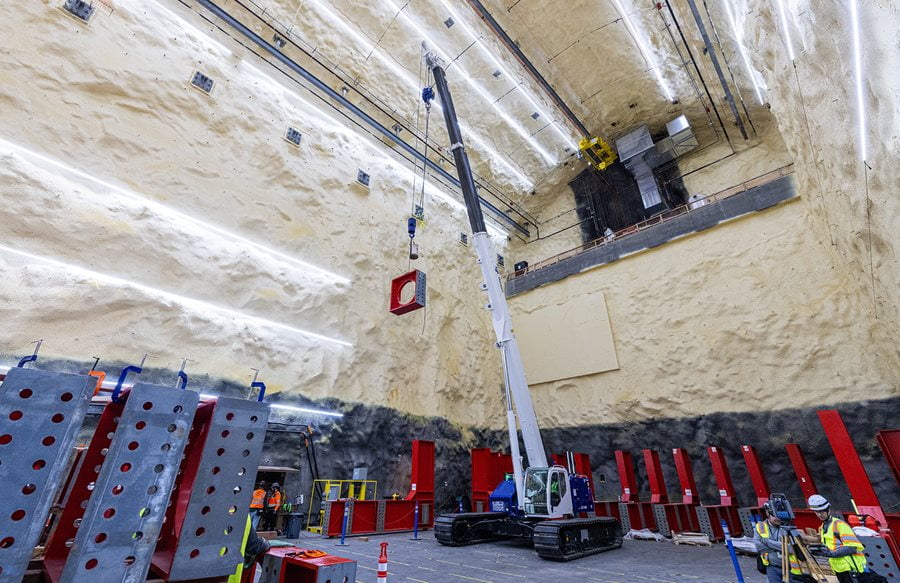
Construction of detector module cryostats is under way for the Deep Underground Neutrino Experiment (DUNE) located at Sanford Underground Research Facility (SURF) in Lead, South Dakota. Photo credit: Matthew Kapust, SURF
Particle physicists worldwide are celebrating this week as construction begins on the far particle detector at the Deep Underground Neutrino Experiment (DUNE) located at Sanford Underground Research Facility (SURF) in Lead, South Dakota.
Nearly a mile underground, crews are starting work on the creation of two massive cryostat modules which will each hold around 17,000 tons of liquid argon to keep the DUNE detector at its operating temperature of minus 300 degrees Fahrenheit.
Physicists at The University of Texas at Arlington, led by professors Jaehoon Yu, Jonathan Asaadi, and Raquel Castillo Fernández, have been involved in the DUNE project since its inception a decade ago and played a key role in the development and construction of the field cage and other detector components.
“It is good to see that the tremendous efforts through over a decade of detector R&D, prototyping, and their operations are finally paying off,” Yu said. “Many UTA undergraduate and graduate students have been deeply engaged every step of the way. This marks an important milestone for the project and the construction work.
“Our students will continue to play key roles. Many of them will be stationed at SURF to work underground to assemble the detector components and install them as part of the international team, working closely with world-class physicists and engineers. I am excited to see the light at the end of the tunnel.”
DUNE consists of two particle detectors — one at Fermi National Accelerator Laboratory (Fermilab) in Batavia, Illinois, and the other, much larger one now under construction at SURF. When construction is completed, neutrinos will be generated at Fermilab and launched by accelerator in extremely intense beams toward the detector in Lead, S.D., approximately 800 miles away. All of this will take place 5,000 feet underground.
The far detector at SURF will be the largest of its type ever built and will record neutrino interactions with unprecedented precision. Its design is based on liquid argon time projection chamber technology, which allows for high-resolution, 3D digital images of subatomic particle interactions. Time projection chamber technology was invented in 1974 by UTA professor emeritus David Nygren. Each cryostat at SURF will measure 216 feet long, 62 feet wide, and 60 feet high.
Information gained from DUNE could transform our understanding of neutrinos and their role in the universe. Neutrinos are tiny, harmless particles that are among the most abundant in the universe, yet are the least understood. Neutrinos have no electric charge and mostly pass right through the atoms that make up ordinary matter, very rarely interacting with it. Trillions of neutrinos from the sun go through our bodies every second without causing harm. Because of their properties and tiny size, they are very difficult to observe.
Excavation of the massive underground caverns at SURF was completed in 2024, and crews have been preparing the space for installation of the detector for the past two years.
UTA faculty and students also assisted in the building of prototype detectors which were used to test the kind of detector which will be used at DUNE. The prototypes are located at CERN, the European Organization for Nuclear Research, in Switzerland.
---
The UTA College of Science, a Carnegie R1 research institution, is preparing the next generation of leaders in science through innovative education and hands-on research and offers programs in Biology, Chemistry & Biochemistry, Data Science, Earth & Environmental Sciences, Health Professions, Mathematics, Physics and Psychology. To support educational and research efforts visit the giving page, or if you're a prospective student interested in beginning your #MaverickScience journey visit our future students page.