Friday, Nov 13, 2026
• Victoria Hernandez :
Victoria.Hernandez@uta.edu
Veterans Day, a time to honor all American veterans, was celebrated earlier this month on Wednesday, Nov. 11.
The federal holiday honors their lived experience, and coursework at the School of Social Work and students' future career aspirations also tie directly to military-related care.
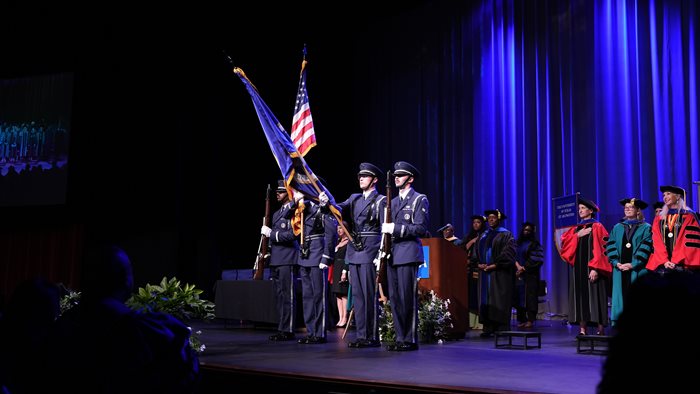
The Dyess Air Force Base Honor Guard presents the colors prior to the 2026 UTA School of Social Work Summer Commencement Ceremony. (Photo by Doughlas Gutierrez)
The School of Social Work offers students the opportunity to tailor their education through multiple military-focused programs.
“It's important to us that military personnel, veterans, and their families have access to the support and resources they need. We work to establish welcoming support channels for military-connected students and to provide an evidence-based curriculum that prepares future social workers to serve these communities effectively,” said Antwan Williams, a retired U.S. Army Lieutenant Colonel and now UTA’s School of Social Work’s assistant dean for communications, marketing, recruiting, and graduate admissions, and an adjunct assistant professor.
In the Master of Social Work (MSW) program, the Direct Practice concentration allows students to focus on Military Social Work or other areas, such as Health Care, Mental Health, Substance Misuse, Aging, and Children and Families, if they choose. This Military Social Work course series provides the clinical practice skills and knowledge needed to deliver care to military personnel, veterans, and military-connected individuals.
Dr. Donald Schuman, an associate professor of practice at the School of Social Work and a retired U.S. Army Sergeant Major, served in the Army for 27 years. He said he learned to teach in the Army, training soldiers in the skills required for their service, and later in the Army Civilian Corps, where he honed his clinical skills.
He served as an ROTC sergeant major and as an adjunct professor of military science at Portland State University and the University of Portland. After retiring from the Army, he earned his MSW at Portland State University in 1999, worked as a VA readjustment counselor in Midland, and later served in the Army Civilian Corps in Germany and at Fort Hood and Fort Rucker before coming to UTA to teach.
"I have always believed in giving back to the profession," Schuman said. "And so, I started working here, and I've been giving back ever since."
When Schuman first came to the UTA School of Social Work, there was only one military course. He said that with just one course, students could gain basic insight into military social work, but "you can't really scratch the surface."
The certificates exist not only because students asked for more coursework, but because the people they will serve are carrying injuries that can become a matter of life and death.
"We're not just talking about people who have problems; we're talking about people who have severe, significant problems that they don't know how to handle," Schuman said. "And without help, they lose hope. And when they lose hope, it becomes life or death."
The Military, Veteran, and Family Care Graduate Certificate is open to all graduate students at UTA and others who have completed a master’s or bachelor’s degree. It prepares students to understand military, military-connected, and veteran culture to effectively serve these populations across health and social service agencies.
The Military Social Work Graduate Certificate is designed for current MSW Direct Practice students and graduates of MSW Council of Social Work Education-accredited programs who seek to strengthen their knowledge and ability to assume advanced, evidence-based practice roles serving individuals and families connected to the military and veterans.
"It isn't just 'I want to know the difference between a colonel and a sergeant.' It's about people who have experienced trauma and whose life experiences are life-changing and significant, not unlike other populations we have," Schuman said. "That's what social work does. We work with populations that aren’t fully recognized and that don't get much attention. So, the substance use population, the military population, and the population of people who experience trauma—that's why it's important."
Shayne Benson is an MSW student in the Direct Practice concentration, focusing her curriculum on mental health and substance misuse. Along with her degree, she is currently pursuing both military-focused certificates.
“I’m pursuing both those certificates just because it’s a population that means a lot to me,” she said, adding that her father served for 26 years. “I mean, it was my whole life. And I know for myself, even just as a kid that grew up military, the transition to the civilian world is an interesting one, navigating paths that are like, ‘I don’t even know what this is.'”
She noted that the benefits of the GI Bill and Chapter 35, which help families of military service members pay for school and job training, made grad school possible for her after she completed an international studies degree at Texas A&M University.
"I want to give back to the communities that have served me, and an organization that has made a lot of this possible for me," Benson said.
She said that, growing up, social work was all around her, without her even knowing it.
"Social work is supporting people through different programs, and we had a lot of that in the military," she said. "These support groups and programs help you adjust to your life. We just moved somewhere. We know no one. My dad's in a new job. It was just so ingrained in life, the support systems we had. Honestly, as a kid, I didn't even realize that. And I've learned so much more about it in my social work classes, thinking back, 'Oh, yeah, that was social work, right?'"
Even if students choose to pursue a different career outside of military social work, they can carry that knowledge across professions.
"I think having background knowledge and what we're learning in those certificate classes helps us interact with people in general better and helps us see that everybody comes from different backgrounds and has gone through different things. We can still be cognizant of how we are interacting with them, how they're responding, and what might be in play there as well," Benson said.