Friday, Oct 02, 2026
• Karen Magruder, Rachel Voth Schrag :
karen.magruder@uta.edu, rachel.votschrag@uta.edu
DSW or PhD? Understanding Social Work’s Two Doctoral Pathways
For social workers considering doctoral education, one of the first questions is often: what is the difference between a PhD and a DSW? Both are doctoral degrees that social workers may pursue, and neither is inherently “better” than the other, because they serve different purposes. The best fit depends on your needs, preferences, and career goals.
The simplest distinction is that the PhD is a research doctorate, while the DSW is a practice doctorate. PhD programs prepare students to become scholars whose primary role is typically to generate new knowledge through independent research and inform the profession through building the knowledge base. DSW programs follow a practitioner-scholar model, preparing experienced social workers to critically use, translate, and apply research to innovate and advance practice in clinical settings, organizations, communities, leadership, policy, or higher education.
Table 1
DSW and PhD Comparison*
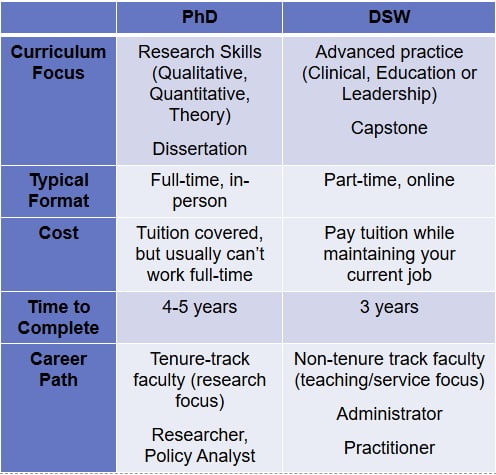
*Note: This table reflects typical differences, but individual programs may vary widely.
Aims and Focus
The primary distinction between the two degrees is how they prepare graduates to contribute to the profession. PhD programs emphasize developing researchers who generate original knowledge through rigorous scientific inquiry, while DSW programs emphasize developing practitioner-scholars who critically evaluate existing knowledge and apply it to improve and innovate practice. Depending on the program, DSW study may focus on advanced clinical practice, organizational leadership, social work education, or other areas of professional practice.
Careers
Depending on professional contexts, there can be considerable overlap in what graduates can do, but the degrees typically prepare students for different career trajectories or areas of emphasis. PhD graduates often pursue research-intensive careers, including tenure-track faculty positions, positions in research institutes or policy think tanks, and other roles in which conducting and publishing original research is central. DSW graduates often pursue advanced clinical practice, organizational leadership, higher education administration, consulting, and teaching-focused faculty roles, such as part-time adjunct opportunities or full-time non-tenure track faculty positions. Remember, these are general patterns rather than firm boundaries, and individual skills and careers vary.
Curriculum
PhD curricula typically emphasize research methods, including quantitative and qualitative skills, statistics, theory, and methods of scientific inquiry, culminating in an original research dissertation which develops new knowledge in an area of Social Work Scholarship. DSW curricula generally emphasize the application and translation of research to advanced practice, with coursework related to areas such as leadership or education. DSW study typically culminates in a capstone project involving a combination of applied research and high-impact practice-based work.
Format
Both PhD and DSW programs may be available across a range of geographic locations and delivery formats, including in-person, hybrid, and online options. However, PhD programs are more commonly structured as full-time, campus-based programs, while many DSW programs offer part-time and online formats designed to accommodate working professionals. Again, individual programs vary considerably.
Tuition & Funding
PhD programs are more likely to offer full tuition support and stipends through research or teaching assistantships, particularly for full-time students, but the demands of these programs may make maintaining full-time professional employment difficult. DSW programs are more commonly tuition-based, with students financing their education while continuing to work in their existing careers. When comparing programs, it is helpful to look beyond the advertised tuition rate and consider the full financial picture, including scholarships and assistantships, ability to remain employed, time to completion, and any income that may be forgone while pursuing the degree.
UTA’s Programs
Want to learn more about UTA’s doctoral options?
PhD
- Research Focus: UTA’s PhD curriculum is designed to equip emerging scholars with research skills to advance knowledge and scholarship, pursue excellence, provide leadership and service, and promote justice.
- Full Time On-Campus: The program is in person and includes two years of full time course work and an additional two years of independent research culminating in the dissertation.
- Affordable: All admitted students are offered a full tuition scholarship and stipend payments tied to work as a GRA or GTA. Full time employment is generally not allowed for students receiving support.
- Applications: We enroll a new PhD cohort each year at the beginning of the Fall Semester. Check out our admissions page for our current application deadline. Our PhD Program Website provides information on the process and address admissions FAQs. Be sure to also watch this video for tips on crafting a competitive application.
DSW
- Teaching Focus: UTA’s DSW curriculum is designed to equip social work professionals to elevate their impact through practical skills in effective teaching and leadership.
- Flexible: This 45 credit hour part-time 3-year DSW program is slated to be ideal for busy working professionals, balancing the flexibility of 100% online, asynchronous courses with ample opportunities to connect and engage “live” with faculty and peers.
- Affordable: We understand that a DSW is an investment, but cost is a significant short-term factor. We are proud to be among the most affordable DSW programs in the nation. UTA’s tuition estimator can help give you a ballpark idea of anticipated rates. This video tutorial explains how to use the Tuition Estimator. For out-of-state students, please use the chart on this page to estimate rates; with our NRODE program, out-of-state rates are very similar to in-state. We also offer each student one paid Graduate Teaching Assistantship (anticipated $3,500 for one semester). DSW students will be eligible to apply for three $1,000 scholarships offered by the School of Social Work starting in Spring 2027, and you are welcome to pursue other funding sources such as outside (e.g. national, cause-based) scholarships, student loans, veteran benefits, employer reimbursement programs, etc. The UTA Office of Financial Aid and Military & Veteran Services can provide more information.
- Applications: We enroll new DSW cohorts each Spring and Summer. Check out our admissions page for current application deadlines. Our DSW application guide includes screenshots to guide you through the process and address admissions FAQs. Be sure to also watch this video for tips on crafting a competitive application.
Got questions? Our comprehensive DSW FAQ page might already have the answers you need.
So, Which One?
Rather than asking which doctorate is "better," ask which model of doctoral education fits your goals.
If you want intensive preparation to become a researcher or tenure-track professor at a research-intensive university, conducting research and publishing as a central part of your career, a PhD may be the stronger fit. If you are an experienced practitioner who wants to apply scholarship to innovate and advance practice, leadership, or social work education, a DSW may align more closely with your goals. And, importantly, if neither degree clearly advances the career or life you want, neither may be the right choice. Remember, most social workers have a fulfilling and impactful career without ever earning a doctorate.
A doctorate is a significant investment of time, energy, and money. The letters matter less than finding a program whose purpose, curriculum, format, funding, and outcomes align with what you actually want to do with them.