1. Complete the Pre Work for Feb 19 TTK
This brief prep will help you learn the tools before trying the challenges.
February 19, 2026: Creating Engaging Explainer Videos & Podcasts
The good news: If you can’t attend the live in-person event, you can complete all activities asynchronously and still take part in the Chef’s Challenge and gain the full learning experience.
🍽 About the Session (For Your Reference)
Step into our studio‑style Test Kitchen for a supportive, engaging, and hands‑on space where faculty can quickly experiment with creating polished explainer videos and mini‑podcasts using Adobe Express and Adobe Podcast. This session focuses on simple, repeatable workflows that enhance clarity and student engagement while keeping the learning curve gentle for everyone. Ideal for faculty looking to make complex ideas more visual, audible, and accessible.
Even if you’re participating asynchronously, you will still be able to learn the key ideas and fully engage in the Chef’s Challenge. All materials will be available on the CRTLE website → CRTLE Events → CRTLE Technology Test Kitchen.
Below are the steps to follow so you can explore the tools, complete the hands‑on tasks, and prepare your own “dish” for the challenge:
Resource Guide: Level-Up Your Career Portfolio with Adobe Express
Recipe Cards: Link to Recipe Cards and Promoting Tips
Review the Adobe Firefly Generative AI prompting tips: Adobe-Firefly-Generative-AI-prompting-tips
Name Tag Adobe Tutorial:
Resource Guide: Supercharge Your Syllabus: Multimodal Design in Adobe Express
Participation in the Chef’s Challenge helps faculty progress through the Test Kitchen’s chef-themed tiers. Each tier recognizes growing engagement, creativity, recognition, and leadership—mirroring the process of exploring ingredients, crafting dishes, and leading a kitchen.
NOTE: To allow for flexibility, if you cannot attend the in-person events, you can access the link for that session’s test kitchen on our main website or below (to be posted) and participate on your own!
Goal: Sample core tools, ideas, and teaching “ingredients” introduced in the Test Kitchen.
How to Earn Taste Tester:
Faculty complete ONE of the following:
Taste Tester = exploration, curiosity, and foundational engagement.
Goal: Move from tasting to creating—transforming ideas into instructional artifacts.
How to Earn Sous Chef:
Faculty must:
Participation in the Chef’s Challenge naturally produces photos, prompts, rubrics, reflections, and student examples—making it an ideal vehicle for earning Sous Chef status.
Sous Chef = hands-on creation + contribution to the campus teaching community.
Goal: Lead, showcase, and contribute back to UTA’s teaching excellence community.
How to Earn Executive Chef: Faculty must:
The Chef’s Challenge serves as the foundation for any of these culminating activities—reflection, artifact-building, and student engagement narratives all translate beautifully into final-tier scholarship or presentations. Executive Chef = innovation, leadership, and scholarly contribution.
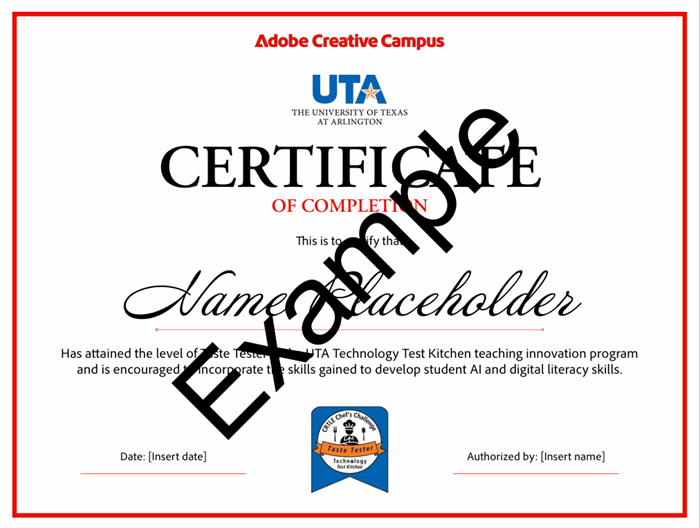
Whether you are exploring new teaching approaches, creating instructional artifacts, or preparing to share your work with the campus community, the Chef’s Challenge provides a natural, enjoyable pathway through the Test Kitchen’s three-tier recognition system.
Start as a Taste Tester, grow as a Sous Chef, and rise to Executive Chef—one challenge at a time.
Faculty Mentor
Technology Test Kitchen

Email: laiken@uta.edu
Faculty Mentor
Technology Test Kitchen

Email: jiyoon@uta.edu
Faculty Mentor
Technology Test Kitchen

Faculty Mentor
Technology Test Kitchen

Faculty Mentor
Technology Test Kitchen
Faculty Mentor
Technology Test Kitchen

Email: psmith@uta.edu
Faculty Mentor
Technology Test Kitchen

Email: sshelton@uta.edu
Many thanks to our Test Kitchen Faculty Mentors! Faculty mentors in the Technology Test Kitchen play a hands‑on, supportive, and highly visible role in helping their colleagues confidently explore new teaching tools and multimodal practices. They serve as guides and co‑learners, offering quick demos, answering questions, and helping faculty troubleshoot small hurdles as they experiment with tools like Adobe Express, Firefly, and Canvas integrations. Mentors also model “low‑stakes” exploration by sharing their own teaching examples, helping participants remix templates, and encouraging creative risk‑taking. During sessions, they circulate to provide individualized coaching, help faculty connect the tools to pedagogical goals, and contribute ideas for future “recipe cards” and mini‑activities. Overall, they create a welcoming, collaborative environment that empowers instructors to try something new—and to walk away with classroom‑ready artifacts they can use right away.