Tonya Holloway

Photograph of Tonya Holloway Beatrice Mcbride

Graduate student Tonya Holloway directed Pretty Fire, a one-woman show written by the acclaimed stage and film actress Charlayne Woodard. The play, which tells “a touching story of an African American family through three generations of love, struggle and triumph,” was presented at the Latino Cultural Center in Dallas in April 2025. It was produced by Soul Rep, the longest running African American theatre company in Dallas, co-established by Tonya Holloway in 1996.

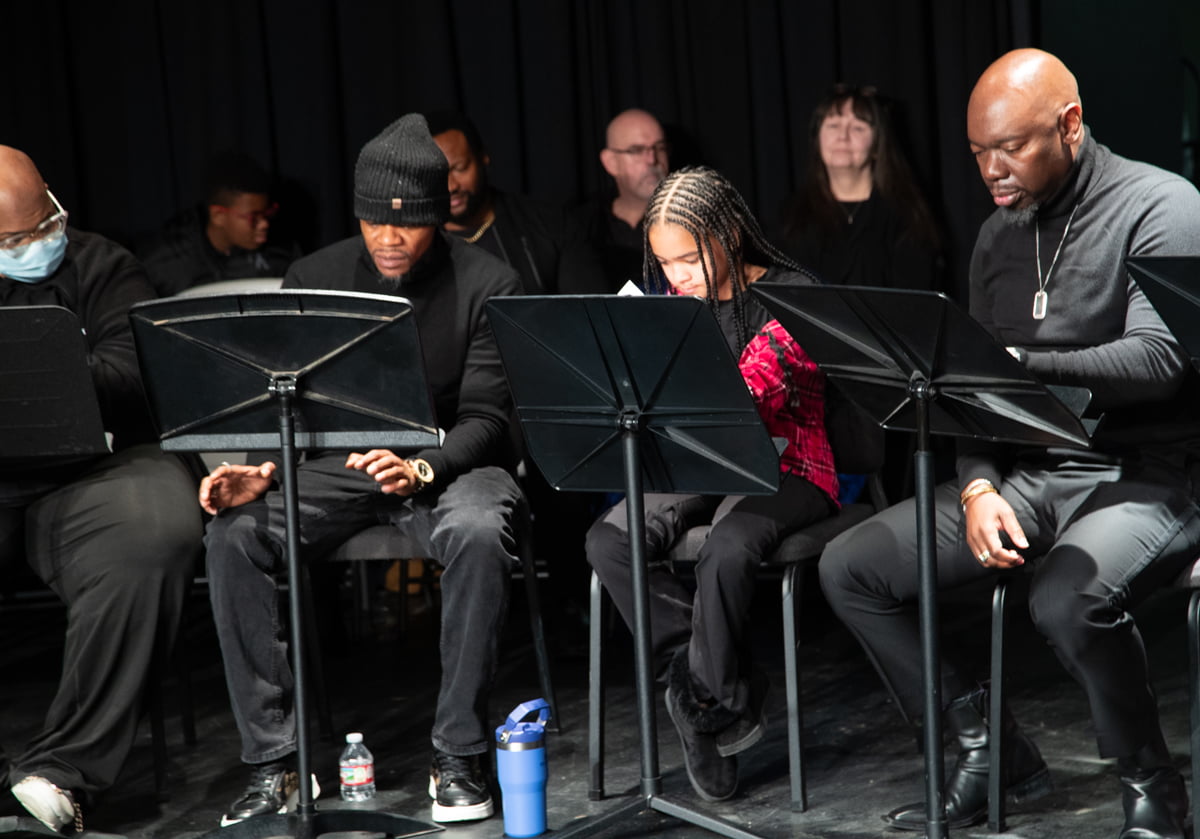
Earlier in 2025, Tonya won the Denton Black Film Festival Short Screenplay Competition, along with the Viewer's Choice Award for Best Music Video, which she filmed on UTA campus. During the festival, she also directed and produced a live reading of the two screenplay competition finalists – the first time the festival hosted such an event.

Readings Beatrice Mcbride

Live reading of the screenplay competition finalists at the Denton Black Film Festival Short Screenplay Competition, 2025. Photos courtesy of Tonya Holloway.

We chat with Tonya about her 20-year long career in film, commercial and theatre industries, the Soul Rep Theatre Company, which celebrates its 30th anniversary, and her pre-thesis film – the winning screenplay created under the mentorship of UTA Cinematic Arts professors Changhee Chun and Daniel Garcia.

I have always been fascinated with television and wanted to make films. My parents wondered: why does this 5-year-old child keep talking about TV? In the 1970s in my neighborhood in Fort Worth nobody was thinking about a career in the cinema industry (the closest you could get to performances would be a dance contest at YMCA :). Without realizing the difference, I thought that one has to act in order to be in film. So, when I made it to college, I majored in theatre. Gladly, it gave me a great foundation with the training I got with Stanislavsky, and Uta Hagen, and Meisner techniques, and the Greek and Shakespeare theatre... In the theatre there are no do-overs – it’s just you in the moment, and the audience. So, I don’t regret that. But had I known the world of production firms, I would absolutely go straight there.

In 1994, I auditioned for Dr. Pepper commercial at KD Studios where I got a “thank you but no” answer. Before leaving the room, I asked: “Is there anything I could do on this commercial other than acting?” They offered me a production assistant role while I had no idea what a PA entails. Working in this capacity was like being in a candy store – I was constantly asking questions! This job connected me with new people and led to more production assistant roles. I would spend long hours on the set, and then waiting tables at night, but I was in hog heaven and eventually started moving from PA to video assistant, to assistant editor roles, to sitting in the editor chair finally.

In the 1990s, I first learned Adobe Premiere. The director whom I was working with at that time used to do focus groups for CapriSun, Lunchables, and other products. I would film for hours with him while people were talking about products. Then out of hours of footage we had to pull golden nuggets and make 2-3 minute presentation for the clients. Throughout this process, he was training my eye for what to look for. My hobby is building jigsaw puzzles – and that’s what editing was for me. These editing assignments made me thrive and brought me more commercial work projects. A lot of times I was the only female in the team, other than costume and make-up artists. It felt empowering and I thought that I might never have to act again. That’s how I finally got into the film industry.


Because of my love of film, SoulRep Theatre Company have integrated film components into the programming – we have done one feature and four shorts thus far. COVID period was hard for theatre companies, particularly those that didn’t have their own space, like SoulRep. In order to stay afloat, art companies around the nation often were trying to put on shows via video format. In this case, SoulRep had me in their back pocket.

In 2020, my colleague Anyika McMillan-Herod was commissioned by the Southern Methodist University’s Association of Practical Theology to write an original play Do No Harm about the so called “father of gynecology” J. Marion Sims (1813-1884) known for his operations on women with no anesthesia. This story imagines what life must have been like for his patients by giving voice to three enslaved women - Anarcha, Betsey, and Lucy - who are mentioned in Sims’ autobiography. In the heart of COVID, we filmed this story in the mansion and slave house located in the Old City Park in Dallas. The staged production took place later at the Wyly Theatre. One of the things I will never forget is from a live zoom session with the Harward University medical students who watched the film. A female student in this group observed that still these days the prejudice exists that “black women have high tolerance of pain,” which proved that the effects of Sims’ approach still linger today. I experienced it as an expecting mother at 28, not being treated properly by medical personnel.

Pretty Fire is written by Charlayne Woodard. I first came to Charline’s work as a kid watching her musical Ain't Misbehaving on PBS (and then over and over on a self-recorded videotape). It came full circle now when I did her play. At SoulRep, we focused on the first part of Pretty Fire (out of three) that tells the story of Charlayne’s life until she turns 11. The actors in my play have black dresses and the whole set simply consists of 2 benches.

I wanted to allow room for the art of storytelling and the performance itself. It is a two women play with no breaks, and the actresses in their roles are fully believable. Throughout the play there is constant moving of benches, which represents different locations, for instance, when the actress is going from a church to a grandma’s house, or to a school. I tell my actors: “You are going to be out of breath. If you are not – then you are not doing this right.” In my work I incorporate a lot of movement, unless the moment calls for a pause. I want the audience to see the actor’s body morph as they talk to another imaginary person. For example, as a viewer you can sense the difference how the dialogues switch between two different grandfathers (taller and shorter) when the actor morphs her body accordingly.

UTA professors totally put new lenses on my glasses. Things that I never paid attention to became amplified. In my directing work, I am very sensitive to the pace and energies on the set. I picked up a lot from professor Changhee Chun who always gives such poignant feedback on movement of the actors and cameras when we work on school assignments. I love the fact that we have professors from Peru, South Korea, a classmate from Nepal. I get to learn about film from their cultures and their unique approaches. That has opened my toolkit so much!

Mastering the skill of telling the story through the visual lens, without overusing the dialogues has become an important task for me... At our program here, experiments with equipment are also encouraged, although we don’t have full access to various cameras. When Bart Weiss was here, he made sure to make students shoot on film instead of digital cameras, in order to have this experience and sensibility, which I find also important.


The kids are really infectious! I went in inspiring them to do work and exercises that we do here at the university level. My motto in the classroom is: “We are not here to make TikTok videos. We are gonna make art.” Whatever we do in the classroom has legs outside the school. I make sure the kids are building their creative portfolios and I started placing their work in festivals. Two of my students have been featured in the Dallas International Film Festival program this year already. I am committed to opening the doors for kids who want to make it in the film industry.

Any kind of comedic element. I come from a family of storytellers who managed to preserve their own history from the moment of getting off the boat in West Virginia. My love for history, in particular, comes from my grandmother on mom’s side. I am drawn to the human element in the story. A good sci-fi or a thriller is great, but simple matters of the heart and stories that connect people of any background speak most to me. I seek characters who are rich in personality traits that mirror people in our lives.

I found a story 10 years ago and kept it in my back pocket, until my main advisor Daniel Garcia convinced me to develop it into a film when I pitched it to him. It comes from the Federal Writers' Project (FWP) of the Library of Congress's holdings – a collection of oral history interviews captured during depression years that document the stories of former slaves. I read all the stories from Texas and major northern cities and stumbled upon the narrative of Walter Graham from Fort Worth. He tells the story of a white girl who was kidnapped from Kentucky, painted black, taken to the south and sold as a slave in Texas, near Corpus Christi. The woman eventually married a black man on the plantation, and one of her children married Walter Graham who tells this story.

This 10-minute-long film will be set in 1857. Taking it from the point of people in the slave quarters, I will explore the array of emotions that would have happened between black slaves and a person who they were told is their enemy. The fundamental question here is: What happens when the oppressed becomes the oppressor? The real protagonist of the story was a 5-year old Mary Schlauser, probably from the immigrant blacksmiths family of German descent, based on her last name. I have some pictures and the death certificate of her daughter in Fort Worth, which will be used in the film credits.