From the Lab to Real Life: How UTA College of Science Is Moving Cancer Research Forward
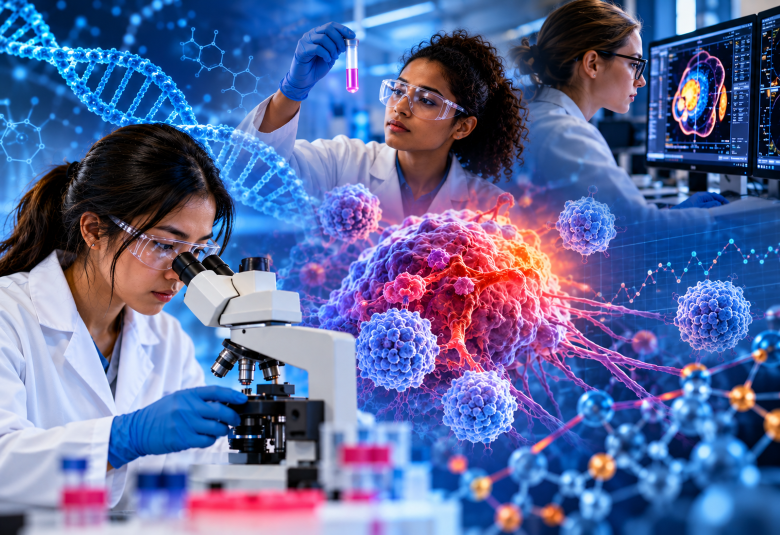
Cancer is not just one disease. It is a group of diseases that begin when changes happen in our cells, genes, or biological systems. Because cancer is so complex, scientists from many fields need to work together to find answers that matter.
At the UTA College of Science, cancer research brings together experts in biology, chemistry, physics, mathematics, and data science. By working as a team, they are not only searching for new ways to understand and treat cancer, but also helping students like YOU become the next generation of scientists who ask important questions.
UTA is a Carnegie R1 research university, which means it is recognized for top-level research. For College of Science students, this is more than just a title. It means you can go beyond textbooks and take part in research that leads to real scientific breakthroughs.
Understanding Cancer at the Cellular Level
Some of the biggest questions in cancer research begin with the smallest parts of our bodies: our cells.
Normally, our cells grow, divide, and die in a process that is carefully controlled. Cancer can develop when these controls break down, allowing abnormal cells to survive or multiply when they should not.
In 2025, UTA doctoral student Rashna Sharmin, working in the laboratory of Piya Ghose, assistant professor of biology, helped reveal new information about how cells control mitochondria during programmed cell death.
Sharmin found that mitochondria can help keep a cell alive even when they are not making energy. This research, published in Current Biology, offers new insight into how cells control death. This matters for diseases like cancer, because cancer can develop when abnormal cells that should die keep surviving.
The research, which included Mark Pellegrino, UTA associate professor of biology, was supported by the Cancer Prevention Research Institute of Texas and the National Institutes of Health.
Using Data Science to Search for Answers
Today, cancer research often involves analyzing large amounts of biological data with advanced statistics and computer models.
In 2025, UTA researchers developed a computer tool to identify transcriptional regulators, proteins that help control whether genes are turned on or off. When these controls fail, it can lead to diseases like cancer.
Xinlei "Sherry" Wang, Jenkins Garrett Professor of Statistics and Data Science, led the research, along with UTA postdoctoral researcher Zeyu Lu and Lin Xu of UT Southwestern Medical Center.
By discovering which regulators are involved in key biological processes, scientists can better understand what causes cancer and other diseases. This combination of biology, mathematics, statistics, and data science shows how cancer research today connects many fields.
UTA Department Of Data Science
Physics and the Future of Cancer Treatment
Physics also plays a key role in cancer research, especially when it comes to developing and improving radiation therapy.
In 2025, UTA researchers built a system to study alpha radiation and how it could be used to treat cancer. This platform lets scientists control factors like radiation dose and delivery, so they can test different treatment conditions in the lab.
The project, led by Yujie Chi, UTA associate professor of physics, and Professor of Graduate Nursing Zui Pan, was selected as one of only 18 Best in Physics projects from approximately 2,000 accepted presentations for the 2025 annual meeting of the American Association of Physicists in Medicine.
Students Joshua Rajan, Harsh Arya, and Mainul Abrar also contributed to the research, with Rajan presenting the team's work at the AAPM annual meeting in July 2025.
 Chemistry and the Search for New Therapies
Chemistry and biochemistry add another important piece to the cancer research puzzle.
At UTA, the Department of Chemistry and Biochemistry includes anti-cancer drug discovery as a research area. Faculty work in biochemistry, synthetic chemistry, analytical chemistry, and nanochemistry. This research helps us understand molecules, biological processes, and possible new therapies.
Photodynamic therapy is another research area in the department. This method uses light-activated compounds to trigger chemical reactions that destroy targeted cells. This method opens up new possibilities for cancer treatment and other medical uses.
These research areas show why cancer research needs scientists who can think across different fields. Finding a promising molecule is only the beginning. Scientists also need to discover how it interacts with cells and whether it works as a treatment.
UTA Department of Chemistry and Biochemistry
Students Becoming Part of Cancer Research
UTA students do more than just learn about cancer research. You can get involved and take part in real research projects.
In fall 2025, College of Science undergraduates Adrian Reyes, Julie Tran, and Vy Duong were selected to attend the highly competitive National Symposium for Predoctoral Research at St. Jude Children's Research Hospital. Only 23 students were selected from more than 200 applicants, and three came from the UTA laboratory of Soroush Ghaffari, assistant professor of research and a member of UTA's RISE 100 initiative.
Reyes, a microbiology major, studied how tumors evade the immune system, exploring mechanisms cancer cells use to escape an immune response.
Tran, a biological chemistry major with minors in biology and biochemistry, studied whether combining a cancer vaccine with a laboratory-developed antibody called EXX1 could improve outcomes. Her research found that the combination improved survival time and helped prevent tumor regrowth in the experimental model.
Duong, a biology major, focused on wound healing and tissue regeneration. While her project did not focus specifically on cancer, her research examined immune regulation and the roles different immune cells play during tissue repair.
All three were members of UTA's Institute of Biomanufacturing and Precision Medicine for North Texas (IMPRINT).
Their experiences are a first-hand example of how undergraduate research within the College of Science can take you beyond the classroom and put you side by side with scientists and other students working on important biomedical questions.
Preparing the Next Generation of Cancer Researchers
The future of cancer research will depend increasingly on working across different scientific fields and bringing together new ways of thinking.
Biologists will investigate cells and genes. Chemists will explore molecules and potential drugs. Physicists will improve radiation technologies. Mathematicians and data scientists will search for patterns within enormous datasets.
If you are thinking about a career in medicine, biotechnology, pharmaceuticals, biomedical research, or data science, UTA's research environment shows that there is no single path to cancer research.
The scientist helping develop tomorrow's cancer treatment could be a biologist studying cellular mechanisms, a chemist developing a therapeutic compound, a physicist improving radiation delivery, or a data scientist analyzing biological signals. No matter your field of study, it starts with you.
At UTA College of Science, your journey can start in the classroom, but it does not have to stop there.
By getting involved in research, working with others, and making discoveries, you can help answer some of the toughest questions in human health. You could help create a future where cancer is found sooner, treated more precisely, and defeated more often.
That is science moving forward.