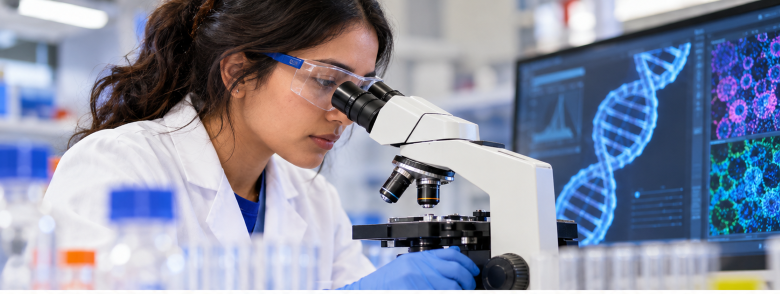
From DNA to Disease Prevention: The Role of Biology Students in Advancing Human Health
Major improvements in human health come from understanding how biological processes work.
Biology asks important questions, like why some people get certain diseases while others do not, how genes affect how cells work, how infections spread, and how what we know about DNA, cells, and microorganisms can help prevent disease.
Biology helps us find answers to these important questions.
By studying the genetic causes of disease and how living things interact with their surroundings, biology connects scientific discoveries to real health problems. At The University of Texas at Arlington College of Science, biology students gain knowledge, research experience, and critical thinking skills that are important for improving human health.
UTA Department of Biology
Understanding Health at the Molecular Level
DNA holds the instructions that guide how living things grow and function. Changes in these instructions can sometimes lead to disease.
Today’s biological research lets us study these processes in greater detail. Fields like genetics, molecular biology, and cell biology help us look at how genes are expressed, how cells communicate, and how living systems react when normal processes are disrupted.
Understanding these mechanisms gives us a strong base for asking questions that matter for human health.
Being able to study DNA and other biological data has led to progress in cancer research, genetic disorders, infectious diseases, and personalized medicine. Increasingly, researchers use genetic information to understand disease risk and create treatments that fit each person’s unique biology.
New discoveries in biology are quickly shaping how healthcare improves and changes. As students, understanding these advances helps you see how your studies connect to real progress in medicine.
UTA College of Science
From Understanding Disease to Disease Prevention
Biology helps us understand how diseases start, how they spread, and how we can prevent them.
Microbiology lets us study bacteria, viruses, and other microorganisms that affect our health. By looking at how these microbes interact with our cells and immune system, scientists learn how infections happen and find ways to prevent and treat disease.
But preventing disease takes more than just lab research.
At UTA, the College of Science students and researchers study how genetics, living things, environments, and populations are connected. Understanding these links is important for solving real problems like infectious diseases and environmental health issues that impact our communities.
By looking at biology from molecules to populations, students see that improving health means understanding life at every level.
UTA Biology Undergraduate Programs
UTA Biology Graduate Programs
UTA Biology Certifications
Discovery-Based Learning in UTA Biology Education
At UTA College of Science, biology students do more than just learn facts. They build skills in asking questions and investigating how science works.
In labs, with faculty mentors, and through research, students learn how to turn questions into experiments and use results to push science forward.
These experiences help students build skills they can use in many science careers.
Students learn how to analyze information, evaluate evidence, manage data, communicate science, and solve problems. Research shows that science is not always a straight path. Experiments lead to new questions, and understanding grows as new evidence appears.
These transferrable skills prepare UTA students for graduate school, professional programs, research labs, and careers in life and health science and beyond.
Being in the Dallas-Fort Worth area gives UTA students access to a major city and its opportunities. By studying genetics, microbiology, molecular biology, and human health, students gain skills for careers in healthcare, research, biotechnology, and more.
UTA Admissions
Apply to UTA
Biology Careers With Significant Impact on Human Health
Biology, technology, and healthcare are coming together to create new career paths for students who understand living systems and want to solve real-world problems.
With a biology degree, graduates can work in biomedical research, biotechnology, lab science, public health, pharmaceuticals, and clinical research. Biology also prepares students for medical, dental, and other health professions, or for advanced study in science.
Innovative technology is continuously opening new career opportunities in the world of biology. Fields like genomics, bioinformatics, artificial intelligence, and data analysis give scientists new ways to study big sets of biological data. Future biologists will work with others across fields, combining lab science with computer tools to find patterns and speed up discoveries.
This is what sets the UTA College of Science apart. We do not wait for science to change and then react. Instead, we lead the way by preparing the scientists that the future will need. Skills like scientific reasoning, data literacy, teamwork, and communication are more important than ever in biology.
UTA Department of Biology Research Focus Areas
Preparing the Next Generation of Scientists
The future of healthcare relies on understanding diseases earlier and finding better ways to prevent them, not just treating them.
UTA students and researchers are helping to shape this future.
By studying DNA, cells, and microorganisms, and preparing for careers in healthcare and research, students learn how discoveries at the molecular and cellular level can improve health.
This is what makes the UTA College of Science unique. We do not wait for what will come next. Every day, we innovate, discover, and learn. We are preparing scientists the future needs. Our journey shows that curiosity leads to discovery, and discovery leads to real impact.
Whether it is DNA research or disease prevention, the next big step in health begins with asking the right questions and helping students find the answers.