Address:
601 W. Nedderman Drive, Suite 105
Arlington, TX, 76019-0108
Sustainability Reporting
Reporting with Impact
Sustainability reporting has gained increased importance amongst corporations globally as it provides information about the organization’s economic, environmental, and social performance!
At UTA, the Office of Sustainability uses two frameworks to support the evaluation of UTA's key impacts and to determine report topics: the GRI Reporting Framework, the most widely used standard for sustainability reporting worldwide; and AASHE’s Sustainability Tracking, Assessment & Rating System (STARS), a transparent, self-reporting framework for colleges and universities to measure our sustainability performance. UTA’s Sustainability report has been drafted and designed using the GRI Framework. The GRI Standards are the global standards for sustainability reporting featuring a modular, interrelated structure, and reporting on a range of economic, environmental and social impacts
These reporting frameworks enable us to measure and report our sustainability performance transparently and with accountability. This can increase the trust that stakeholders and the community have in us and achieve a competitive edge.
Advancing Regional Sustainability Through Community Engagement
The University of Texas at Arlington's submission for the Carnegie Elective Classification for Community Engagement demonstrates how sustainability, climate resilience, and environmental stewardship are woven into the university's core academic and civic identity. Across interdisciplinary research, experiential coursework, and strategic community partnerships, the report highlights UTA's active role as an urban anchor institution driving long-term ecological and societal solutions throughout the Dallas-Fort Worth region and beyond.
At the center of these efforts, the UTA Office of Sustainability spearheads regional impact through initiatives like the Regional Center of Expertise (RCE) for Education in Sustainable Development Goals in North Texas. By uniting higher education, industry, government agencies, and nonprofits, RCE North Texas advances the United Nations Sustainable Development Goals locally—from multi-partner food recovery and reuse programs to major watershed conservation efforts, including a litter abatement project restoring more than 21,000 acres within the Village Creek Lake Arlington watershed.
The self-study also underscores UTA's leadership in circular economy solutions and resilient infrastructure. Recent milestones featured in the report include receiving the State of Texas Alliance for Recycling (STAR) Environmental Leadership Award for post-consumer composting, pioneering "plastic roads" on campus using recycled plastics, and advancing multimodal transit innovations like the award-winning autonomous RAPID shuttle system. Through student-led urban mobility coalitions like Walkable Arlington, hands-on riparian design and conservation projects, and community agriculture at the UTA Organic Community Garden, the report illustrates how UTA empowers students, faculty, and local stakeholders to build a more sustainable, equitable future.
STARS
AASHE’s Sustainability Tracking, Assessment & Rating System (STARS), is a transparent, self-reporting framework for colleges and universities to measure our sustainability performance. STARS® is intended to engage and recognize the full spectrum of higher education institutions, from community colleges to research universities. It encompasses long-term sustainability goals for already high-achieving institutions, as well as entry points of recognition for institutions that are taking first steps toward sustainability. STARS is designed to
- Provide a framework for understanding sustainability in all sectors of higher education
- Enable meaningful comparisons over time and across institutions using a common set of measurements developed with broad participation from the international campus sustainability community
- Create incentives for continual improvement toward sustainability
- Facilitate information sharing about higher education sustainability practices and performance
- Build a stronger, more diverse campus sustainability community
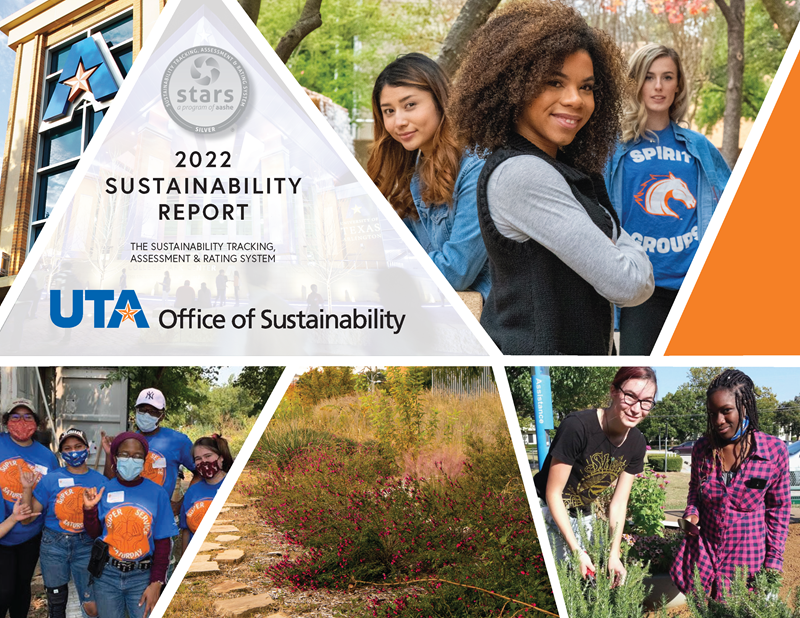
In 2022, UT Arlington received the Silver Rating for the STARS report. View the certificate here.
2022 SUSTAINABILITY REPORT
The University of Texas at Arlington’s 2022 Sustainability Tracking, Assessment, and Rating System (STARS) Report is a summary of the current state of sustainability at the University based on our reporting to the Association for the Advancement of Sustainability in Higher Education (AASHE), as well as in alignment with the U.N. Sustainable Development Goals.
GRI Report
UT Arlington's is one of the few universities in the U.S to release a Sustainability Report using the GRI (Global Reporting Initiative) Framework. The GRI Standards are the global standards for sustainability reporting featuring a modular, interrelated structure, and reporting on a range of economic, environmental, and social impacts. This report covers UTA's significant economic, environmental, and social impacts along with topics that influence the assessments and decisions of its stakeholders. To ensure that this report incorporates UTA's significant impacts along with the concerns of its stakeholders, the process involved includes mapping its value chain, evaluating its sustainability context, comparing its performance to peers, engaging with stakeholders and validating our final set of material issues. These activities are instrumental in determining not only UTA's significant impacts, but also where and when they occurred. Data provided, if not explicitly referenced otherwise, is being generated, managed provided by UTA.
Waste & Recycling Audits
In order to better understand waste practices across the campus, as well as improve data collection and outcomes, the Office of Sustainability uses Waste & Recycling Audits to track progress. These can vary in scale and location, with an audit of the College Park Center completed in February 2026.