Child Welfare Current Projects

Current Projects

The CWRC and affiliates are engaged in various child welfare-related research projects. Below are some current and recently-completed projects by topic area:

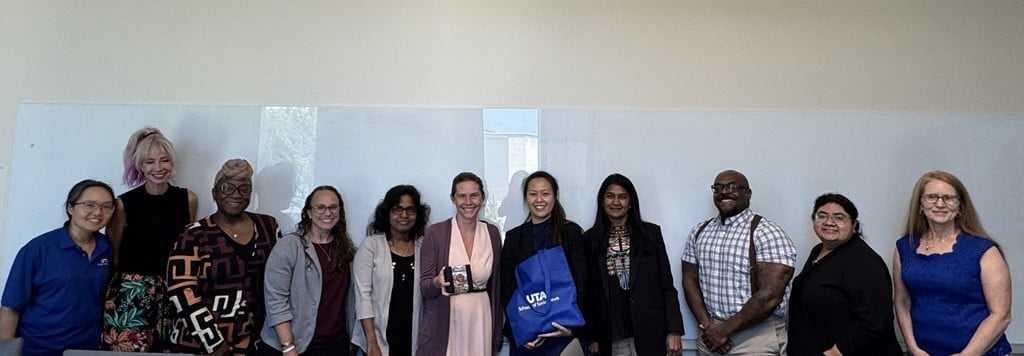
Group photo of some of UTA School of Social Work faculty and staff

Project: Interprofessional Education to Promote Equity in Mandated Reporting: A Certificate Approach (PI: Dr. Catherine LaBrenz; funded through the Office of Juvenile Justice and Delinquency Prevention)

Over two-thirds of reports of alleged child maltreatment come from professional mandated reporters (usually comprised of social service, education, healthcare, and criminal justice workers). Yet, only a fraction of alleged reports are substantiated, often due to misunderstandings of what constitutes maltreatment. Furthermore, individuals who work in child- and family-serving professions often report feeling unprepared to identify and report potential maltreatment. This three-year project will develop and pilot three interprofessional education modules to better prepare the workforce for mandated reporting of child maltreatment. In Fall 2025, the new interprofessional education modules will be integrated into courses in social work, nursing, criminal justice, and education to increase preparation for the workforce and knowledge and skills to critically identify and report potential child maltreatment.


Related Publications: Online interprofessional education to identify and response to child maltreatment. Journal of Teaching in Social Work.


Project: Understanding and Preventing Burnout and Turnover in Child Welfare

The nature and demands of child welfare often trigger high levels of stress and burnout in workers over time, which increases turnover. Turnover among child welfare workers and supervisors is prevalent, negatively affecting the outcomes of children and families in the child welfare system. High turnover of child welfare professionals is costly due to the need to recruit and train new staff to secure a competent and qualified workforce and to ensure a manageable workload. Moreover, filling vacancies can be time-consuming. As part of our Co-Lab meetings, we have examined factors related to burnout and turnover in the child welfare workforce, using both primary and secondary data. We also conducted an intervention study to pilot test using external group supervision for child welfare supervisors, and found external group supervision helps with reducing STS and stigma, improving supervisory skills, and was perceived as a source of support, but had little impact on other outcomes.

The CWRC also has an ongoing partnership with the Title IV-E Stipend Program at UTA and provides program evaluation and research support. As part of this partnership, we have examined the relationship between state-level investment in Title IV-E stipend programs and child outcomes, including placement stability, time in foster care, and reunification.

Related Publications:

Examining a decade of Title IV-E outcomes: A scoping review. Journal of Public Child Welfare

State investment in Title IV-E stipend programs and child length of stay in foster care: A national study. Journal of Public Child Welfare

Informational justice, job autonomy, and child welfare workers’ intention to stay | Journal of the Society for Social Work and Research

Sinking or swimming: perspectives of the children without placement crisis: Journal of Public Child Welfare

Why do child welfare supervisors leave their jobs?: pathways to supervisors’ resignation behavior. Journal of Public Child Welfare

A pilot study on external group supervision for child welfare supervisors: A mixed-methods design. Human Service Organizations: Management, Leadership & Governance

Investing in the child welfare system through the workforce: Lessons learned from a Title IV-E child welfare stipend program. Social Sciences


Project: NewDay Services FOCUS+ Evaluation 2026-2027

In partnership with James Bell Associates, the Annie E. Casey Foundation, and NewDay Services, UTA is conducting an evaluation of the effectiveness of the FOCUS+ parenting program. Using administrative state child welfare data, the team will compare family preservation and reunification outcomes among children whose parents receive FOCUS+ services and a matched comparison group.

Project: Co-Lab Model to Increase the Use of Data-Driven Decisions in Family Preservation

The Co-Lab wing of CWRC engages affiliates and scholars in monthly meetings to explore large child welfare data to examine trends, patterns, and protective and risk factors associated with various child welfare outcomes. Through these monthly meetings, the CWRC leads multiple projects to examine geospatial disparities, state-level policies, and other contextual factors that impact family preservation and recurrences of child maltreatment. 

Related publications:

Adolescents with substance use referred to child protective services: Does substance use treatment prevent foster care entry? Child & Family Social Work

State child maltreatment policies and disparities in substantiation: A study of state-administered child welfare systems in the US. Child Maltreatment

Reasonable efforts to preserve families? An examination of service utilization and child removal. Child Abuse & Neglect

Rural/urban and racial disparities in receipt of family preservation services: An intersectional examination. Child Abuse & Neglect.

Strengthening families: Protective factors and family resource center participation. Families in Society: The Journal of Contemporary Social Services

Project: Keeping Families Together: Preserving and Reunifying Families with Substance Use Disorder through a Family Recovery Court. (PI: Dr. Catherine LaBrenz; co-PI: Dr. Hui Huang; co-PI Dr. Philip Baiden; Co-PI Dr. Yeonwoo Kim; funded through State Justice Institute)

This project consists of a collaboration with the Family Recovery Court of Williamson County to conduct an evaluation of their innovative model to support reunification and recovery for families involved in child welfare with histories of parental substance use. Since 2020, Dr. LaBrenz and her team have used an implementation science framework to assist the Family Recovery Court with identification of its core components, explore participant experiences with the program, and compare outcomes for families enrolled in the Family Recovery Court to a matched comparison group.   For more information about the Family Recovery Court, visit: https://www.wilcotx.gov/502/Family-Recovery-Court

Recent publications related to reunification:

Systemic family engagement to preserve and reunify families: Lessons from the U.S. and Chile

Family reunification as a case goal is influenced by maltreatment type and the occurrence of caregiver-specific abuse

State-level policies and reunification: A multi-level survival analysis

Children removed for inadequate housing are less likely to be reunified than peers: analysis from AFCARS data

Betrayal trauma, parental substance use disorder, and reunification outcomes among child welfare-involved families

Through ongoing collaborations with colleagues at UTA and beyond, the CWRC leadership team examines post-adopt experiences of children, youth, and families.

Dr. Huang is leading a federally funded project to support adoptive families in Texas. The project titled “Effectiveness of KEEP Toddler for Supporting Adoptive Parents with Children Adopted from the Child Welfare System: A Randomized Control Trial,” will evaluate the effectiveness of the KEEP Toddler intervention in improving parenting practices, caregiver well-being, and developmental outcomes for toddlers adopted from foster care. Funded as a four-year, $1.79 million grant from the U.S. Department of Health and Human Services, Administration for Children and Families (ACF), Adoption Opportunities Program, this study will generate evidence on an innovative, evidence-informed support program designed to strengthen adoptive families and promote positive outcomes for young children with child welfare involvement. The study. The project period runs from September 30, 2026, through September 29, 2030, and is led by Dr. Hui Huang (Director of Research, CWRC) in partnership with OSLC Developments, Inc., and CK Family Services.

KEEP Toddler is a virtual parenting support program for caregivers of children ages 2 to 4 that combines 16 weeks of group-based skills training with individualized coaching and support. The study will enroll 280 adoptive families across North Texas and use a randomized controlled trial, the gold standard for program evaluation, to compare families receiving KEEP Toddler with families receiving post-adoption services as usual. Outcomes related to child well-being, parenting stress, family functioning, adoption stability, and adoption dissolution will be assessed over a 12-month follow-up period.

CWRC’s expertise in adoption has also been recognized through consultation on global projects, including TransformAdopción, a project to transform the child protection and adoption systems in Chile.

Recent publications related to adoption:

A better adoption? Evolution, challenges, and projections of Chilean adoption policies and practices

Walking toward adoption: A critical analysis of the PRI Program in Chile

“Siblings must stick together”: Chilean parents’ perspectives on sibling group adoption and post-adoption contact

Opening adoption in Chile: Perspectives on post-adoption contact among Chilean adoptive parents. Families in Society: The Journal of Contemporary Social Services

Project: Former Foster Youth’s Educational Expectations and Experiences (PI: Dr. Hui Huang, Supporting: Dr. Catherine LaBrenz, Dr. Eusebius Small; funded by Wolen’s Impact Fund)

Higher education has been a driver in promoting social mobility. It is widely acknowledged that obtaining a college degree is now the minimum threshold for entry into the middle class. In the US, 38% of the population aged 25 and older have bachelor’s or higher degrees. However, the college enrollment and graduation rates are much lower among former foster youth: significantly fewer enroll in college (40% compared to 72% of the general population), and less than 10% graduate with a bachelor’s degree. Literature on higher education needs among former foster youth highlights financial hardship, academic struggles, mental health challenges, and life stressors as common reasons for college dropout. There are limited studies on former foster youth not yet in college and former foster youth in community colleges. This project aims to address the knowledge gap by studying former foster youth not yet in college as well as former foster youth at UTA, many of whom came from community colleges. We have conducted a needs assessment of barriers and facilitators of enrollment and completion of college among former foster youth. Our rationale for conducting this needs assessment is to use the findings to inform the development and piloting of interventions to increase college graduation rates among former foster youth.

Project: Evaluation and Supervision Support to the UTA Emerging Mavericks (EM) Program

Related to support for transition age youth, we have provided technical support to the UTA Emerging Mavericks (EM), a campus support program designed to support students with lived experience in foster care or homelessness. Our technical support includes designing intake assessment, needs assessment, case management database, student engagement strategies, and community engagement strategies.

Related Publications:


Bridging the gap: The perspectives of child welfare workers and professionals on ageing out of out-of-home care. Child & Family Social Work


Focus group meetings with the Transition Resource Action Center (TRAC)

Do independent living services protect youth aging out foster care from adverse outcomes? An evaluation using national data

Project: CourtCare

Funded through the National Institute on Disability, Independent Living, and Rehabilitation Research, CourtCare examines the role of innovative court models in improving community-based living and overall wellbeing for children with disabilities in foster care.

System Transformation

Project: Community Based Care Collaborative

The Community Based Care Collaborative is a partnership between UT Austin, UT San Antonio, and UT Arlington to conduct a process evaluation of the rollout of community-based care across Texas. Check out our round one report here: Community-Based Care Program Evaluation - Texas Institute for Child & Family Wellbeing.


Project: State of Child Welfare Series

In partnership with the Annie E. Casey Foundation, UTA has been conducting analyses for the State of Child Welfare Series, a project to develop state child welfare data profiles and sheets for child welfare policy advocates.

Related Publications related to system transformation:

Community-Based Care Program Evaluation - Texas Institute for Child & Family Wellbeing.

Systemic family engagement to preserve and reunify families: Lessons from the U.S. and Chile. Children and Youth Services Review