
School of Social Work Future Students

Welcome, future social worker!

You are considering a profession built on a simple, demanding idea: that every person's dignity is worth showing up for. That instinct — to notice when something is wrong and to act on it — is where every social worker's story begins, and we would be glad to help you write the next chapter of yours here.

UTA students sitting at a table having a group discussion.

Why Social Work

People choose social work for many reasons—personal experiences, volunteering, or learning how much one caring person can matter. The profession turns that instinct into skills to support families, communities, and policy change. Social work is demanding, but few careers offer such a direct connection between your daily work and someone else’s better life.

A Profession the World Still Needs

Social work exists because people need more than good intentions on their behalf — they need trained, credentialed professionals who understand trauma, systems, policy, and the practical mechanics of getting someone from crisis to stability. Hospitals need social workers to help patients navigate discharge and long-term care. Schools need them to catch what a struggling student cannot say out loud. Courts, veterans' programs, child welfare agencies, mental health clinics, and nonprofits of every size depend on this workforce to function at all.

Demand for social workers keeps growing precisely because the problems they address — poverty, addiction, isolation, family breakdown, inadequate access to care — are not going away. This is steady, necessary work, and it will remain so for the whole of your career.
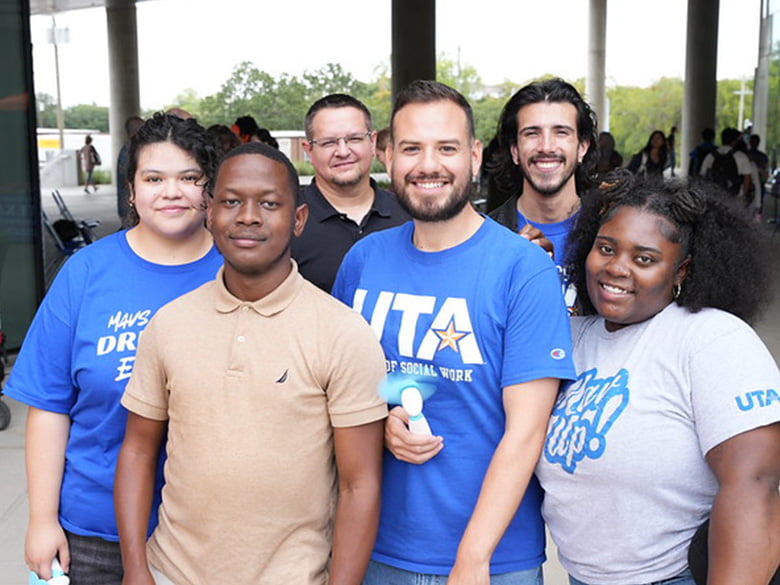
UTA student taking a group photo during School of Social Work Welcome Week.

Social work and the issues shaping society

Every major challenge facing communities today — the mental health crisis, the opioid epidemic, housing instability, the needs of an aging population, the long aftermath faced by veterans and their families, gaps in child welfare, inequities in health and access — eventually lands on a social worker's desk. Social workers are trained to see the whole picture: the individual in front of them and the systems, policies, and conditions shaping that individual's life.

Four degree programs and certificate programs, one professional path

The UTA School of Social Work offers four degree programs, each built for a different point in a social work career — from a first professional credential through the highest levels of research and practice leadership. Many students move through more than one of these programs over the course of their careers.

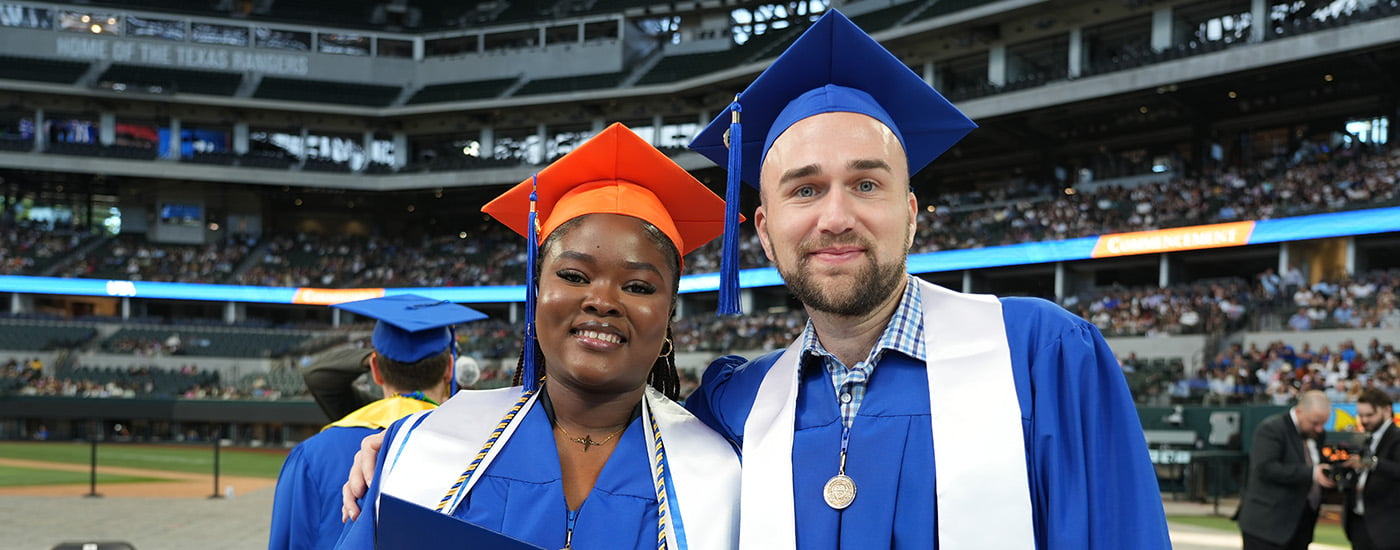
Two UTA School of Social Work graduates.

The BSW is the entry point into professional social work and the foundation for a generalist practice career. Students learn the profession's core knowledge, values, and skills — direct practice with individuals and families, an understanding of communities and social systems, and the ethical grounding that guides every decision a social worker makes. A required field practicum puts that classroom learning into practice under professional supervision, so graduates leave ready for entry-level positions in child welfare, schools, healthcare, community organizations, and beyond. For many students, the BSW is also the fastest route into a graduate program, since UTA's advanced-standing MSW option is built for BSW graduates to continue directly into deeper, specialized study.

The MSW is the profession's advanced practice credential and the degree most clinical, supervisory, and licensed positions require. Students choose a concentration — direct clinical practice with individuals and families, or community and administrative practice — and build the specialized skill set that concentration demands, supported by an extensive field practicum in a real practice setting. The program is offered in person and fully online, so working professionals and career-changers alike can complete it around their existing responsibilities. Graduates go on to clinical licensure, leadership roles in social service organizations, and specialized practice in mental health, healthcare, aging, child and family services, and community practice.

Alongside its degree programs, the School offers graduate certificates that let students and working professionals build focused expertise without committing to a full additional degree. Each certificate can be added to a current degree plan or, in most cases, completed on its own.

Administrative Leadership

Builds the management and decision-making skills needed to lead social service programs and organizations.

Organizational Leadership

Prepares students to guide organizational strategy, staff development, and change within human service settings.

Community Leadership

Focuses on community organizing, coalition-building, and leading collective change at the neighborhood and regional level.

Policy Leadership

Develops the skills to analyze, influence, and shape the social welfare policy that determines what services communities can access.

Military Social Work

Prepares MSW direct-practice students for advanced, evidence-based clinical work with service members, veterans, and their families.

Military, Family, and Veteran Care

Open to any graduate student, this certificate builds skill in non-clinical support — understanding military culture and connecting service members and families to the resources they need.


The DSW is a practice doctorate for experienced MSW-holding professionals ready to step into teaching, organizational leadership, or the highest levels of independent clinical practice. Delivered fully online in a three-year, cohort-based format, the curriculum blends advanced practice coursework with leadership and teaching preparation — including a paid teaching practicum, content on social work entrepreneurship, and an explicit focus on sustaining a long career in a demanding field. Where the PhD trains researchers, the DSW is built for practitioners who already know the work and now want to lead it, teach it, or shape it at an organizational level.

The PhD is a research doctorate for students who want to generate the knowledge the profession relies on, not only apply it. Coursework in theory, advanced research methods, and critical evaluation of social work policy and practice prepares graduates for careers in academia, research institutions, and organizations that need rigorous evidence to guide their work. PhD students work closely with faculty on original scholarship aimed at improving social conditions and strengthening the evidence base for social work practice, and most graduates go on to faculty positions where they teach the next generation of social workers while continuing that research.

Wherever you start, there is a path forward here

Whether you are beginning with a BSW, advancing your practice with an MSW, or pursuing a doctorate to lead, teach, or research the field, UTA's School of Social Work is built to meet you at your stage of the journey — and to help you go further than you expected.

Questions About School of Social Work Admissions?

Get information about School of Social Work Academic Programs, Admissions Requirements, Complete Future Student Interest Form, and more.

Get More Information

Get in Touch with SSW Admissions

Brianna Gibbs, MS
Academic Recruiter
Email: brianna.gibbs@uta.edu
Phone: 817-272-2551
Office:  SWSH 203O

Tamia King
Academic Recruiter
Email: tamia.king@uta.edu
Phone: 817-272-9123
Office:  SWSH 203N

James Brown, MS
Manager of Strategic Enrollment
Email: james.brown2@uta.edu
Office:  SWSH 203R

Antwan C. Williams, JD, MS
Assistant Dean of Communications, Marketing, and Recruitment
Email: antwan.williams@uta.edu
Office:  SWSH 416L

Tuition

Estimator

UTA offers affordable in-state tuition for Texas-resident students - both in-person and online.
Calculate Your Tuition

Tuition

Information & Resources

Tuition Information & Resources